
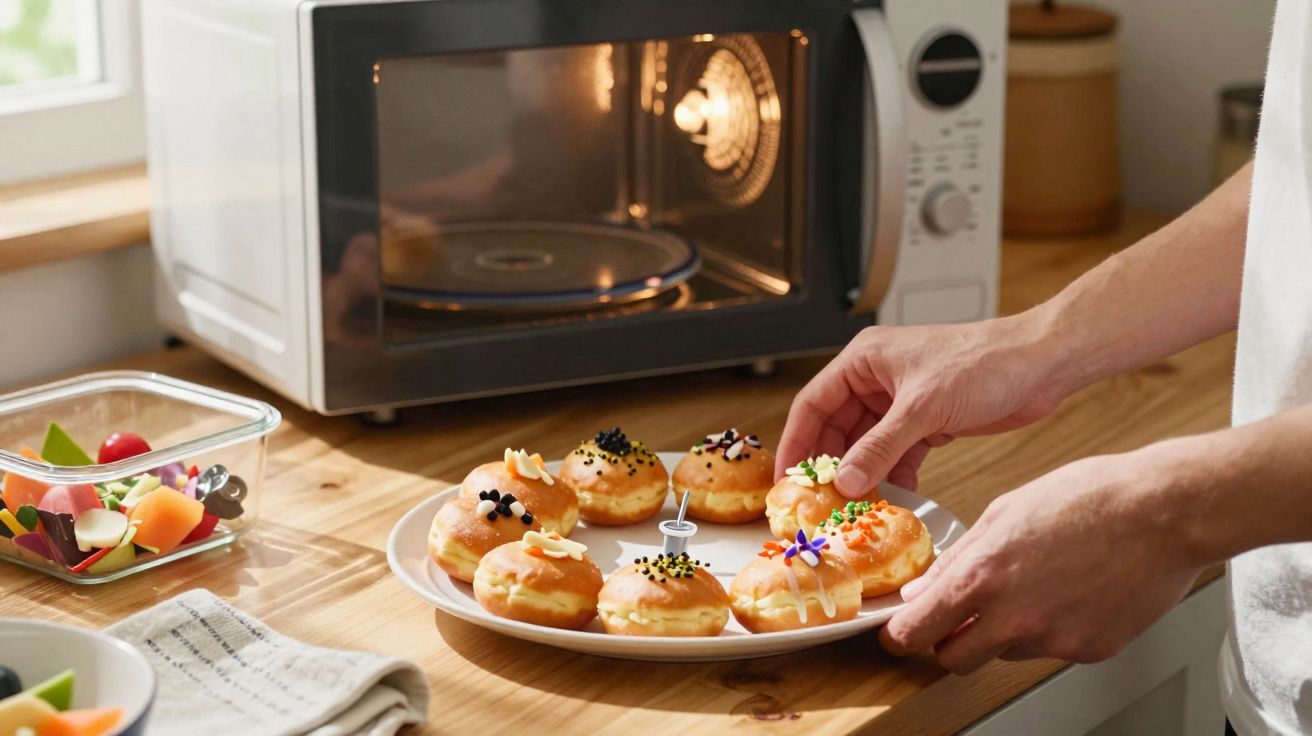
It tends to play out the same way. It’s late, you open the fridge with a fork already in your hand, and you’re faced with yesterday’s pasta or the half-finished burrito you swore you’d deal with “tomorrow”. You shove it all on a plate, slide it into the microwave, jab a few half-hearted holes with the fork, punch in 1 min 30 secs, and wander off. Then you take the first mouthful: one corner is blisteringly hot, the middle is practically polar, and the edges have somehow turned to rubber.
Most of us know that exact disappointment-food that manages to be boiling and icy at the same time.
There is, however, a small (almost laughably simple) tweak that can completely change how that plate reheats.
Why your microwave keeps letting down your leftovers
A common myth is that a microwave heats food from the inside out. In reality, it mostly warms from the outside towards the centre, and your leftovers suffer for it every lunchtime. When food is heaped up, the middle behaves like a bunker: sheltered from the microwaves and, as a result, sheltered from the heat too.
When you drop everything into a mound in the centre of the plate, you’re essentially constructing a fortress of cold. Microwaves bounce around, hit the outer areas first, and lose energy before they properly reach a thick, compact middle. That’s how you end up with a sauce that’s steaming on top while the rice underneath is still chilled.
It isn’t the plate that’s the problem. It’s the way the food is arranged.
Imagine you’ve brought home leftover takeaway: a big pile of fried rice. You tip it onto a plate, leave it thickest in the middle, set 2 minutes, and scroll on your phone while the microwave hums away. When it pings, the surface looks promising-light steam, good smell, everything seems fine.
Then your fork hits the centre and finds a cold, dense lump. You stir, sigh, and send it back in. By the time the middle is finally hot, the outer grains are starting to dry out and stiffen, and what was decent rice is turning into a sticky, overheated disappointment.
Now picture the same rice, but arranged as a ring with a gap in the middle. Same microwave. Same time. A very different outcome.
Microwave ovens don’t heat a plate perfectly evenly. The energy is typically stronger nearer the outer area of the rotating turntable and weaker towards the dead centre. That’s why we all experience those classic “hot spots” and “cold spots”. Food piled in the middle gets hit twice: it’s dense and it sits in a weaker zone.
By arranging your leftovers into a donut, you shift more of the food into the area where the microwaves tend to be most effective. At the same time, you reduce the thickness of the food layer, so the energy can travel through it rather than being stopped by one tight clump. That empty circle in the middle isn’t wasted space-it acts like a built-in heat distributor.
All of a sudden, your microwave is working with your food instead of against it.
The microwave donut trick that changes everything on your plate
Here’s the step-by-step method. Start with your plate, then use a fork or spoon to loosen and separate the leftovers. Avoid big chunks, compact balls of rice, or a tall stack of pasta. Next, push the food outwards from the centre and spread it into a ring.
Leave a clean hole in the middle-roughly the width of a small cup or the base of a mug.
Try to keep the ring fairly even all the way around. Don’t leave a mound on one side and a thin smear on the other. Press it down slightly so nothing is stacked too high. You’ve now made your “leftover donut”: a simple band of food positioned where reheating tends to be strongest.
Now, when you press start, the heat has a much better chance of reaching every bite.
For most of us, the real issue isn’t that the microwave is rubbish-it’s that we’re careless with the layout. We tip, heap, cover, and hope. And to be fair, not everyone is going to do this perfectly every day. You’re tired, you’re hungry, you just want it hot and quick. Still, this takes about 10 seconds, and it saves you that grim first mouthful of cold cheese or icy mashed potato.
Another common mistake is cramming together foods with very different moisture levels in one dense pile. A thick piece of chicken beside a wetter sauce will reheat unevenly when it’s all packed tight. Spreading everything into a donut shape gives the drier parts a chance to warm through without scorching the saucier bits.
Be relaxed about it-this isn’t about making a restaurant-style plate. It’s about making a plate that doesn’t trick your mouth.
“After I started arranging everything into a ring,” one busy office worker told me, “my sad desk lunches became a lot less… sad. I stopped gambling with my leftovers every time I used the microwave.”
- Spread food into a clear ring, not a heap in the centre
- Keep the donut thickness even around the plate
- Leave an obvious hole in the middle so heat can circulate more effectively
- Break up clumps of rice, pasta, or meat before you microwave it
- For dense foods, try slightly lower power so heat can move inwards rather than scorching the outside
Extra tips for better leftovers with the donut trick
Once you’ve shaped the ring, it can help to pause halfway, give the food a quick stir or rotate the plate, and then finish heating. Even with a turntable, a short mid-cycle mix evens out stubborn hot and cold patches.
Also, if your leftovers look a bit dry (rice and pasta are common culprits), adding a small splash of water before reheating can improve texture. Pair that with a loose cover (such as a microwave-safe lid) and you’ll reduce those chewy edges that come from moisture escaping too quickly.
Beyond the donut: how this tiny habit changes your routine
After you’ve tried the donut trick a few times, your relationship with your microwave shifts slightly-especially when it comes to leftovers. Late-night pasta stops arriving with lava-like edges and a frozen centre. That slice of Sunday lasagne starts tasting much closer to Sunday.
You may also find you waste less. Day-old vegetables and slightly soggy rice feel more “worth keeping” when you know they’re likely to reheat properly. Food waste often begins with small disappointments-a few bad reheats that make leftovers feel unappealing. When reheating is reliable, you’re more inclined to give yesterday’s meal another go rather than letting it languish at the back of the fridge.
This is where that small, almost silly-looking circle becomes a genuine habit-not just a microwave hack.
| Key point | Detail | Value for the reader |
|---|---|---|
| Donut-shaped layout | Move food into a ring around the outer area of the plate, leaving a hole in the centre | Far fewer cold spots and less frustrating reheating |
| Even thickness | Keep the ring flat and consistent, avoiding large clumps | More reliable texture and temperature in every mouthful |
| Microwave-friendly mindset | Use the microwave’s hotter zones instead of fighting them | Better-tasting leftovers, less waste, and less daily annoyance |
FAQ
- Q1 Does the donut shape really matter with powerful, modern microwaves?
- Reply 1
- Q2 Should I still use a cover or lid when I arrange food in a ring?
- Reply 2
- Q3 How big should the hole in the middle actually be?
- Reply 3
- Q4 Does this work for soups, stews, or very liquid foods?
- Reply 4
- Q5 Is it better to reheat at full power or a lower setting with the donut method?
- Reply 5

Comments
No comments yet. Be the first to comment!
Leave a Comment