
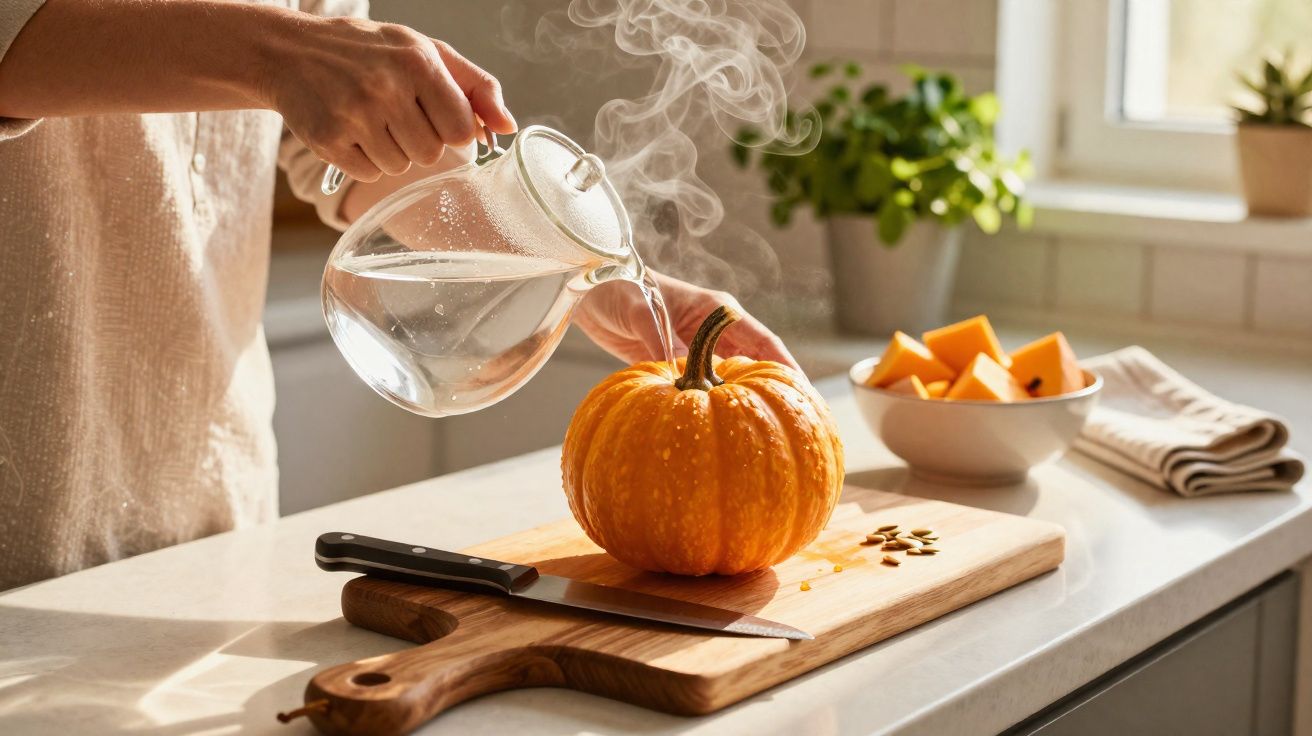
In the hush of the kitchen, the thunk of metal meeting pumpkin seems far too loud. One hand clamps the handle, the other presses against a stubborn orange rind that won’t budge, and a single thought edges in: why does this feel like trying to cut through timber?
The chopping board creeps sideways. The blade bites, then stalls halfway in as if it’s having a laugh at your expense. For a moment you can almost picture an A&E doctor asking, with professional calm, how you managed to slice your thumb while attempting to make soup. Meanwhile, online, people are turning pumpkins into elaborate cats and castles. You’re simply trying to keep all your fingers.
Somewhere between irritation and self-preservation, you reach for your phone and start scrolling. In a cooking forum, a casual comment jumps out: “Use the hot water trick. Cuts like butter.” You pause. Hot water… on a pumpkin?
It sounds absurd.
Why pumpkins are so hard to cut
Before any tricks, it helps to acknowledge the obvious: pumpkins can be proper kitchen bullies. That cheerful orange orb on your worktop hides a thick, fibrous shell designed to survive outdoors for weeks, not to behave nicely for a recipe photo. The skin is tough, the flesh is compact, and the whole thing loves to roll the second you apply pressure.
For many people, the struggle begins the moment the pumpkin comes home. You set it on the board, reach for your best knife, and feel your shoulders tighten. This isn’t only about technique-it’s about leverage, friction and a vegetable that feels suspiciously close to a free weight. It’s hardly surprising so many people opt for the pre-prepared packs.
A London-based supermarket chain once shared a small but telling figure: each year around Halloween, their sales of ready-cut pumpkin rise by nearly 30%. It’s not that people have suddenly developed a passion for neat orange cubes-it’s that a whole pumpkin can feel like too much effort. You can practically hear the internal debate at the shelf: I could take the big one… or I could avoid 20 minutes of swearing at a chopping board.
There’s another factor most glossy recipe images don’t show. The pumpkins in photos look soft and obliging; the pumpkin on your counter often isn’t. Cool storage, dry air and time spent on a supermarket display all contribute. By the time it reaches your kitchen, the pumpkin can be a hardened veteran.
Look closely and it makes perfect sense. Pumpkins are built to protect their seeds from weather, animals and decay. The rind thickens, the flesh firms, and moisture sits deeper inside. So when your knife hits that first wall, it meets resistance millimetre by millimetre. You’re not “bad at cutting”-you’re up against a small fortress. The smarter move isn’t to push harder, but to change the conditions.
The hot water trick for cutting pumpkins (and why it works)
This is where the hot water trick comes in, and it’s almost suspiciously straightforward. Instead of attacking the pumpkin with force, you use gentle heat to soften the outer layer so your knife has less work to do. It’s the same principle as running hot water over a tight jar lid before twisting it-just applied to a far more awkward shape.
How to do it
- Fill a large pot or a clean sink with very hot tap water. Aim for as hot as is sensible from the tap-not boiling and not dangerously scalding.
- Lower the whole pumpkin in. If it’s too large, leave the stem area sticking out.
- Leave it to soak for 10–15 minutes. The warmth softens the skin and the first few millimetres of flesh without cooking the pumpkin through.
- Lift it out and dry it thoroughly.
The change won’t be dramatic in your hands-the pumpkin won’t suddenly go floppy. But when you make that first cut, the blade meets noticeably less resistance. The initial slice, the one that usually feels like splitting a log, becomes steadier and smoother. Your wrists will notice immediately.
Real kitchens aren’t always set up for the neat version of this. If your sink is small or the pumpkin is enormous, you can still make it work: - Use a large bowl or washing-up tub and rotate the pumpkin, soaking one side at a time. - Alternatively, press a clean cloth soaked in hot water firmly over the section where you plan to start cutting, reheating the cloth as it cools.
A few unglamorous safety points matter here-and they’re the difference between helpful and hazardous: - A wet pumpkin is slippery, so dry it properly before going anywhere near it with a blade. - Use a chopping board that won’t skate about; a damp tea towel underneath helps keep it steady. - Start by slicing off a small piece from the base to create a flat, stable bottom. It’s an extra step, but it makes everything calmer and safer.
On a busy Wednesday evening, all of this can sound like a ceremony. Let’s be honest: nobody is giving spa treatments to a sad quarter of pumpkin every day. But for the big, rock-hard ones-the “this could go wrong” ones-those extra 10 minutes can be the difference between a satisfying chop and an A&E anecdote.
“The first time I tried the hot water trick, I thought it was nonsense,” laughs Emma, a home cook from Manchester who carves pumpkins with her kids every year. “Then my 10-year-old asked why I wasn’t swearing this time. That’s when I realised: okay, this actually works.”
People also share variations. Some briefly microwave a small whole pumpkin for 2–3 minutes before cutting, just to take the edge off the hardness. Others combine methods: a hot-water soak, then a short rest on the counter. The common thread is gentle heat-not enough to cook it-so the pumpkin still holds its shape for roasting, soup prep or carving.
Here’s a quick cheat sheet to keep handy: - Use very hot tap water, not boiling water, to avoid half-cooking the pumpkin. - Dry the skin completely so the knife won’t slip. - Stabilise it by trimming a small flat base first. - Choose a sharp, weighty knife, not a flimsy one. - Cut into halves or wedges first, then move on to tidy cubes.
What this small change improves in everyday cooking
On the face of it, this is just hot water and a pumpkin. Yet there’s something deeply satisfying about turning a dreaded job into a manageable one. The moment your knife goes in cleanly instead of bouncing off feels like a quiet win: you’re no longer wrestling your ingredients-you’re in control again.
That shift has knock-on benefits. When the “difficult bit” stops feeling dangerous or exhausting, you’re more likely to actually cook what you’ve bought rather than leaving it on the counter until it turns soft and accusatory. A simple habit can reduce food waste, make midweek soup more realistic, and move pumpkin from seasonal decoration to a genuinely useful ingredient.
It also helps to remember that cutting is only one part of the process. Once you’ve got the pumpkin open, a sturdy metal spoon for scraping seeds, a bowl for the slippery innards, and a clear plan (roast wedges first, cube later) makes the whole job faster. If you’re batch cooking, roasting a full tray and freezing purée in portions can turn one awkward pumpkin into several easy meals.
Finally, choosing the right pumpkin can make life easier before you even turn the tap on. Cooking varieties (often labelled for eating) tend to have denser, sweeter flesh and can be more straightforward to prep than some very large carving pumpkins. If you’re buying for food rather than lanterns, it’s worth checking the label and picking a size you can handle comfortably.
| Key point | Detail | Why it helps you |
|---|---|---|
| Softening the skin | Hot water relaxes the pumpkin’s outer layer without cooking it | Makes the first cut safer and far less stressful |
| Simple routine shift | 10–15 minutes soaking while you prep other ingredients | Saves time overall and reduces the chance of injury |
| More usable pumpkin | Easier cutting means you actually cook the whole vegetable | Less waste, more meals, better value for money |
FAQ: the hot water trick
Does the hot water trick change the taste of pumpkin?
Not really. The water only softens the outer layer slightly. The flavour and texture inside stay the same once roasted or cooked.Can I use boiling water instead of hot tap water?
You can, but it’s a gamble. Boiling water may start cooking the outer flesh, which can make it uneven and harder to cut cleanly.Is this method safe for carving pumpkins with kids?
Yes-provided an adult handles the knife. Because the skin is softened, you need less force, which is safer around small hands.What if my pumpkin is too big for the sink or pot?
Soak one side at a time and rotate every few minutes, or press a hot, damp cloth over the area you plan to cut first.Can I combine the hot water trick with the microwave method?
Yes. A brief microwave burst after a hot-water soak can help even more for very hard pumpkins. Keep the timing short to avoid cooking it through.
Comments
No comments yet. Be the first to comment!
Leave a Comment