
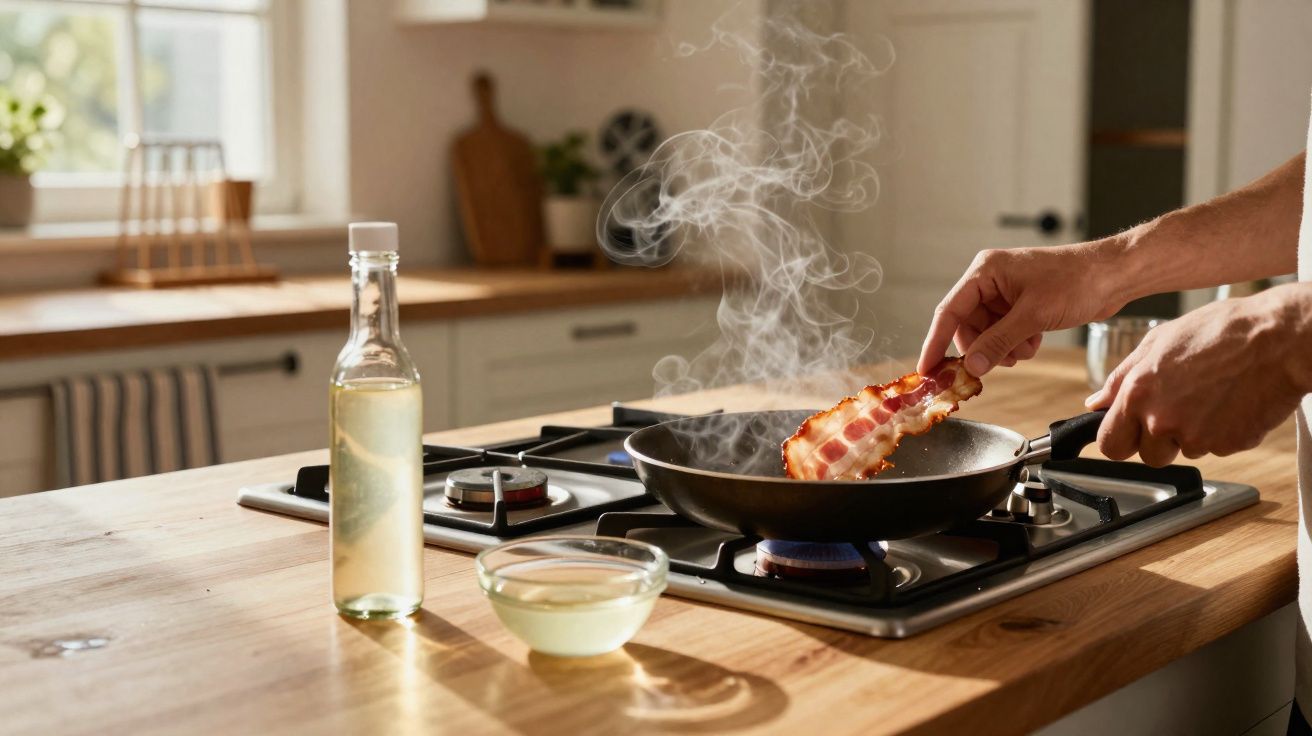
The first rashers of bacon land in the frying pan with that deeply satisfying sizzle. Or perhaps it’s a gorgeous salmon fillet, skin-side down, crackling away - the sort of meal that makes you feel unusually put-together.
Ten minutes in, the kitchen smells irresistible. Twenty minutes later, the hallway has the vibe of a budget café at 7 a.m. An hour on, your bedroom somehow carries a faint echo of… lunch. You open a window, flap a tea towel, light a candle that only succeeds in inventing a strange “bacon-and-vanilla” fragrance.
Then, one day, someone’s gran shares a slightly odd bit of wisdom: set a small bowl of white vinegar beside the hob before you start cooking. No gadgetry, no magic - just vinegar. And the result feels almost too simple to be true.
Why kitchen odours linger long after the pan has cooled
Walk into a kitchen where fish has just been fried and the smell feels almost visible. It clings to the steam that mists the window and hitches a ride on the light greasy haze you only properly notice when you wipe the extractor hood the next day. The scent doesn’t merely “hang in the air” - it ends up on soft furnishings, painted walls and even your hair.
Most homes are far less sealed than we imagine. Air moves between rooms, carrying microscopic droplets of fat and odour molecules with it. Curtains, cushions and that coat thrown over a hallway chair behave like little sponges. That’s why your living room can smell of cod an hour after dinner, even when the plates are already stacked in the dishwasher.
A lot of people try to solve this with perfume: scented candles, plug-ins, sprays, diffusers. The trouble is they rarely remove anything - they just disguise it. Fish plus vanilla, bacon plus synthetic lavender. What makes the real difference is catching odour molecules early, before they settle everywhere. That’s exactly where a humble bowl of white vinegar comes in.
Imagine a small, clear dish tucked near the hob while you cook - nothing fancy, just a shallow bowl half-filled with plain white vinegar. It doesn’t froth, it doesn’t steam theatrically; it simply sits there, doing its quiet work. You carry on as usual: turning the bacon, basting the fish, stirring your pan sauce. At first, the room still smells strongly of dinner.
Then comes the surprising bit. Once the pans are washed and the worktops wiped, the usual heavy, greasy “after-smell” that normally lingers just… isn’t as intense. The hallway isn’t saturated with fishiness. You step into the bedroom and, instead of that stale note of yesterday’s bacon, there’s almost nothing. It smells like a kitchen that has already moved on.
The bowl of white vinegar trick that helps stop your home smelling like a fryer
This is chemistry, not folklore. White vinegar contains acetic acid, which can interact with certain odour-causing compounds and neutralise them rather than covering them up. Many cooking odours lean alkaline; when they meet a mild acid like vinegar, they can become less potent and disperse faster. In practice, it’s like giving roaming smell molecules somewhere to land, instead of letting them circulate into every curtain and cushion you own.
At a microscopic level, hot fat turns your kitchen air into a busy interchange. Tiny droplets of grease and steam rise, carrying odour molecules along with them. Those molecules drift, bump into surfaces, and settle - especially on fabrics. With a bowl of white vinegar nearby, a portion of that traffic meets the acetic acid at the liquid’s surface: some compounds are absorbed, others react and become less noticeable. It’s not total coverage - air currents are messy and kitchens are chaotic - but it’s often enough to change the whole sensory feel of the house after cooking.
How to set it up (and why timing matters)
The method is almost embarrassingly straightforward:
- Before you switch on the hob, pour plain distilled white vinegar into a wide, shallow bowl. A depth of a few centimetres is plenty.
- Put the bowl close to the burner you’ll be using for bacon, salmon or other fish - close enough to sit in that invisible cloud where steam and fumes hover, but not so close it might get knocked over.
- Leave it in place throughout cooking, then keep it out as the kitchen cools.
The aim is for the vinegar to be present at the moment odours are released - when fat particles are still airborne and mobile. A shallow dish matters because surface area is doing the work; more exposed vinegar means more opportunity for odour molecules to meet it. Some people also place a second bowl on the opposite worktop, creating a sort of quiet “odour net” around the hob.
It’s only fair to be honest: a bowl of white vinegar won’t erase every trace of smell as if someone flicked a switch. Strong spices, very fatty bacon, or a full-on fish fry can still leave a whiff. What usually changes is the strength and the staying power. Instead of waking up to the ghost of last night’s mackerel, you’re more likely to notice a faint reminder that disappears after a quick airing. That shift alone can be the difference between “I never cook fish at home” and “Salmon on a Tuesday? Why not.”
A real-life test: bacon in a small flat
On a rainy evening in a compact city flat, a young couple decided to try the tip. They were fed up with washing their duvet cover every time they treated themselves to crispy bacon. So, before the first strip hit the pan, they put a small glass ramekin of white vinegar beside the hob. They cooked as normal - no extractor on maximum, no windows thrown wide open in the cold.
After eating, they did their usual test: shut the bedroom door for an hour, then walk back in. Normally, the smell arrives first - a soft, greasy cloud that makes the room feel smaller. This time, it was just the ordinary blend of laundry, books and a hint of detergent. No phantom bacon. The kitchen still held a warm, lightly savoury note, but the air felt noticeably less heavy. They ended up laughing at how low-tech it was: no filter, no expensive machine humming in the corner - just vinegar in a bowl, quietly getting on with it.
Scenes like this play out in thousands of homes with no lab coats involved. People try the vinegar bowl with pan-seared salmon, then breaded fish fingers, then duck breast or chorizo. It’s informal, but the pattern is consistent: the richer and greasier the odour, the more obvious the difference tends to be when the vinegar is present from the start. Nobody is logging results in a spreadsheet, yet everyday life provides its own data - fewer flatmate comments about “yesterday’s dinner”, and fewer “What have you been cooking?” questions when someone walks in hours later.
How to use vinegar for cooking smells without making your home smell like a chippy pickle
Keep it simple to start with. Choose plain distilled white vinegar - not cider vinegar, not balsamic. Pour a modest amount into a wide, shallow dish (a soup plate or ramekin works well) and set it near the hob before the pan heats up so it can get to work as soon as the first fumes rise.
If you’re cooking something especially pongy - oily fish or very smoky bacon - you can put a second bowl on a nearby worktop or even on the dining table. Leave the bowls out for 30–60 minutes after cooking, then pour the vinegar down the sink. Don’t reuse it; it will have collected odour compounds and won’t perform as well next time. When smells are particularly stubborn, a quick wipe around the hob with fresh diluted vinegar can reinforce the effect on nearby surfaces.
Two common slip-ups explain why some people think it “doesn’t work”:
- Using far too much vinegar in a small space. You don’t need a mixing bowl full. Often a few tablespoons in a shallow dish is enough.
- Putting the bowl miles from the hob. Placement matters; it needs to sit where the cooking fumes actually travel.
Another mistake is waiting until the place already reeks of fried cod and then setting out vinegar. At that point it can still help a bit, but much of the settling has already happened. The trick works best as prevention, not rescue. And let’s be honest: nobody remembers to do it every single day. Life gets busy, you cook on autopilot, and the vinegar only crosses your mind once the smell has taken over. That’s fine - using it when you can still adds up over weeks.
What surprises many people is how quickly your nose stops noticing the vinegar itself. That sharp note is strongest right after you pour it, then it fades into the background as cooking aromas take over - bacon, onions, garlic. What you’re left with isn’t a vinegar-scented home, but a home that recovers faster from what you’ve just fried.
A quick practical note (especially in small UK kitchens)
If you’ve got children or pets underfoot, use a heavier bowl and place it where it won’t be easily knocked - for example, pushed back on the worktop beside the extractor hood rather than right on the edge near the pan handle. Open-plan flats can also benefit from positioning the second bowl nearer the sofa area, because that’s where odours often drift and settle into soft furnishings.
“I used to open every window, light two candles, and still go to bed in a house that smelled like fish,” says Claire, 42, who cooks salmon often. “With the vinegar bowl, it’s like the smell has an off-switch. Not gone, but softer. My kids stopped complaining that their pyjamas smelled like dinner.”
Pair it with habits that actually stop smells spreading
This small ritual works best alongside a few simple routines that respect how odours travel and cling:
- Switch on your extractor hood as soon as you start cooking, not halfway through.
- Crack a window on the opposite side of the room to create gentle airflow.
- Wipe splatters quickly; dried grease keeps giving off odour for longer.
- Wash or replace kitchen towels often - they’re secret smell magnets.
- Let pans cool, then wash them, rather than leaving them overnight.
Used together, these small habits shift your home’s baseline smell. Not sterile and not artificially perfumed - just less trapped in last night’s recipe. You still get the pleasure of bacon on a lazy Sunday or a garlicky fish dish midweek, without paying for it with a home that smells like a snack bar for the next 24 hours.
Living with smells rather than battling them: what this little bowl changes
There’s a particular relief in walking into the kitchen the morning after frying fish and noticing… nothing in particular. No accusatory haze of old grease. No lingering reminder of last night’s pan. Just morning coffee, maybe toast - the ordinary rhythm of a new day. In a small space where every odour feels amplified, that difference can be huge.
Smell is emotional as much as it is chemical. It affects how welcoming a room feels and whether it seems calm or cluttered. A bacon cloud can feel cosy on a Sunday, yet oddly oppressive on a Wednesday when you’re trying to work at the kitchen table. A bowl of white vinegar isn’t merely a “hack”; it’s a simple way of quietly reclaiming your space. You get to cook what you fancy without negotiating with your curtains, your bedding, or that one flatmate who can’t stand fish.
The more interesting question isn’t “Does this work perfectly every time?” It’s “What changes in daily life when cooking doesn’t leave such a long shadow?” Perhaps you’d fry sardines in winter without dreading days of smell. Perhaps bacon wouldn’t be reserved for the rare weekend when you can air the place out for hours. Small experiments - vinegar here, airflow there - can make homes feel more flexible, more forgiving, and easier to share. And that’s exactly the kind of tip people pass from one kitchen to the next.
| Key point | Detail | Why it matters to you |
|---|---|---|
| Bowl near the hob | Place a shallow dish of white vinegar close to the pan before cooking | Neutralises odours as they form, rather than hours later |
| Use the right vinegar | Plain distilled white vinegar, small quantity, wide surface area | Strong effect on smells, minimal “vinegar” scent in the room |
| Combine with airflow | Extractor hood, cracked window, quick wipe of splatters | Lighter air at home, even after strong-smelling meals |
FAQ
- Does the vinegar bowl completely remove fish or bacon smell?
Not entirely, but it often makes the odour noticeably weaker and much shorter-lived. The house “moves on” faster.- Will my kitchen smell like vinegar instead?
Usually not. The vinegar smell is strongest right after you pour it, then it fades behind the cooking aromas. What remains afterwards is more neutral air.- How much vinegar should I put in the bowl?
A few tablespoons to a shallow layer in a small dish is enough. Surface area matters more than depth; a wide plate works better than a tall glass.- Can I reuse the vinegar once it’s absorbed odours?
It’s best not to. Tip it away after use; it will have collected odour molecules and may be less effective next time.- Is it safe to do this every time I cook?
Yes. White vinegar is food-safe and non-toxic. If you find the smell distracting, simply use less or place the bowl a little farther from where you’re standing.




Comments
No comments yet. Be the first to comment!
Leave a Comment