
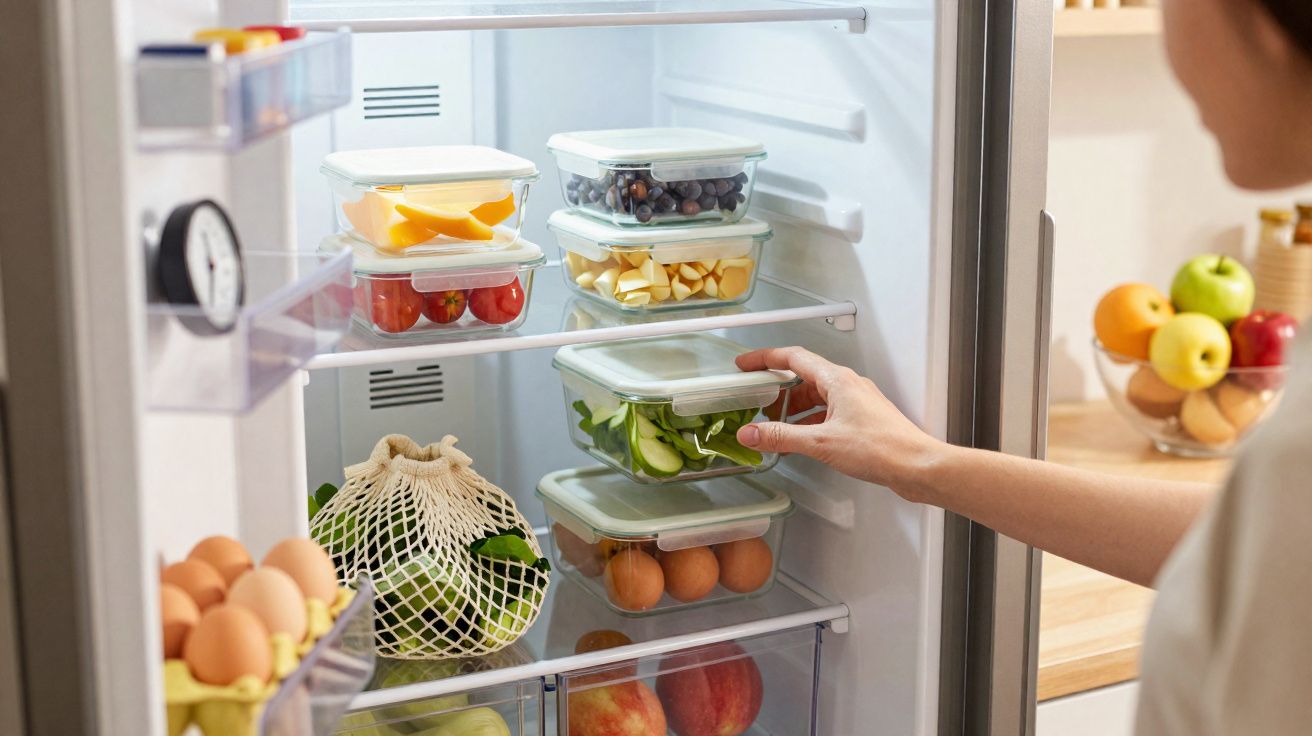
Stuck-together yoghurts, leftovers wedged into opaque tubs, and a crushed bag of salad hiding behind the milk. You shove things in, squash them down, and tell yourself you’ll “sort it out later”. A few days on, you find the same limp salad, fruit speckled with bruises, and that piece of cheese that now looks like a science project.
Most of us know the feeling of binning far more than we ever actually ate. It stings your bank balance and your conscience. We blame the product, the supermarket, or the use-by date. But what if the real issue is simply how we pack the fridge?
One overlooked detail changes almost everything: the space between your food. Hardly anyone talks about it, yet it quietly decides how long your groceries stay fresh.
Why a crowded fridge quietly kills your food
Open a well-organised, not-too-full fridge and you can almost sense the cold air moving around. Open a fridge crammed to the brim and you’re faced with a solid wall of plastic, glass and cartons. The chilled air has very little room to weave through. You can’t see it happening, but you pay for it in lost days of freshness.
Fridges are built to circulate air, not to act like a giant game of Tetris. When every pot, carton and food container is touching, the temperature stops being even. Some items sit in pockets that run a bit warm; others end up near areas that are cold enough to edge towards freezing. The outcome is predictable: quicker ripening, textures turning unpleasant, and bacteria getting a better chance to multiply.
A jam-packed fridge isn’t just untidy. It becomes a delicate system that slowly suffocates itself.
WRAP in the UK has estimated that households throw away tonnes of edible food each year, often because of “premature spoilage”. Surveys rarely include a tick-box for “fridge too full”, but experts recognise it instantly when they open the door: shelves where nothing can shift, and items pushed to the back for weeks, effectively exiled.
Picture a yoghurt trapped right at the rear behind a pan of leftovers. That spot is slightly warmer and the airflow is poorer. It can spend days sitting at a borderline temperature while the rest of the fridge is fine. Eventually you open it, taste it, hesitate, and bin it. Next week, the same cycle repeats.
Overfilling creates another quiet problem too: you stop knowing what you have. When you can’t see it, you don’t eat it. The cold chain matters, but so does the “line of sight” chain.
In simple terms, your fridge is controlled micro-weather. A motor generates cold, fans push it around, and air needs to circulate around what you’re storing. For that to work properly, you need actual empty space-literally a few centimetres between tubs, jars and vegetables. Without it, cold air hits obstacles, stalls, and forms warmer pockets.
That’s why the “strategic” zones-often lower down and close to the sides or back-can become colder than intended, while the middle stays milder. Some foods end up kept too cold and lose their texture; others mature too quickly. The fridge runs for longer, uses more energy, and still delivers worse results.
Space in a fridge is a bit like space in a conversation: if everyone speaks at once, nothing really gets through. Leave a little air, and things can breathe-food included, in its own way.
A related note: temperature and door habits matter, too
Airflow does the heavy lifting, but it works best alongside steady temperature. In most UK homes, a fridge temperature of about 0–5°C is recommended; if yours runs warmer, even a perfectly spaced shelf will struggle. A cheap fridge thermometer can reveal warm spots you’d never guess were there.
It also helps to keep the door opening short and purposeful. Standing with the door open while deciding what to eat dumps cold air out and pulls warm, moist air in-exactly the conditions that speed up wilting, condensation and spoilage. Good spacing recovers faster after a door opening, because air can move freely again.
How to give your fridge room to breathe (refrigerator airflow tips)
The first tactic is almost annoyingly straightforward: put less in the fridge. Not forever, not perfectly-just start with one “test shelf”. Take everything off it, throw away what’s clearly gone, group similar items together, then put back only what’s still being used, leaving about a finger-width gap between each thing.
What you’re creating are invisible “air lanes”. A bottle, a jar, a gap. A tray, a gap, a lemon. It can feel wasteful-almost indulgent-not to exploit every centimetre. Yet this is where the benefit shows up: steadier temperature, smells staying more contained, and less surface condensation on food.
It’s a small, ordinary habit, but it can noticeably extend the life of what you buy.
For many people, the trouble starts after a big shop. You arrive home, unpack fast, and stack everything in. The yoghurts get piled, the vegetables land wherever they fit, and the cheese is shoved into a random corner. Door closed-job done. And then it’s forgotten.
Realistically, nobody has the time to “merchandise” their fridge every day. Still, you can reduce the damage with a few simple systems. One is to reserve a front-of-shelf “use first” zone. Another is to keep a clear bin for anything already opened-half a cucumber, an unsealed sauce, a tub of leftovers-so it’s visible and gets finished.
A family in Manchester told me they cut their food waste by nearly a third using one ultra-simple rule: never stack more than two items on top of each other. Less height means more air movement and better visibility.
Underneath it all, the logic is reassuring: you don’t need to become perfect-your fridge needs to become easier to read. Leaving space gives you a chance to spot what’s about to be wasted: a lonely yoghurt nearing its date, that abandoned half cucumber, a sauce that’s been open too long.
The common mistakes are remarkably similar: - forcing fruit into a vegetable drawer that’s already packed tight; - putting still-warm leftovers into large containers that take up half a shelf; - storing bottles in a tightly packed vertical row, like a miniature warehouse.
Anything that blocks, compresses or overpacks tends to shorten the life of your food.
A domestic refrigeration specialist once put it to me like this:
“Your fridge performs better when you give it a bit of freedom. A fridge that’s around 80% full, with air between items, keeps food fresher for longer than one that’s stuffed right to the limit.”
To get there without turning your kitchen into a showroom, these benchmarks help: - Leave roughly 2–3 cm between items on each shelf. - Avoid pressing food right up against the back wall, where the air is often coldest. - Choose rectangular, not-too-tall containers rather than round ones that waste space. - Do a five-minute weekly clear-out-timer on, quick decisions only. - Don’t fill vegetable drawers beyond about 80% of their capacity.
Repeat these small steps without obsession and a “stifled” fridge becomes an efficient tool. It won’t look impressive on social media. You’ll notice it in how long your tomatoes stay usable.
Another practical add-on: packaging choices that reduce moisture build-up
Spacing improves airflow, but you can go further by reducing trapped humidity. If salad leaves are sweating inside a tightly sealed bag, they’ll wilt quickly even in a well-spaced fridge. Lining a container with a piece of kitchen roll (and replacing it when damp) can help manage moisture for leafy greens and herbs.
Likewise, letting hot leftovers cool to room temperature (within safe limits) before refrigerating prevents excess steam from raising humidity and encouraging condensation on nearby food. Better airflow plus less moisture is a powerful combination.
The quiet satisfaction of food that actually lasts
Once you start leaving a little space between foods, something surprisingly satisfying happens. Items stop “vanishing” into the back. You find fewer forgotten casualties because you see them in time. That visibility alone changes how you relate to what you buy.
Salad keeps its structure for two or three extra days. Cheese avoids that odd surface film. Fruit isn’t all touching, which reduces the damp contact points where moisture lingers and decay speeds up. The fridge becomes less of a graveyard for good intentions and more of a place with movement and rotation-almost lively.
You don’t need to become obsessed with food storage to feel the relief of throwing less away. People don’t mention it much, but it genuinely helps.
An airy fridge also tells a different story: a calmer rhythm. Less “I’ll stock up just in case”, more “I’ll buy what I’ll actually use”. That shift builds gradually. You realise you don’t need fifteen open sauces at once, or three half-finished bags of grated cheese competing for space.
It isn’t a dramatic makeover. It’s a set of tiny choices that add up: you buy a bit less, you cram in a bit less, and you waste far less. You finish a whole salad before it darkens. You get through a tub of hummus in time. Day after day, you see that the simple gap you leave between products buys each food a few more days.
Next time you open the fridge, look for one question: where could air move, right now? Which container could shift to create a small cool corridor? Which habit could you tweak so that this cold rectangle becomes your ally, rather than the quiet witness to what you waste?
We often underestimate what “empty space” can hold: a little air, a few stable degrees, and a clear view of what you already own. It’s not flashy and it won’t go viral-but in the soft hum of a working fridge, it changes how long your food lasts and, in a small way, how we consume.
| Key point | Detail | Benefit for the reader |
|---|---|---|
| Air circulation | Leaving gaps between foods allows cold air to move freely. | Food stays fresh for longer; temperature is more stable. |
| Less-packed fridge | Keep it to around 80% capacity and avoid excessive stacking. | Less waste and better visibility of what you already have. |
| Simple organisation | Use bins, keep stacks low, and create a “use first” zone. | Saves time, makes the fridge easier to use, and reduces shopping costs. |
FAQ
- Do I really need to leave gaps between every single item? You don’t have to line everything up with a ruler, but aiming for a few centimetres of space between the main items makes a big difference to airflow.
- Is a full fridge always bad for food preservation? Not necessarily. A well-organised fridge that’s about 70–80% full can work very well. The real problem is overstuffing with no room for air to circulate.
- How much longer will food last if I space it out? It varies, but many people find leafy greens, dairy and leftovers last 1–3 days longer when the temperature is more even.
- Does container type matter for airflow? Yes. Low, stackable, rectangular containers use space efficiently and leave more “channels” for air than tall, bulky or awkwardly shaped boxes.
- Should I change my shopping habits as well? Buying slightly less, shopping slightly more often, and avoiding bulk buys you can’t finish complements the airflow approach and reduces waste even further.


Comments
No comments yet. Be the first to comment!
Leave a Comment