
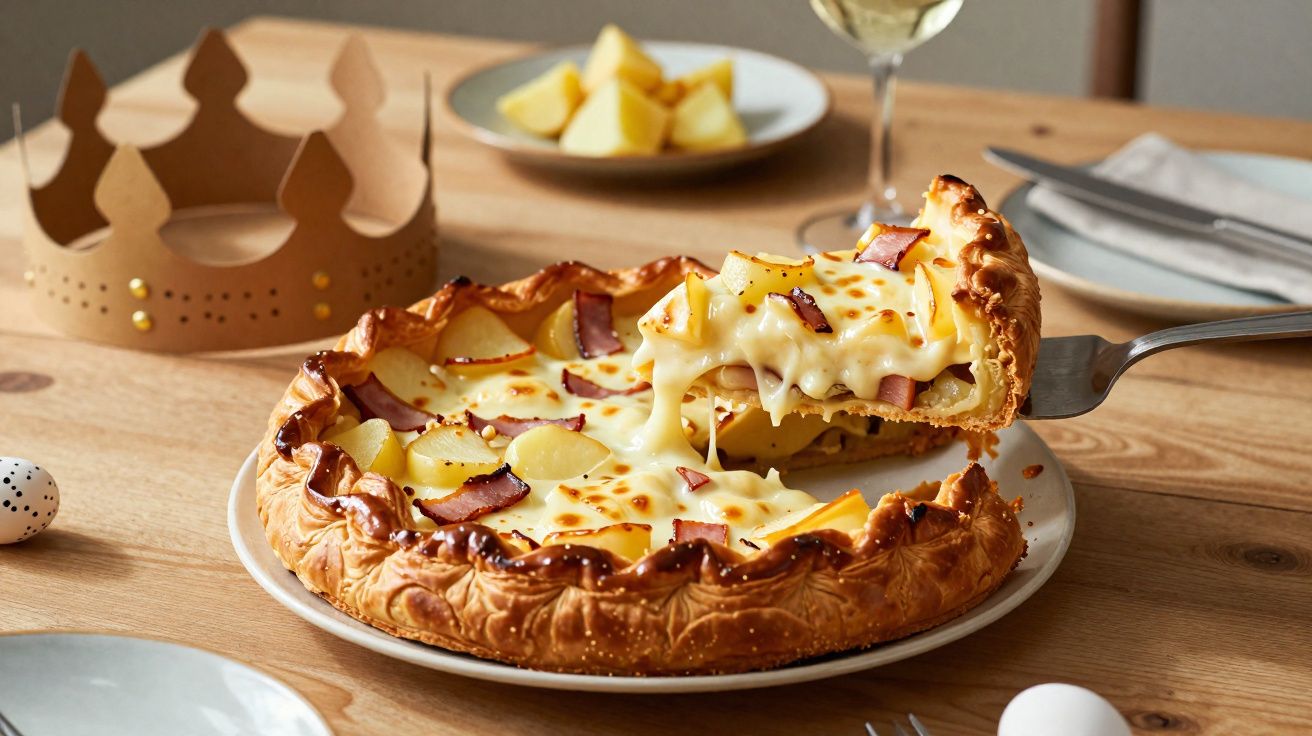
Not with frangipane and almonds, but with crackling lardons, oozing Reblochon and buttery puff pastry just beginning to lift. In kitchens across France every January, the same debate crops up: “Right… are we doing a proper main course, then the galette des rois?” You can practically hear the host’s long exhale-the one who’s already peeled the potatoes, set the table and hidden the fève. Somewhere between the pull of tradition and the reality of a weekday evening, a quietly brilliant thought is catching on: what if the galette itself was dinner?
At first glance, it feels like heresy. A tartiflette-style galette des rois: creamy potatoes and cheese in place of sweet almond filling. A savoury variation that nods to Epiphany customs while giving in to winter comfort food cravings. But once you’ve watched one arrive at the table-golden, steaming, with a crisp paper crown perched on top-you start to question the “rules”. Perhaps it isn’t a gimmick at all. Perhaps it’s exactly the sort of January solution people have been waiting for.
Tartiflette meets Epiphany: why this mash-up works so well
The first thing you notice with a tartiflette-style galette des rois is the brief pause at the table. Plates are set down, someone cuts through the puff pastry lid with a satisfying crack, and for a beat nobody knows whether to laugh or reach straight in. Then the cheese stretches in slow, glossy strands, the potatoes spill out, and the decision is made for everyone. A “traditional” dessert has just been turned into a full-on Alpine-style meal.
This crossover lands because it fits a very real January mood: dark, cold evenings; tighter budgets; the pressure to host; and a very adult desire for comfort food that still feels a bit special. Instead of juggling a roast, sides, and then a sugary galette that half the table is too full to enjoy, you get one centrepiece that does everything. Main course. Epiphany ritual. Fève moment. All in a single, unapologetically rich pie.
It also keeps what matters about the galette des rois: community, ceremony and a bit of silliness. Tartiflette is designed for sharing and lingering conversations; the galette des rois is about gathering round, handing out slices, and crowning the “king” or “queen” (often with someone ducking under the table to decide who gets what). Put the two together and you keep the spirit of Epiphany while loosening the strict course-by-course script. Less stress, less washing up, and fewer people vanishing to “sort dessert” while everyone else drifts away.
There’s a practical side, too. Families with young children, flatmates in small flats, and office Epiphany get-togethers all want something that feeds a crowd, feels festive, and doesn’t demand professional pastry skills. A tartiflette-style galette des rois hits that sweet spot: photogenic enough for social media, but still pleasantly rustic. Nobody is grading your pastry edges while they’re busy chasing melted Reblochon with a forkful of potato.
One note that hosts quietly appreciate: the fève is easier to manage in a single dish, but it still needs care. Choose a sturdy, food-safe fève, tuck it in away from the very edge, and remind everyone to eat thoughtfully-especially if children are at the table. The tradition is meant to be playful, not a trip to the dentist.
How to make a tartiflette-style Galette des Rois that holds together
The key is to build it in layers and keep moisture under control. Start with good all-butter puff pastry, cut into two circles slightly larger than a standard galette des rois. Parboil waxy potatoes in well-salted water until only just tender, then slice fairly thinly so they heat through without turning to mash.
Meanwhile, fry smoked lardons with sliced onions until the kitchen smells like a ski chalet. Tip off most of the rendered fat, but leave a little behind for flavour. In a bowl, combine the potatoes, lardons and onions with a spoonful of crème fraîche, salt to taste, and a generous amount of black pepper.
Lay the first pastry circle on a baking tray, then spread the filling over it, leaving a clean border around the edge. Push chunks or slices of Reblochon (or another washed-rind cheese) into the mixture so it melts from the inside out. Hide the fève somewhere sensible-ideally not in the very first bite of the keenest guest. Brush the border with beaten egg, place the second pastry circle on top, and seal the edges by pinching, twisting or crimping.
Score a simple pattern on the lid with the tip of a knife (don’t cut all the way through), brush with egg again, then bake in a hot oven until it’s risen, deeply golden and visibly bubbling at the seams.
Most failures come from going timid or going overboard. Too little filling and the galette eats like a forlorn snack; too much and the pastry splits or stays damp in the middle. Aim for a generous but level layer-plenty of substance, not a mound. Let the filling cool before assembling, and chill the built galette for 15–20 minutes so the pastry keeps its shape and puffs properly. Bake it on a preheated tray so the base crisps rather than steams.
And on a human level: don’t chase perfection. On a tired January evening, nobody needs patisserie-window symmetry. What people remember is that you sat down and ate with them instead of hovering anxiously by the oven. Let’s be honest: hardly anyone manages that every day.
“Last year our kids barely touched the traditional galette,” says Clara, 38, from Lyon. “This time I made a tartiflette-style one and suddenly they were fighting over the fève and mopping up the plate with bread. It felt like we’d turned the whole Epiphany thing into something that actually suited us.”
If you want to make this genuinely weeknight-friendly, lean on shortcuts without guilt. You can parboil the potatoes and cook the lardons and onions the day before, then refrigerate everything. Ready-rolled puff pastry works perfectly well. For mixed diets, split the filling in two: one half with lardons, one half with sautéed mushrooms, and assemble a half-and-half galette like a pizza so everyone gets what they want.
- Choose waxy potatoes so they keep their shape inside the galette.
- Pick a bold cheese that melts properly (Reblochon, Raclette, Mont d’Or).
- Let the filling cool before it touches the pastry.
- Chill the assembled galette for a better rise and cleaner edges.
- Bake on a hot tray to help the base turn crisp and golden.
More than a trend: what a tartiflette-style galette des rois says about January eating
A tartiflette-style galette des rois might be a small idea, but it points to a bigger shift. People are weary of having to choose between options that don’t reflect real life: a “proper” meal or a fun dessert, tradition or practicality, comfort food or something camera-ready. This mash-up quietly answers: why not have both? Why not fold the ritual into the dish and stop forcing the evening into rigid courses that no longer match how we live now?
It also pushes back against the perfection culture that clings to celebrations online. The galette des rois was never meant to be a performance piece. It was a straightforward way to share food, have a laugh, and mark Epiphany while winter still feels long. Updating the filling to match what people genuinely crave doesn’t break the tradition; it keeps it alive. The crown still tilts, the fève still gets found, and the “king” or “queen” still grins-just with melted cheese involved.
If you’ve ever stared into the fridge on 6 January wondering how you’ll feed six hungry friends, honour Epiphany, and keep your sanity intact, this kind of hybrid earns its place. It acknowledges the mental load as much as the appetite. It tells guests: you’re welcome here, but I’m not pretending I’ve got three spare hours to cook like a restaurant. And, oddly enough, that honesty tastes excellent.
| Key point | Detail | Why it matters to you |
|---|---|---|
| Savoury galette as a complete meal | A tartiflette-style filling turns the galette des rois into both main course and celebration dish | A realistic way to host Epiphany without cooking multiple courses |
| Layered method | Parboiled potatoes, lardons, onions and melting cheese sealed in puff pastry | Helps prevent soggy pastry and keeps the result rich but balanced |
| Tradition, refreshed | Keep the fève, the crown and the ritual, while switching the flavour profile | Lets you respect customs while adapting to modern tastes and time constraints |
FAQ
Can I make a tartiflette-style galette des rois without pork?
Yes. Swap the lardons for smoked tofu, sautéed mushrooms, or caramelised leeks. The important thing is keeping a savoury, slightly smoky note so the cheese and potatoes don’t taste one-dimensional.Which cheese works best if I can’t find Reblochon?
Raclette, Mont d’Or, Taleggio, or even a strong, properly melting Camembert can work. You’re looking for character and full melt, not bland creaminess.Is it still a “real” galette des rois if it isn’t sweet?
Purists may disagree, but the heart of the tradition is sharing a crowned pastry with a fève hidden inside. Keep the ceremony and you’re absolutely in the spirit of Epiphany.Can I prepare it in advance for a crowd?
Prepare the filling a day ahead and chill it. Assemble the galette a couple of hours before baking, refrigerate it, then bake just before serving so it arrives hot and fully puffed.What should I serve with a savoury galette des rois?
A crisp green salad with a sharp vinaigrette cuts through the richness. To drink, try a white wine from Savoie, a dry cider, or sparkling water with lemon to keep things light.





Comments
No comments yet. Be the first to comment!
Leave a Comment