
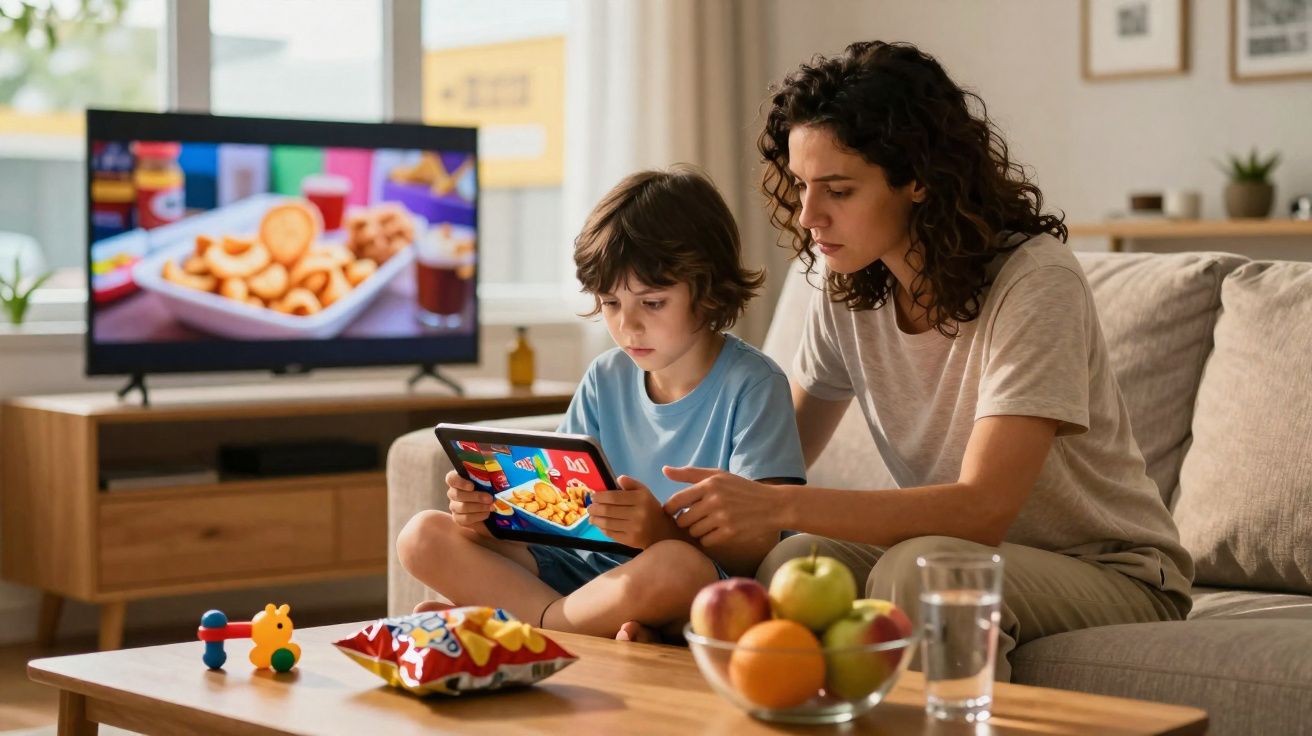
The television had barely warmed up when the first advert rolled in.
A glowing burger rotated in slow motion, cheese stretching theatrically, fizzy drink bubbling like a sparkler. My mate’s eight-year-old edged forwards on the sofa, transfixed-as if it were a magic trick.
His mum exhaled, muttered “here we go again”, and gripped the remote like it was defensive equipment.
Most families recognise the moment: your child can sing three fast-food jingles perfectly, yet still stumbles over a whole sentence in a book.
From there, the proposed fix can sound straightforward. Some governments want ad bans: stop junk food marketing where children are most likely to see it-during kids’ programmes, on YouTube, on billboards near schools, even on buses.
Parents often describe that idea as a relief.
Opponents frame it as the creeping nanny state.
Somewhere between the kitchen table and Parliament, the argument has shifted into a bigger question: who gets to shape children’s cravings-and who should be allowed to?
Junk food advertising and children: are we protecting kids, or policing taste?
Walk through any town or city with a child and you can practically chart their attention by poster and screen.
A glossy burger on one wall, bright cereal on the next, a friendly cartoon character promising “fun” if you scan a QR code.
By the time children reach their teens, they may have been exposed to tens of thousands of food promotions-most pushing products that are salty, sugary, or high in fat. That isn’t random; it’s strategy.
Food marketing aimed at children is built to bypass careful thinking and go straight for instinct.
Bold colours. Catchy music. Influencers. Games and giveaways. Children’s brains are still developing, still learning what “everyday food” looks like-and advertisers are right there helping colour in the picture.
The UK and HFSS (high fat, salt, sugar) rules
In the UK, limits on junk food adverts during children’s television have been in place for years. More recently, broader restrictions on HFSS (high fat, salt, sugar) advertising-such as curbs before 9pm-have edged through politics, consultation, and heavy lobbying.
That matters because families don’t experience advertising in neat categories. A “kids’ channel” is only one slice of the day; children watch family programmes, clips, and live sport too. The practical question is whether rules reduce overall exposure, not just shift it elsewhere.
What other places show us
Quebec has restricted junk food advertising to children since the late 1970s. Research there has associated the policy with lower fast-food consumption and a slower rise in childhood obesity compared with nearby regions.
At the other extreme, switch on American cable during a big sporting event and it can feel like an unbroken parade of pizza, wings, and fizzy drinks. Studies have linked that sort of intense commercial pressure to more “pester power” at home and higher calorie intake among younger viewers.
The evidence isn’t perfectly tidy, but the direction is difficult to dismiss.
Critics argue this is where boundaries start to blur: if the state can restrict adverts for crisps, what comes next-ice cream, a sweetened latte, or anything that isn’t “healthy enough”?
Public health specialists respond that the focus is on products and placement, not shaming people. They point to health services under strain and the long-term cost of treating diabetes and heart disease rooted in childhood patterns.
The underlying logic is simple: children are not merely “small adults”. They’re easier to influence and less equipped to spot persuasion. So, the argument goes, food marketing around minors should be handled more like gambling or alcohol-more caution, tighter limits.
That’s the tension in plain terms: are we making the playing field fairer, or scrubbing it clean?
Where parents end and the “nanny state” begins
Imagine it’s 7pm at the dinner table.
You’ve worked all day, you’re running on fumes, and you’re trying to convince a child to eat broccoli after they’ve been gently nudged towards chips since breakfast by every glowing screen in the house.
Many families use a sort of “advert buffer” to take the edge off:
- Watching less live TV and choosing streaming options with fewer food adverts during peak children’s hours
- Muting advert breaks or skipping them where possible
- Naming the tactics out loud: slow-motion cheese pulls, “limited time only” urgency, impossibly tidy happy kids
- Setting a few simple home norms (for example, water as the default drink, fruit visible on the counter)
None of this is a miracle cure. But it can shift children from passive targets to slightly more active critics-harder to hook, even by a small margin.
At the same time, plenty of parents admit something privately and plainly: they’re exhausted by the idea of taking on billion-pound marketing machines alone. They may not want the government dictating what’s on the plate, but they also don’t want every walk to school to feel like a sales assault.
That’s when the phrase “nanny state” appears. It’s a loaded label, designed to make regulation sound patronising. Yet we tolerate (and often welcome) many safety rules: seatbelts, smoke-free pubs, age limits on alcohol.
Food feels messier because it’s tangled up with identity, comfort, celebration, and class. Who gets judged as “reckless”?
The parent grabbing chicken nuggets after a late shift-or the company putting those nuggets in front of their child on every app?
And, realistically, nobody manages perfect meals every single day.
Public health advocates often stress that junk food ad bans aren’t about outlawing burgers. They’re about lowering the volume.
Public health lawyer Sheila, who has advised on advertising regulation in Europe, put it to me this way: “Advertising doesn’t only sell products-it sells what feels normal. Restricting junk food ads to kids isn’t banning treats. It’s saying childhood shouldn’t be a 24/7 sales pitch.”
Policies with the strongest track record tend to pair restrictions with practical support, such as:
- Limiting junk food advertising in places where children are the main audience
- Backing schools with genuine food education rather than brand-sponsored materials
- Helping small businesses add healthier options without taking an unsustainable financial hit
- Funding campaigns that make everyday cooking feel realistic, not like a lifestyle fantasy
- Publishing results transparently so the public can see what is (and isn’t) changing
The bigger “nanny state” risk often isn’t one obvious law-it’s quiet, unchecked corporate influence dressed up as personal “choice”.
Two issues that rarely get enough airtime: algorithms and enforcement
One complication is that modern advertising doesn’t just sit in a predictable advert break. On social media and video platforms, children can be targeted through behaviour, location, and interests-often without a clear label saying “this is an advert”. That can make ad bans feel powerful on paper but leaky in practice unless digital targeting is tackled directly.
The other challenge is enforcement. Rules are only as strong as the definitions and penalties behind them. If brands can pivot to influencer content, sponsorships, games, or “family-friendly” branding that still reaches children, then restrictions risk becoming a game of whack-a-mole rather than genuine protection.
Between freedom and fairness, where do we draw the line?
If you strip the debate down to its frame, it isn’t truly about chips versus apples.
It’s about power: who gets to shape children’s preferences-parents, governments, or companies with advertising budgets that rival public health departments?
Banning junk food adverts to children won’t suddenly empty fast-food queues or turn toddlers into kale enthusiasts. Children learn from what’s normal at home, in school, and in their neighbourhood.
But when the environment shouts “treat” every few seconds, “personal responsibility” can start to look like a rigged contest.
Some see ad bans as the first step on a slippery slope towards being told what to eat, drink, and buy. Others see them as the minimum courtesy in a shared space-like turning down a speaker so everyone else can think.
Perhaps the better question isn’t “nanny state or not”. Perhaps it’s this: in a world where persuasion never sleeps, what does meaningful choice for children actually require?
| Key point | Detail | Value for the reader |
|---|---|---|
| How ad bans work | Typically aimed at HFSS (high fat, salt, sugar) products in child-focused media, placements, and time slots | Helps you see what may genuinely change in your child’s day-to-day media environment |
| What parents can still do | Use ad-light or ad-free options, discuss marketing techniques, and set simple home food norms | Offers practical levers even when policy is imperfect or slow |
| Where the controversy lies | Tension between child protection, corporate freedom, and fear of a nanny state | Helps you form a nuanced view rather than picking a side based on slogans |
FAQ
Question 1: Do junk food ad bans actually reduce childhood obesity?
Evidence suggests they can reduce exposure and may slightly lower junk food intake, with findings often cited from places such as Quebec and the UK. On their own, effects are typically modest, and they tend to work better alongside wider measures such as improved school meals and community support.Question 2: Are governments trying to ban junk food altogether?
Generally, no. Most approaches limit where and when junk food advertising can target children rather than banning products outright. Adults remain free to buy what they want; the intention is to reduce aggressive marketing aimed at kids.Question 3: Does this hurt small businesses and local takeaways?
Most restrictions are designed to address large-scale advertising and major brands. Local takeaways rarely buy national children’s TV slots, although broader rules on public-space advertising can still have knock-on effects.Question 4: What can I do if my country doesn’t have these bans?
You can reduce advert exposure at home, talk openly with children about marketing tactics, push for healthier food options at school, and support local campaigns that call for responsible food advertising standards.Question 5: Isn’t this just parents’ responsibility?
Parents matter enormously, but they do not control billboards, scheduling, or recommendation algorithms. Many experts argue responsibility should be shared between families, governments, and the food industry-rather than being dumped on parents alone.



Comments
No comments yet. Be the first to comment!
Leave a Comment