
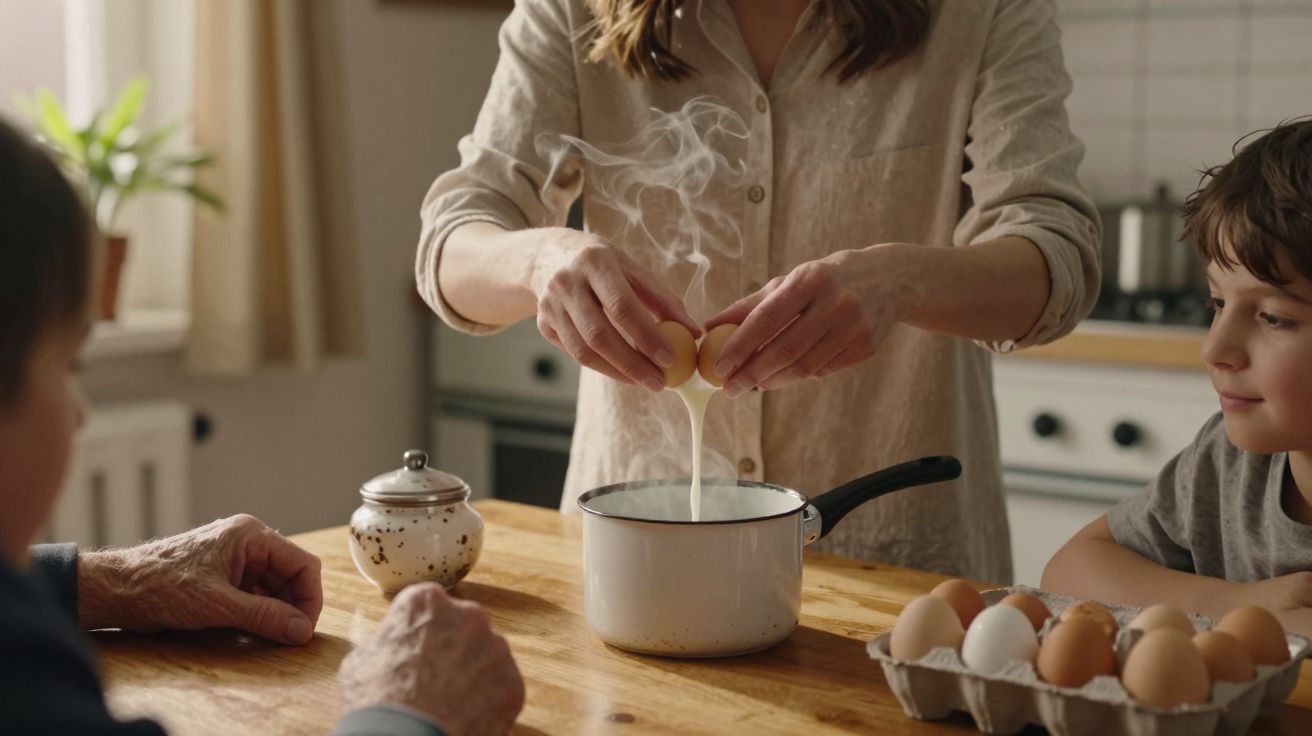
Milk is only just beginning to steam. Two eggs are beaten in a chipped mug. If there’s any sugar left in the jar, in it goes. Someone’s mum stands at the hob, testing a drop on her fingertip, trusting instinct rather than a written recipe. In some houses, that’s pudding. In others, it looks like something that’s gone wrong.
Look at social media for long enough and you’ll find the argument: eggs in milk. Some people swear it’s comfort in a bowl; others insist it’s vile; a few admit they only ever had it when the fridge was nearly bare. A plain-looking dish that, without warning, reveals who grew up learning to make every ingredient stretch - and who never had to. One recipe, two childhoods, and suddenly the conversation gets prickly.
When eggs in milk tastes like survival
There’s a quiet kind of class test hiding in a saucepan of warmed milk and beaten eggs. Ask someone, “Did you ever have eggs in milk as a dessert?” and watch what happens. Some faces soften with nostalgia. Others pull a confused expression, as if you’ve suggested sabotaging breakfast. The divide usually isn’t really about flavour - it’s about money, about class, and about what counted as a treat when there was almost nothing to work with.
For plenty of people who grew up skint, eggs in milk wasn’t a cute throwback from a cookbook. It was what you made when there was no cake, no ice cream, and no spare change - just basics and the need for something warm. You kept the heat low, stirred patiently, sweetened it if you could. That thin, hot, eggy milk might have been the only comforting thing before bed. Meanwhile, other children in the same town and the same decade thought “dessert” meant branded ice cream in a bright tub. Same country, wildly different worlds.
The dish is almost comically straightforward: warm the milk, whisk in eggs, add sugar if you have it, maybe a little vanilla if you’re lucky, and cook it until it thickens a touch. In some places it stays more like a drink; in others it edges towards a weak custard. The exact method matters less than the reason it exists: it’s built from what many struggling households could usually find - milk, eggs, and the determination to make something feel celebratory anyway. That’s why a humble bowl can feel like an accidental confession.
How families quietly hacked dessert with eggs and milk
Turning “not much” into something that feels like care has its own logic. Families who relied on eggs in milk as dessert often had a routine: warm the milk slowly so it doesn’t catch at the bottom, beat the eggs with a fork until the yolks vanish, then pour them in as a thin stream while stirring constantly so it doesn’t scramble on contact. This isn’t about making restaurant custard. It’s about not wasting a single egg.
Some households added one spoonful of sugar and called it a proper treat. Others dropped in stale bread to bulk it out, nudging it into pudding territory. Grandparents might slip in a strip of lemon peel or a pinch of cinnamon - a small, stubborn refusal to accept blandness. Children would cradle hot bowls in both hands, convincing themselves this was every bit as good as anything from the supermarket freezer. On cold evenings, belief did a lot of the heavy lifting.
And yes, it went wrong, too - and those mishaps became family folklore. Heat too high, milk boiling, eggs turning into soft curds. You still ate it, because throwing food away wasn’t part of the deal. Let’s be honest: nobody makes this every day purely because they fancy it. Parents learnt to read the steam rather than the clock. They tasted, nodded, and said, “Nearly there,” even if they were simply hoping it would come together this time. The stakes were tiny and enormous at once.
Over time, “eggs in milk” did more than fill bellies - it quietly sorted people into those who understand what it means to turn leftovers into memories, and those who don’t. When someone reacts with disgust, it often says more about distance than it does about taste. One person’s “poor kid dessert” is another person’s curiosity, like something you’d see in a food museum. The rationale is blunt: protein, fat, sugar and warmth in one cheap bowl. It isn’t fancy cooking. It’s survival wearing a sweet disguise.
Making eggs in milk today (eggs in milk), without the shame
If you want to make eggs in milk now, the basic approach is still simple. Put milk into a small saucepan (dairy, or a richer plant milk) and warm it gently until it’s steaming. In a separate bowl, beat 1–2 eggs with a fork until smooth. Add a spoon of sugar, a splash of vanilla if you like, and a small pinch of salt to lift the flavour.
Then do the crucial bit: tempering. While whisking quickly, drizzle a little of the hot milk into the eggs so they warm gradually. When the mixture looks loosened and warm, pour it back into the saucepan. Keep the heat low and stir in relaxed figure-eights. You’re aiming for a loose, drinkable custard - not scrambled eggs. The moment it lightly coats the back of a spoon, take it off the heat. Don’t let it boil. Pause, breathe in the smell, and notice what it brings back.
If people struggle with it, it’s usually for one of two reasons: they turn the heat up and rush, or they walk away “for a second”. The pan catches, the bottom burns, and the whole kitchen smells like defeat. Others go the other way and overthink it, chasing a flawless, glossy texture from a chef’s video. That isn’t the point of eggs in milk. The point is: good enough, hot enough, sweet enough - right now.
On a drained evening, it can still be a genuine act of care: for a child home late from practice, for yourself after a grim shift, for anyone who needs to feel looked after. Sometimes a steaming mug of egg-thickened milk does more than a fancy dessert you waited an hour for.
A practical note that older generations often knew without naming it: treat this like a fresh, warm dish. Use eggs and milk that smell and look right, heat it gently until the eggs are cooked through, and serve it straight away. If you want it colder, cool it quickly and chill it - but it’s at its best warm, when the comfort factor is doing most of the work.
It’s also worth saying out loud what many people learnt quietly: eggs in milk was often a way to reduce waste. Milk that was close to turning could sometimes be rescued with heat and sugar; a bit of flavouring could make it feel intentional. Today, with food prices and waste both on people’s minds again, that thriftiness can be a choice rather than a badge of shame.
“We didn’t call it ‘eggs in milk’,” a woman in her thirties once told me. “My mum would just say, ‘I’ve made you something warm.’ I only worked out years later it was our version of pudding when the money ran out.”
Behind this kind of recipe sit a few unspoken rules that many poor kids can recite without thinking:
- Never pour away milk that’s about to turn; heat and sugar can sometimes pull it back from the edge.
- Eggs are valuable, so you stretch them with more milk - and sometimes even a little water - than any cookbook would recommend.
- A dash of cheap vanilla or a pinch of spice can convince your brain it’s “dessert”, not “leftovers”.
What this “poor kid dessert” says about us now
Bring up eggs in milk online and you’ll hit a nerve. Some people answer with real tenderness: “My nan used to make this when we had nothing - I can still taste it.” Others laugh, or pull a face, without noticing how that lands on someone who sees their childhood in the saucepan. Food has always drawn invisible boundaries; this one just happens to be traced with a whisk.
There’s a strange reversal happening, too. Stylish restaurants sell versions of “deconstructed custard” and airy milk-and-egg foams for more than some families once spent on a week’s groceries. Influencers pipe it into little jars and call it minimal. Meanwhile, older readers scroll and think, quietly: we were doing that before it was fashionable - we just didn’t have a choice. Same ingredients, different stories, very different price tags.
The real question isn’t “Are eggs in milk delicious?” It’s what you hear when someone mentions them. Some people taste shame. Some taste care. Some taste absolutely nothing, because they never needed this bowl to exist. On the table it’s just pale, sweet liquid. In a life, it can be the gap between going to bed hungry and going to bed with something warm inside you.
Maybe, the next time someone says, “We used to have eggs in milk for dessert,” the kindest response isn’t “That’s grim,” but “What did it mean in your house?” Because behind that plain recipe there’s often an entire economic biography: redundancies, rent panic, inventive parents, exhausted grandparents, and children who learnt early how to make 1 litre of milk last until the end of the week. It’s messy, raw, and oddly beautiful.
| Key point | Details | Why it matters to readers |
|---|---|---|
| Basic “eggs in milk” ratio | Begin with 1 large egg per 250 ml of milk, plus 1–2 tablespoons of sugar. Warm gently until it thickens slightly. | Gives a dependable starting point, whether you’re chasing nostalgia or turning leftovers into a quick dessert. |
| How to avoid scrambled-egg lumps | Always use tempering: whisk a little hot milk into the eggs before returning the mixture to the pan, and keep the heat low while stirring constantly. | Stops the grainy, curdled texture that puts people off and keeps the dish comforting rather than disappointing. |
| Cheap ways to make it feel special | Add a pinch of cinnamon, nutmeg or cocoa; toast an old bread crust in butter and float it on top; serve it in mugs rather than bowls. | Shows how families made a “poor” recipe feel like a real treat without spending extra. |
FAQ
Is eggs in milk actually safe to eat?
Yes - provided you heat it enough for the eggs to cook through without boiling it hard. Aim for a gentle simmer where the mixture thickens and lightly coats a spoon, then drink or eat it while it’s still warm.Is this the same as custard or custard sauce?
It’s in the same family, but it’s usually simpler and more frugal. Traditional custard often uses extra yolks, sometimes cream, tighter temperature control and usually vanilla; eggs in milk is the everyday version built around what’s available.Why do some people associate this dessert with being poor?
Because it relies on basic staples many low-income households keep to hand: eggs, milk and a little sugar. If you couldn’t buy ice cream, biscuits or chocolate, eggs in milk was a cheap way to give children something sweet after a meal.Can I make a decent version with plant-based milk?
Yes. Pick a creamier option such as soya or oat, keep the same egg ratio, and consider adding a little more sugar or vanilla because some plant milks taste less rich. The texture will change slightly, but it can still feel soothing and familiar.Why does this dish trigger such strong reactions online?
Because it doesn’t only taste of eggs and milk - it tastes of childhood circumstances. People who ate it out of necessity can feel exposed when others call it “gross”, while those who never needed it may miss the emotional weight carried by a simple saucepan.



Comments
No comments yet. Be the first to comment!
Leave a Comment