
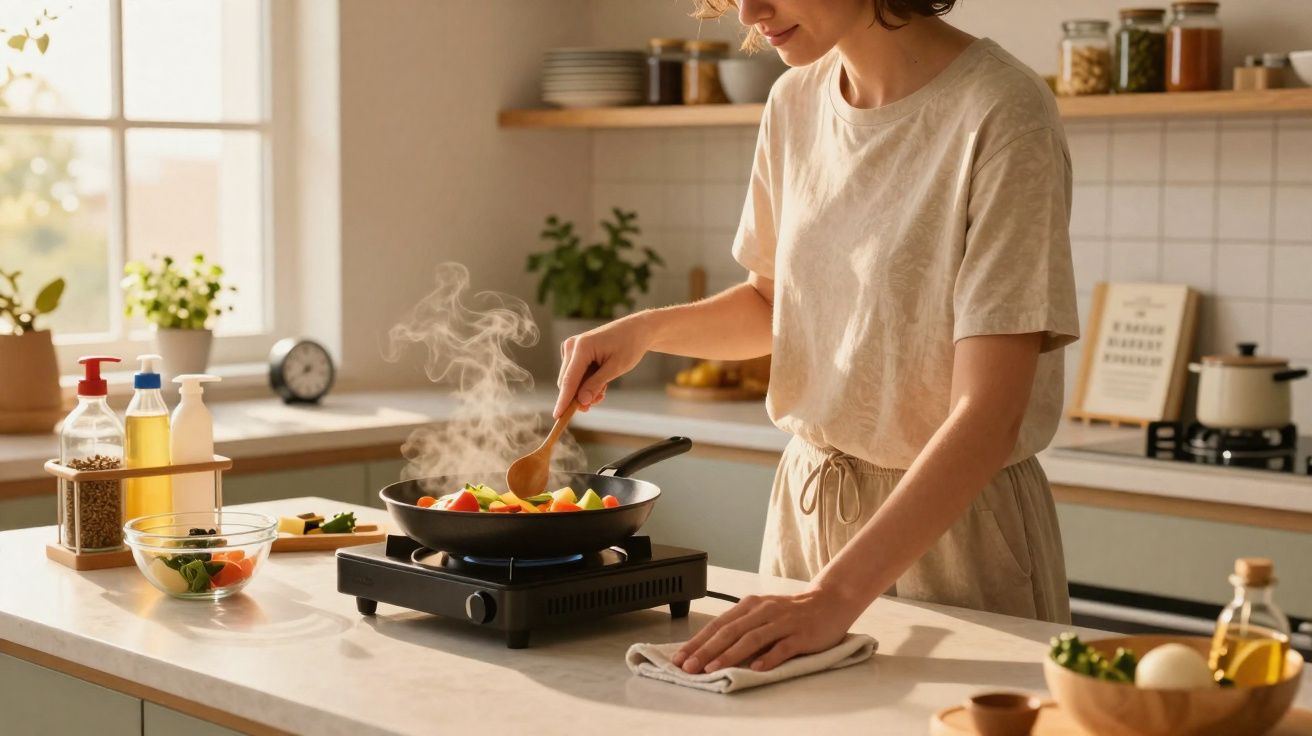
While the pasta water quivers on the hob, one hand keeps the sauce moving and the other has already swiped a fleck of tomato from the worktop. The chopping board gets a quick rinse before the onions have properly softened. And by the time dinner is dished up, the sink is oddly… empty.
Some people simply cook this way. They can’t bear the slow build-up of bowls and utensils glaring at them in the corner of their vision. Others create a brilliant meal-and leave behind a miniature disaster area. On a busy weeknight, that gap can decide whether the evening feels calm or completely draining.
Psychology has begun paying attention to this everyday pattern: cleaning while cooking. Not as a moral virtue or a character flaw, but as a small clue to how someone manages attention, stress and mental load.
What psychology notices in people who practise cleaning while cooking
If you watch someone who tidies as they go, you’ll often see a repeating cadence. They chop, sweep scraps into the bin, rinse the knife, nudge the board into the dishwasher, wipe a splash, then return to the pan. The kitchen rarely gets the chance to unravel.
This isn’t only about “being tidy”. It’s more about anticipation. These cooks register mess earlier than most-almost before it becomes obvious. Their brain doesn’t wait for the sink to fill up before acting; it prompts a small reset while the sauce bubbles and the oven warms.
A study reported in Personality and Social Psychology Bulletin compared how people felt in homes they described as cluttered versus orderly. Those who viewed their space as “cluttered” or “unfinished” showed higher cortisol levels throughout the day. In kitchen terms, the person who wipes, rinses and puts things away mid-recipe may be quietly reducing later stress without consciously deciding to.
Picture a parent making dinner while children argue in the next room. People who clean as they cook often say they can’t properly switch off if the kitchen is left in ruins. So, while the rice rests, they stack plates; as the chicken browns, they load the dishwasher. It’s not that they adore cleaning-it’s that the calm after the meal matters more than saving a couple of minutes during cooking.
Psychologists sometimes describe a low tolerance to visual noise. For certain minds, a cluttered worktop behaves like background interference: it saps energy. So they build tiny systems-sponge at the sink, bin lid open, compost bowl on standby-to reduce friction for their future self. From the outside it looks like simple tidying; up close it can be a quiet form of emotional self-protection.
There’s also a practical side that’s easy to overlook: keeping surfaces clear can make cooking feel safer and smoother. A wiped-up spill is one less slippery patch; a rinsed knife is one less sharp object lost under peelings. The psychology and the practicality often reinforce each other.
The distinctive traits behind the cleaning while cooking habit in the kitchen
People who clean mid-recipe often share a set of tendencies that goes beyond liking a gleaming worktop. A key one is prospective thinking: they naturally picture what the kitchen will look and feel like in 20 minutes, and that imagined future is vivid enough to shape what they do now.
Another common thread is conscientiousness. Research linking household order with personality suggests that those who score higher on conscientiousness often keep steadier routines-whether that’s laundry, meal prep or general organisation. In the kitchen it can show up as an internal checklist: peel, chop, pan, rinse, put away. They don’t need to write it down; the sequence is built into their movements.
At a subtler level, many of these cooks experience control as calming. Life beyond the kitchen might be hurried, uncertain or loud. Managing a small 8 m² space offers a pocket of clarity. The sponge, the tap and the knife respond immediately to their actions; the feedback is instant and satisfying. This isn’t “magazine perfectionism”. It’s more like having a reliable grip on something.
There’s a social dimension too. In surveys about household habits, people who clean while cooking often mention not wanting someone else to deal with their mess. They imagine the moment a partner or flatmate walks in after dinner. A clear worktop becomes a quiet message: I’ve taken responsibility. In that sense, soap and suds can be a form of consideration and fairness.
How to borrow the best of cleaning while cooking (without becoming obsessive)
If tidying as you go isn’t your default setting, you can still adopt the most useful parts.
Start with a single, concrete change: create a mess station. Use one large bowl or tray as the landing zone for peelings, wrappers and used spoons. Instead of spreading chaos across every surface, you keep it contained in one obvious spot.
Then link cleaning to waiting time. Nearly every recipe includes pauses: water coming up to the boil, a pan heating, the oven ticking down a few minutes, a sauce reducing. Use those 30–90 seconds deliberately. Rinse two items. Wipe one splatter. Put one ingredient back in the cupboard. Small, specific actions teach your brain that “waiting time = reset time”, and the habit builds with surprisingly little effort.
People who tidy while they cook rarely announce, “Now I will do the cleaning part.” It merges into the cooking. You can copy that by using simple anchors: - the knife never sits dirty on the board; - the bin stays open while you chop; - handles are turned safely and the area is wiped when you turn the heat down.
The aim isn’t sainthood-it’s a smoother rhythm that makes cooking feel lighter.
One caution: it’s easy to turn the kitchen into a stage for self-judgement. If you compare your reality to pristine social media kitchens, a single pan drying on the rack can feel like failure. That inner critic will kill the pleasure of cooking faster than any burnt toast. On a Tuesday night after work, feeding yourself is already a win.
Let’s be honest: nobody truly keeps this up every single day. Even the most organised person has evenings when the sink becomes a quiet mountain reserved for “tomorrow”. The point isn’t to win an imaginary cleanliness competition. It’s to test a few small shifts that make the end of your day feel less heavy-not more rule-bound.
On a practical level, the biggest mistake is aiming for a total makeover. Going from “everything everywhere” to “hotel kitchen” in a week is a fast route to giving up. Choose one recurring frustration-grease on the hob, a pile of chopping boards, knives disappearing under vegetable scraps-and design one tiny response for that issue alone.
“My sink used to look like a crime scene after every meal,” laughs Laura, 34, who cooks for three children. “I began by washing only the knives before we sat down. That was all. A month later I noticed half the kitchen was already reset before pudding. It felt like magic, but it was really just tiny habits adding up.”
It can also help to frame this as self-care rather than housework. A few anchors keep that mindset clear: - Define your “good enough” kitchen for weekdays versus weekends-different days can have different standards. - Outsource future stress: anything you rinse now becomes one less decision for your tired, post-dinner self. - Use music, podcasts or a phone call to turn short cleaning bursts into entertainment or connection. - Protect one clean surface as mental “breathing space”, even if the rest of the kitchen is still mid-chaos.
A final angle worth considering is sustainability and waste: a dedicated compost bowl and a quick rinse of reusable items can reduce lingering smells and make it easier to sort recycling without it piling up. For some people, that environmental clarity adds another layer of calm to the routine.
What this tiny habit quietly suggests about you
People who clean while cooking aren’t “better adults” than those who don’t. Most of the time, they’re simply more sensitive to future overwhelm. Their mind runs a low-level calculation in the background: How tired will I be later? What can I make easier now? In that sense, it’s a small kindness to their future self-written with a dishcloth.
At a deeper level, psychology suggests this habit often combines structure with flexibility. These cooks may like order, but they aren’t necessarily rigid. They can spill, improvise, change the recipe halfway through-then fold that unpredictability back into a system that still leaves the kitchen breathable at the end. In a world that can feel uncertain, that small island of predictability brings genuine relief.
On a Sunday night, with the last pan still warm and plates stacked to dry, the difference shows up in the body. One person walks away slightly tense, already thinking about the clean-up waiting later. Another switches off the light and the kitchen feels like an exhale. Many of us have had that moment when a small habit change reveals just how much mental weight we were carrying without realising.
Next time you cook alongside someone, notice their rhythm. Do they move in loops, erasing traces as they go? Or do they let the mess expand and clear it in one concentrated sweep at the end? Your sweet spot is usually somewhere between those extremes. The goal isn’t a showroom kitchen-it’s a way of cooking that respects your energy and your mind.
| Key point | Details | Why it matters to readers |
|---|---|---|
| Use “waiting time” as cleaning time | Turn every pause in the recipe (water boiling, oven preheating, sauce reducing) into a mini-task: rinse two items, wipe a ring on the hob, put one ingredient back in the cupboard. | Converts dead time into progress, so by the time you eat, most of the mess is already handled and the clean-up doesn’t feel overwhelming. |
| Create a single “mess station” | Keep one large bowl or tray for all peelings, wrappers and used utensils. Empty it in one go instead of scattering scraps and packaging across the whole workspace. | Makes the kitchen look instantly calmer, simplifies wiping down surfaces, and lowers the visual stress many people feel in cluttered spaces. |
| Design one non‑negotiable micro‑habit | Pick a simple rule such as “knives are always washed before I eat” or “the sink is cleared of food scraps before I leave the kitchen”. Keep it small and realistic. | Builds a sense of control and consistency without demanding perfection, which is easier to stick to on busy days and slowly reshapes your routine. |
FAQ
Does cleaning while cooking mean I’m a perfectionist?
Not necessarily. Many people who tidy as they go are less focused on flawlessness and more focused on reducing future stress. They like knowing they can rest after the meal without facing a mountain of washing-up.Can I learn this habit if I’ve always been messy in the kitchen?
Yes-especially if you build it in small steps. Begin with one or two actions, such as keeping a mess station on the worktop or rinsing the chopping board straight away. When those feel automatic, add another layer without it feeling like a personality overhaul.Is there any mental health benefit to a cleaner kitchen?
Studies link visual clutter with higher perceived stress and mental fatigue. A kitchen that doesn’t explode every time you cook can make weeknights feel less draining and create a calmer transition from “doing” to “resting”.What if cleaning while I cook kills my creativity?
Some people do feel freer when they let things sprawl during the creative part, particularly with more elaborate dishes. A compromise is to cook “big and messy”, then do one short reset phase while something is in the oven so you still finish in a manageable place.How do I handle this if my partner has totally different habits?
Rather than arguing about who is “right”, discuss what each of you finds stressful: the pile of pans, the sticky worktop, late-night scrubbing. Agree on two or three shared standards and split tasks around those so both of you feel respected.
Comments
No comments yet. Be the first to comment!
Leave a Comment