
Opening the fridge can feel delightfully innocent-until you’re met with a patch of green mould on the cheese. Your stomach drops, the knife pauses mid-air, and the question lands: do you cut off “just the nasty bit”, or do you throw the lot away?
In the supermarket, blocks of Cheddar sit alongside oozy Brie and blue-veined Roquefort, and it’s tempting to treat them all the same the moment mould appears. A cheesemonger wouldn’t. They know a speck on Parmesan is a very different situation from a softened Camembert-and that distinction is where things get genuinely useful.
Why hard cheese resists mould better than soft cheese
Picture a hefty, tightly packed block of mature Cheddar on your chopping board. The rind is firm, the surface is dry, and the interior is dense. If mould shows up, it’s had to work hard just to get established.
Hard cheese behaves a bit like a stone wall: not completely impenetrable, but difficult for unwanted organisms to push deep into. Soft cheese is closer to a sponge-moist, delicate, and full of tiny gaps where microorganisms can slip in, hide, and multiply. That means a small spot you can see on the surface may only be the visible end of a much larger, unseen spread.
Now imagine a fuzzy bloom of blue-green mould on a slice of Gouda. It looks obvious and localised, so you cut out a generous cube around it and the rest appears spotless-yellow, clean, and reassuring. Your brain says, “That’ll do,” and the knife keeps moving. Under a microscope, though, microbiologists don’t see a neat, isolated dot. They see filaments called hyphae, which thread through food like roots through soil.
In hard cheese, those hyphae are slowed, disrupted, and held back by density. In soft cheese, they move with far less resistance, helped along by the higher water content as if travelling on a motorway.
The key difference isn’t what it looks like-it’s how the cheese is built. Hard cheeses such as Parmesan, Grana Padano, or a well-aged Emmental tend to have lower moisture, more salt, and a tighter protein structure. This reduces water activity, which is one of the main factors that makes it difficult for moulds and bacteria to thrive.
Soft cheeses such as Brie, Camembert, or fresh goat’s cheese are wetter, creamier, and more “open” internally. Once spores land, growth can move both outward and inward quickly. With a hard cheese, removing at least 2.5 cm around and below the visible spot can genuinely remove the contaminated area. With a soft cheese, the same trim often removes only what you can see-while leaving behind what you can’t.
Mouldy cheese rescue: how to save hard cheese safely (and when to throw it away)
Start by identifying what you’re dealing with. If it’s hard or semi-hard cheese-a block of Cheddar, Gruyère, Comté, Manchego, Parmesan-a small patch of surface mould usually isn’t the end of the story.
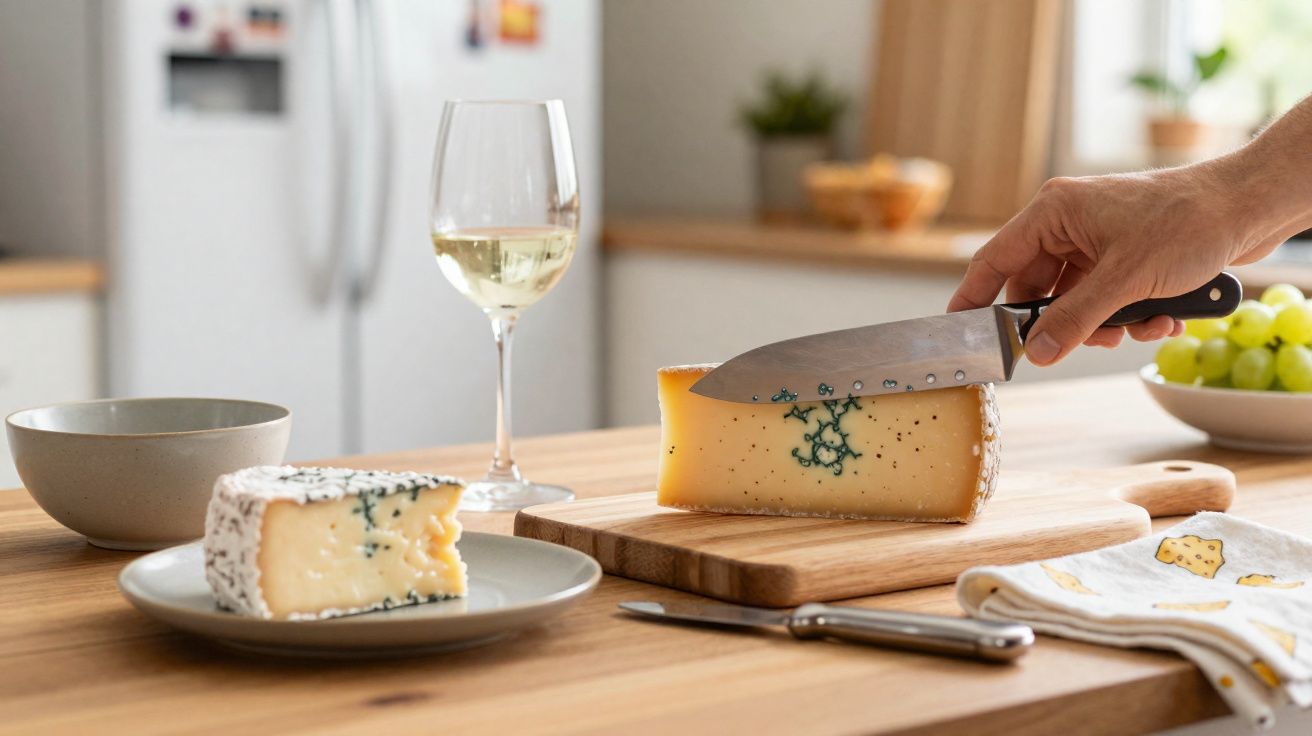
Place it on a clean board, use a sharp knife (ideally long enough to cut cleanly), and remove at least 2.5 cm all the way around the mould and 2.5 cm below it. One detail really matters: don’t slice through the mould and then drag the blade into the “clean” area. Think of it like cutting a stain out of fabric, not scraping off an ugly corner. Once removed, rewrap the remaining cheese in fresh parchment paper or breathable cheese paper, and store it in a colder part of the fridge.
Soft cheese needs a completely different approach. If you see unexpected mould on Brie, cream cheese, ricotta, fresh mozzarella, or a spreadable goat’s cheese that wasn’t mouldy to begin with, treat it as finished. Trimming feels reassuring, but it’s a false sense of safety: the hidden hyphae may already be throughout the interior, sometimes accompanied by mycotoxins. Some moulds on soft cheese can produce these toxins, and they can extend beyond the visible growth.
That’s why food safety guidance is consistent: soft cheese with unwanted mould should be discarded entirely. In day-to-day life, people don’t always follow that instinctively-but it’s the rule that prevents unpleasant surprises.
Professionals often describe cheese as a controlled ecosystem-until it stops being controlled. The moulds intentionally used for blue cheese or the white rind on Brie are selected, managed, and monitored. Random green fuzz on leftover Camembert isn’t part of that design. Once unwanted mould appears on soft cheese, the balance has shifted and the interior can become a playground for microorganisms.
Hard cheeses still have protective hurdles: salt, low moisture, and compact structure. That’s why you can sometimes salvage a corner of mouldy Parmesan, but you shouldn’t try to “be brave” with a mouldy tub of cream cheese-even if binning it feels painful.
A quick note on who should be extra cautious with mouldy cheese
If someone in your household is pregnant, elderly, immunocompromised, or very young, it’s sensible to be stricter than average. Even when guidance says hard cheese can be trimmed and kept, taking the cautious route (discarding it if you’re uncertain) can be the better choice for higher-risk groups.
Keeping cheese safe for longer (without becoming paranoid)
Storage quietly determines how long cheese stays in good condition. Hard cheeses do best with a little breathing room: wrap in parchment paper or proper cheese paper, then place in a loosely closed container or bag. This helps prevent condensation-the tiny “internal drizzle” that encourages mould to colonise surfaces.
Soft cheeses prefer a stable, cold environment at around 4 °C, kept in their original packaging or lightly rewrapped so they don’t dry out, and not squashed at the back of the salad drawer. Don’t leave them sitting out for long after serving: on a warm day, two hours at room temperature is already a long time for a creamy Brie. Once a cheese is cut, it won’t last as long, because every slice increases the exposed surface area where airborne spores can settle.
Many households also have a “miscellaneous” cheese drawer: an overripe Camembert next to an opened bag of grated Emmental and a half-dried block of feta. It’s convenient, but it’s also a great way to create a miniature microbial jungle. Keep very moist or strongly scented cheeses separate where possible, ideally in their own containers.
And if shredded cheese shows mould, don’t negotiate with it-discard it immediately, even if the patch looks small. Shredded cheese has huge surface area, and mould can move rapidly between pieces. Being careful here isn’t perfectionism; it’s practical sense in the confined environment of a fridge.
One more useful habit: if you’ve had mould issues, wash reusable cheese boxes and the fridge shelf with hot soapy water, then dry thoroughly. It won’t sterilise your kitchen (nor does it need to), but it reduces the number of spores waiting to land on the next piece you store.
“Hard cheeses give you a second chance. Soft cheeses rarely do. Your knife can fix a block of Parmesan, but it won’t rewrite the biology of a mouldy Brie.”
When mould appears, a simple mental checklist avoids drama: what type of cheese is it, what does the mould look like, and where is it? If the cheese is hard or semi-hard, the mould is clearly localised, and it isn’t black or unusually dark, then cutting widely and deeply can be an acceptable rescue plan. If the cheese is soft, spreadable, shredded, or pre-sliced, a mould spot generally means everything shares the same outcome.
That slightly miserable moment of throwing cheese away can also be a nudge to buy smaller amounts, or to bring forward that cheese night rather than letting things linger.
- Hard/semi-hard cheese + small surface mould = cut at least 2.5 cm around and below, rewrap, keep cold.
- Soft/fresh/shredded cheese + any unwanted mould = discard the entire product; no trimming.
- Recognised edible rind (Brie, Camembert, blue veins) = normal and intended as part of the cheese.
The odd reassurance hiding in a mouldy corner of cheese
There’s a quiet lesson in that anxious stare at a mouldy block. Food safety advice can feel strict, cold, and occasionally over the top-but it draws boundaries your eyes can’t detect. Once you understand why a hard cheese can sometimes be saved while a soft one can’t, you regain a sense of control.
You’re no longer following a random rule: you’re responding to the food’s structure. When you start seeing cheese as a landscape shaped by water, salt, and texture-deciding what can grow, where, and how fast-it’s difficult to go back to guessing.
Next time you hesitate between bin and knife, you’ll remember how far mould can travel through a creamy paste, and how much it struggles inside a dense, crumbly block. You may buy a smaller wedge of Brie, or wrap your Parmesan more carefully-not out of fear, but out of understanding. You might even talk a friend out of scraping mould off cream cheese, because it isn’t a handy DIY fix-it’s a genuine risk.
And that small conversation, shared over a glass of wine and a half-finished cheeseboard, may stick more than any leaflet ever could. Because, in the end, what we choose to keep or throw away in our fridges says a lot about whether we listen to the microscopic life around us-or pretend it isn’t there.
| Key point | Detail | Why it matters to you |
|---|---|---|
| Cheese structure | Hard cheese = dense, low moisture; soft cheese = moist, open texture | Helps explain why some cheeses can be salvaged while others cannot |
| How mould spreads | Hyphae spread widely in soft cheeses, but stay more localised in hard cheeses | Lowers the chance of consuming invisible toxins |
| Practical actions | Cut 2.5 cm around mould on hard cheese; discard mouldy soft cheese entirely | Lets you apply the right response immediately in your own kitchen |
FAQ
Can I eat the mould on Brie or Camembert?
The white, fluffy rind on Brie and Camembert is a controlled, edible mould that is safe and intended. Random green, black, or pink spots that appear later are not part of the process and mean the cheese should be discarded.How much should I cut off a mouldy hard cheese?
Food safety guidance recommends cutting at least 2.5 cm around and below the visible mould, and avoiding dragging the knife through the mould into the “clean” portion.Is blue cheese mould different from “bad” mould?
Yes. The blue or green veining in blue cheese comes from specific, selected Penicillium cultures added on purpose. Random surface mould that appears later-especially if fuzzy-is unwanted and the cheese should be thrown away.What about mould on shredded cheese or sliced cheese?
If mould is visible on shredded or pre-sliced cheese, the whole pack should be treated as contaminated. Mould can spread quickly between pieces, so trimming one area isn’t considered safe.Does freezing cheese stop mould growth?
Freezing halts mould growth while the cheese remains frozen, but it doesn’t reliably destroy all spores. Once thawed, the same contamination problems can return-and the texture of many cheeses, especially soft ones, may deteriorate.




Comments
No comments yet. Be the first to comment!
Leave a Comment