
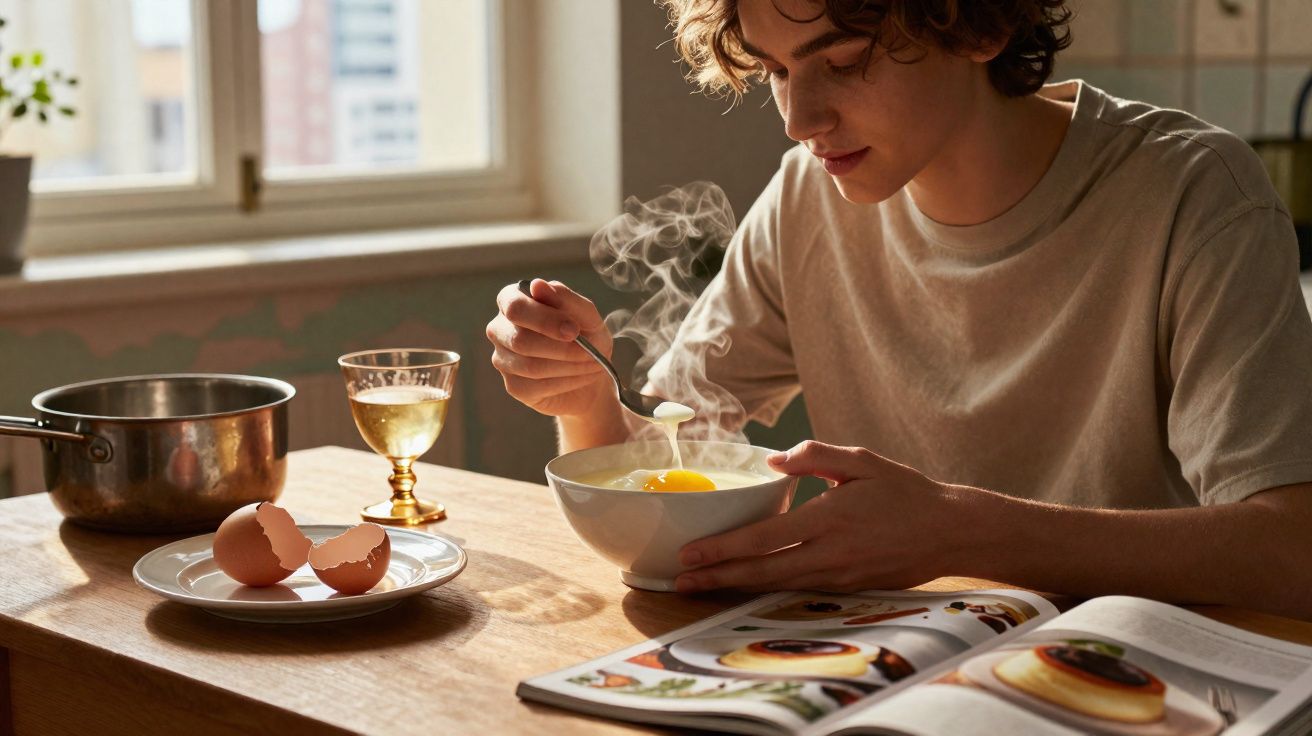
On the middle shelf: three eggs. In the fridge door: the last splash of milk. Not much else to speak of. So you pour, whisk, sweeten and warm it, and within ten minutes a small, steaming bowl lands on the table like a quiet plaster on the day.
This dessert goes by a hundred names depending on where you grew up-or sometimes no name at all. Eggs in milk. Milk with eggs. Egg custard without a crust. A “lazy” flan made when you cannot face anything complicated. In some homes it’s a grandmother’s comfort; in others it’s a month-end fallback. Identical method, two very different wallets.
On the surface it’s simple sweetness. Underneath, it carries stories about getting through a cost-of-living squeeze, the price of the weekly shop, and the low-level fear of running out. All of that, held in one hot bowl you can cradle in your hands.
When a poor man’s dessert ends up on rich tables
Across Europe, eggs in milk was once what you made when the cupboard was bare. One pan, one spoon, one bowl. Inexpensive protein, easy calories, and-if fortune smiled-a trace of vanilla. These days, the same base turns up in fashionable restaurants rebadged as “heritage baked custard” or “farmhouse egg pot”, finished with burnt sugar, berries and a confident price tag of about £10–£12 a portion.
The ingredients have not meaningfully shifted. The surroundings have. A dessert that began as a way to cope has climbed the social ladder without anyone announcing it. Where some diners call it “minimalist comfort”, others simply call it Tuesday.
In Lisbon, I met Ana, a single mum with two children, who makes eggs in milk three times a week. She beats two eggs with sugar, ekes out the last litre of milk, and bakes it in chipped ramekins her sister passed on. “It fills them up,” she told me, “and then they sleep.” She laughs at the photos of the same dish in glossy magazines, sprinkled with pistachios and orange zest and labelled “rustic”. Her version costs around €0.40 a serving (roughly 35p). The magazine version comes in nearer €4 (about £3.40).
A couple of districts away, a new bistro serves a “deconstructed flan” with raw cream and free-range yolks, and the chef posts a slow-motion wobble online. People respond with adoration and appetite. It tastes familiar because it is familiar-only dressed up with better lighting and copper pans. The two worlds rarely meet anywhere except on a feed.
Food has always been performance; lately, though, the backstage is harder to ignore. With grocery bills rising, eggs in milk becomes a small, telling marker of class. For households under strain, it stretches the week and keeps stomachs from going empty. For wealthier diners, it becomes an aesthetic of restraint-a way of signalling “I value essentials” without ever being forced to rely on them. One bowl, two narratives about security and fear, overlapping without touching.
How eggs in milk becomes an economic X‑ray
In theory, eggs in milk is simply kitchen science. Egg proteins set in hot liquid, sugar rounds out the sharp edges, and a pinch of salt makes the flavour clearer. In practice, the pan on the hob can read like an X-ray of a household budget. When money is tight, dessert has to be cheap, reliable and filling: three ingredients, minimal waste, no specialist equipment that can break, scorch or drain the meter.
Set that beside the “same” dessert in a high-end dining room. Pasture-raised eggs at several times the price, milk from a smallholding, ethically sourced vanilla, branded cane sugar. Each upgrade adds cost, and it also adds status. For some diners, paying more is not only about flavour; it is about buying the story attached to the bowl, plus the room and service that come with it.
The differences show up in tiny decisions. If you have spare money, you might separate yolks and whites, discard what you do not need, and chase a particular silkiness. If you are counting coins, you use whole eggs-every time. Even the cookware becomes a clue: a bain-marie, thick ceramic and a temperature probe in one postcode; a dented aluminium pan that catches at the bottom in another. Same dessert on paper, different planet in real life. When a recipe survives every financial storm, it turns into a quiet archive of inequality.
Turning a survival dessert into an honest pleasure (eggs in milk, custard, flan)
If you want to make eggs in milk the “tight budget, good sense” way, use a ratio that behaves: 1 egg to 200 ml of milk. For a small family, 4 eggs and 800 ml of milk makes a generous dish. Beat the eggs with 70–80 g of sugar, a pinch of salt, and a dash of vanilla or a little lemon zest if you have it. You are not chasing perfection; you are chasing warmth.
Heat the milk until it is just about to boil, then pour it into the eggs in a slow stream while whisking. That step keeps the mixture smooth instead of turning it into bits of scrambled egg. Tip it into a shallow ovenproof dish, sit that dish in a larger tray half-filled with hot water, and bake on a low temperature until it is set at the edges but still trembles in the centre. That wobble is the point.
You do not need cream, fancy moulds or a blowtorch. A simple spoon check is enough: dip into the middle and see whether the custard lightly coats it. As it cools, it will firm up on its own. Warm, it feels like a hug; cold from the fridge the next morning, it can pass for something you might buy from a bakery.
Two extra things matter more than most recipes admit: resting time and portioning. Leave the custard to settle for 10–15 minutes after cooking; the texture becomes calmer and the sweetness feels less sharp. And if you are cooking for children (or for yourself after a rough shift), serving it in small glasses can turn “basic” ingredients into something that feels intentionally made.
There is also a practical, unglamorous side: energy use. When electricity is expensive, the oven can be a luxury. A gentle hob method-very low heat, steady stirring, stopping as soon as it thickens-often costs less to run, and it is easier to control if your oven temperature swings.
The classic pitfalls of this dessert mirror the money gap in odd ways. In comfortable kitchens, people tend to fuss: extra yolks, extra sugar, toppings that bury the point. In pressured kitchens, the opposite happens: heat gets rushed, resting is skipped, and the bottom catches because something else demanded attention.
Keep the heat kind. Medium-low is your insurance policy, even if it adds ten minutes. If your oven cannot hold steady, use the simplest cue: bake until the edges look firm and the centre still shivers slightly when you nudge the dish. Do not stress about a few bubbles or light cracking. This is not for a photoshoot; it is for your table.
Let’s be honest: nobody makes this every single day. Some evenings you will microwave instant pudding, or eat a couple of biscuits standing by the sink. That is normal. When you do have ten quiet minutes for eggs in milk, make them matter: taste the spoon, adjust the sugar, and let the recipe fit your life rather than a chef’s television version.
“My grandmother’s custard was never perfectly smooth,” a London reader told me. “It had bubbles, sometimes a skin on top, and we scraped the burnt edges with our spoons. We were poor, but I only understood that later. Back then, I just thought love tasted of vanilla and slightly overcooked milk.”
Behind this modest dessert are a handful of concrete choices that can change the result, even on a tight budget:
- If you can, use eggs at room temperature: they combine more easily and cook more evenly.
- Flavour cleverly: a strip of lemon peel or a teaspoon of budget instant coffee can make it feel unexpectedly luxurious.
- If energy costs are biting, make it on the hob rather than baking: keep the heat very low, stir constantly, and stop when it coats the back of a spoon.
- For children, serve it in small glasses so each portion looks “special”, even when the ingredients are plain.
| Key point | Details | Why it matters to readers |
|---|---|---|
| Real cost per serving | Using supermarket eggs and milk, a basic bowl of eggs in milk works out at roughly €0.30–€0.60 per person (about 25p–50p), depending on sugar and flavourings. | Offers a concrete idea of how this dessert can stretch a tight budget without feeling like a downgrade. |
| Time and fuel investment | Hands-on time is under 10 minutes; cooking is 20–35 minutes in the oven or 10–15 minutes on the hob over low heat. | Helps weigh up comfort against rising energy costs and busy evenings, especially for families balancing work and caring. |
| “Poor” vs “gourmet” versions | A frugal version uses whole eggs, standard milk and basic sugar; an upscale one adds cream, premium eggs, real vanilla and toppings such as caramel shards or nuts. | Makes the class divide visible and invites readers to pick the version that matches their budget-without shame. |
What this humble bowl quietly says about us
There is something almost unsettling about how comforting eggs in milk can be, given how little it requires. While the news cycles through inflation, rent rises and precarious work, millions of people are still whisking the same mixture in small kitchens. It does not fix anything, but it creates a pocket of pleasure you can control, in lives where much feels uncontrollable.
In better-off homes, the identical bowl plays a different part. It becomes a badge of “back to basics”-a reaction against years of maximalist desserts and endless options. Less sugar, more meaning. The twist is that for people who never had those choices, “basics” are not a fashion. They are the default.
Recipes move faster than ever, but the conditions they land in change from door to door. When a fine-dining room redesigns a poor person’s dish, it is not always theft; it can be tribute, or simply ignorance. The strain begins when the original context is erased. If you have never skipped your own meal so your children could eat, eggs in milk will always taste different to you.
This is not only about money; it is about the language we use around food. Lifestyle media celebrates “simple ingredients” while rarely admitting that for many households there are no alternatives. Social platforms reward the smoothest custard, the most flawless surface, the most golden top. They do not often show the pan that stuck, eaten quietly after a late shift. Yet both versions are real, at the same time, on neighbouring streets.
Sharing a recipe like this can do two things. It can flatten everything into “everyone loves comfort food”, or it can open a gentler conversation about who gets comfort-and what it costs. The next time you whisk eggs into warm milk, you might think of Ana’s chipped ramekins, the restaurant’s polished copper pans, and your own place somewhere between. That small bowl is not just dessert; it is a soft, steaming question about the society we are building, and who gets to feel full.
FAQ
Is eggs in milk actually safe to eat, especially if it’s very soft?
If you heat the mixture until it thickens and reaches at least a gentle simmer, the eggs are cooked and safe for most people. The centre can remain slightly wobbly without being raw; what matters is keeping it hot long enough for the proteins to set rather than staying liquid.Can I make a decent version if I only have a microwave?
Yes, in small portions. Whisk egg, milk and sugar in a mug, then cook on medium power in 20–30 second bursts, stirring frequently. Stop the moment it lightly coats a spoon; if you go too far, it can turn grainy quickly.Why does my custard sometimes come out full of bubbles or with a thick skin?
That is usually caused by cooking it too hot or too long, or by whisking lots of air into the eggs. Use lower heat and gentler mixing; if a skin forms, some people lift it off and eat it as a separate, slightly chewy treat.How do restaurants justify charging so much for such a basic dessert?
They price in service, rent and wages, alongside pricier ingredients and presentation. Part of what you pay for is the setting and the story, even when the underlying recipe is very close to what you could make at home.Is there a way to make this dessert lighter or more “healthy” without losing the comfort?
Reduce the sugar slightly, use semi-skimmed milk, and lean on strong flavours-coffee, citrus or warming spices-so it still feels indulgent. The texture will be a touch less rich, but the sweetness and warmth remain.




Comments
No comments yet. Be the first to comment!
Leave a Comment