
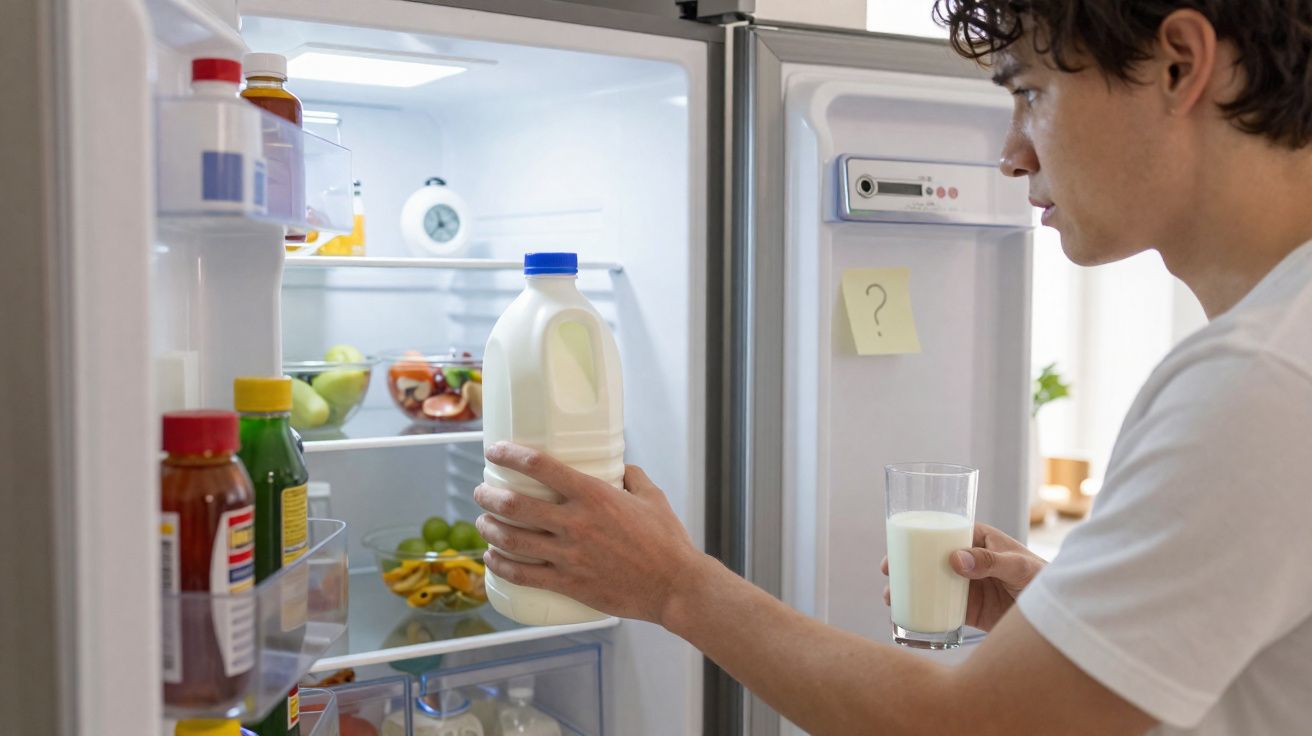
The door swings open. A strip of cold light floods the kitchen, and a carton of milk sits in its plastic cradle on the fridge door like it’s under a spotlight. One person snatches the juice, another rummages for ketchup, and the fridge starts beeping because it’s been left open too long. The milk stays put, quietly taking every gust of warm air.
The next morning, it smells… not quite right. Not awful, just off.
On a frantic weekday you’ll blame the supermarket. On a lazy Sunday you might suspect the fridge is on its last legs. What you almost never blame is that “perfectly designed” door shelf with its neat little rails.
Yet that door-the place that looks made for milk-is often shortening its life without you realising.
Why your fridge door is secretly hostile to milk
Spend one evening in a busy family kitchen and you’ll see it: the fridge door is the most used part of the whole appliance. It opens for a snack, it opens for a quick look, it opens because someone forgot what they were searching for. Every time it happens, cold air spills out and warmer room air surges in-right where the milk is sitting.
It’s tempting to think of the fridge as one evenly chilled box. In reality, temperatures vary. The fridge door is typically the warmest and most changeable area, and milk is one of the most temperature-sensitive foods you can store. Put those two truths together and the common habit of keeping milk in the door starts to look like slow, everyday self-sabotage.
A UK household survey found many people open their fridge around 30 to 60 times a day. Now picture your milk parked in the most exposed spot, getting a little temperature nudge every single time: you add a dash to coffee, the kids grab a yoghurt, someone stands staring inside deciding what to cook. The compressor can’t correct instantly, so the door shelf warms slightly, cools again, then warms again.
That isn’t steady storage. It’s a roller coaster.
Food safety laboratories track this with temperature data loggers. A common finding is that door shelves can rise by several degrees Celsius above the main compartment during busy periods. You won’t necessarily feel anything dramatic when you touch the carton.
But the bacteria inside the milk absolutely will.
Milk is, from a microbe’s point of view, a comfortable all-inclusive: water, sugars, proteins, and time. Refrigeration slows bacterial growth-it doesn’t stop it. When bacteria get repeated short bursts of warmth (even brief ones), the fastest growers benefit most. Each warmer spell speeds up multiplication, and the bacteria don’t “give back” that growth when the milk cools down again.
The impact adds up over time, like compound interest in the worst possible account.
That’s how two identical cartons, bought on the same day, can have very different lifespans depending on where you keep them. The one stored in the fridge door can sour a couple of days earlier than the one kept on a colder, steadier shelf. It’s not superstition; it’s microbiology responding to your routine. You don’t see the growth curve-you just sniff and call it “bad luck”.
Milk storage in the fridge: how to make it actually last
The most effective change is bluntly simple: take the milk off the fridge door and put it on a main shelf, towards the back. Not right at the front, not half hanging out-further in, away from the direct blast of warm air each time the door opens.
If your fridge has a middle shelf, it’s often a good balance: a stable temperature and still easy to reach.
Make it easy for the “future you”. Put the milk somewhere your hand naturally goes when you open the fridge, but inside the main compartment rather than in the door shelf. The goal is to remove friction, not create a daily battle. Many households find it helps to define a consistent milk zone-back right or back left-so the habit becomes automatic.
Once the milk is opened, seal it properly every time. No half-turn cap, no “I’ll tighten it later”. Tiny gaps allow oxygen and airborne microbes to get in, and that doesn’t help freshness.
If you usually buy large bottles, it’s also worth asking a practical question: does your household genuinely finish them before the use-by date once they’re stored correctly? Sometimes choosing smaller containers isn’t a marketing trick at all-it’s a straightforward freshness strategy.
The classic trap is trusting the door layout because it looks designed for bottles. In a way, it is-just not for the most delicate ones like fresh milk. Condiments, pasteurised juices, mustard, and soft drinks tolerate that warm-and-wobbly zone far better. Milk is more like that friend who always needs an extra layer.
Another common issue is leaving milk on the table during long breakfasts or slow coffee chats. Those 20–30 minutes at room temperature push bacterial growth forward each time. Then the bottle goes straight back into the slightly warmer fridge door, and the cycle speeds up. Realistically, nobody returns milk to the fridge to the second, every day-but shaving down that room-temperature time still makes a difference.
Some people also put too much faith in the sniff test. Smell is a late-stage warning. By the time you’re thinking, “That’s borderline,” bacterial levels may already be far above what food safety professionals would consider acceptable-especially for babies, older people, pregnant women, or anyone with a weakened immune system.
“The door is the refrigerator’s mood swing,” one food safety specialist jokes. “If you care about how long something stays safe, keep it away from the mood swings.”
Quick checklist (that actually works in real life)
- Move milk off the door - Keep it on a main shelf, ideally towards the back.
- Limit time at room temperature - During long meals, return it to the fridge between uses.
- Use a fridge thermometer - Aim for about 4°C (around 39°F) in the main zone.
- Rotate smartly - Put the oldest milk at the front of your milk zone, newest behind it.
- Treat sniffing as a last check - Not your main safety strategy.
The emotional side of a “simple” fridge habit
We rarely talk about milk going off, yet it’s one of those small household frustrations that can set the tone for a day. You reach for that morning splash, the smell is wrong, and suddenly you’re improvising: black coffee, dry pancakes, annoyed kids. If money is tight, throwing away half a bottle doesn’t feel like a minor inconvenience-it feels like a waste you can’t afford.
At a deeper level, wasted milk is often a quiet signal that your kitchen habits and your food storage aren’t in sync. Nothing dramatic-just a persistent background irritation. That’s why such a small tweak-moving the bottle, reducing how long it sits out-can feel oddly satisfying. The kitchen starts running a bit more smoothly.
And on a busy week, nobody wants a long set of rules taped to the fridge. Tiny changes that are almost invisible tend to stick. Shifting milk from the fridge door to a main shelf takes seconds and doesn’t require daily willpower-just a one-off decision that your household can follow on autopilot.
On a Sunday, you might go further: rethink what genuinely belongs in the door, and nudge friends, teenagers, or housemates not to park milk there “because it’s easier”. In a shared flat, a quick chat about basic fridge etiquette can prevent the classic moment when someone sniffs the carton, turns around, and silently asks: Who did this?
Two extra habits that protect milk (and the rest of your food)
A steadier temperature helps, but it isn’t the only factor. Don’t overpack the fridge, especially around the back wall: cold air needs to circulate to keep your milk zone consistently chilled. If items are jammed in tight, you can create warm pockets-even on a main shelf.
It also pays to keep the fridge functioning properly. Check the door seals (gaskets) for gaps and wipe them clean; damaged or dirty seals let warmer air seep in and force the fridge to work harder. A quick clean and an occasional seal check can make the whole compartment more stable, not just the door shelf.
Once you notice how door storage affects milk, you start spotting the same pattern elsewhere: salad wilting sooner than expected, drinks that never feel truly cold, leftovers ageing badly at the front while perfectly good food gets forgotten at the back. It’s the same basic story-temperature stability, airflow, and the quiet rules created by your fridge layout.
You don’t need to become obsessive or check a thermometer every hour. What changes things is a bit of curiosity, and a willingness to question what the appliance suggests with its plastic compartments and bottle rails. Fridge doors are built to look tidy-not necessarily to keep your most fragile foods safe for as long as possible.
Key points at a glance
| Key point | Detail | Why it matters to you |
|---|---|---|
| Warmest zone | The fridge door experiences the biggest temperature fluctuations | Explains why milk turns faster in the door |
| Faster microbes | Repeated small warm-ups accelerate bacterial growth | Shows how milk’s lifespan shrinks without you noticing |
| Simple action | Store milk sealed, at the back of a main shelf | Extends freshness, reduces waste, avoids unpleasant surprises |
FAQ
- Why does milk spoil faster in the fridge door than on a shelf? The door warms slightly every time it’s opened, causing frequent temperature swings. Those small rises speed up bacterial growth inside the milk, so it sours sooner.
- Is it really unsafe to store milk in the refrigerator door? For most healthy adults it’s not usually dramatically unsafe, but the risk increases as milk ages. For babies, pregnant women, older people, or anyone with a fragile immune system, steadier cold storage is the safer option.
- What’s the best place in the fridge to keep milk fresh longer? Ideally, a middle or lower shelf towards the back, where the temperature tends to be cold and stable. Avoid the door and the warmer front areas near the opening.
- How long can milk stay out on the counter during breakfast? Food safety agencies generally advise no more than about two hours total at room temperature (less in hot weather). Short trips between fridge and table are better than leaving it out the whole time.
- Does plant-based milk have the same problem in the fridge door? Yes-once opened. Even if some plant-based milks are shelf-stable before opening, they still contain nutrients microbes can use. After opening, they benefit from the same stable cold as dairy milk.



Comments
No comments yet. Be the first to comment!
Leave a Comment