
Last night it was golden, crackly and full of promise. By morning, it’s the sort of bread you could probably prop a door open with. You pause, fingertips testing the rigid crust, already imagining the outcome of a bite: crumbs detonating everywhere and your jaw doing overtime.
You think about the money, the meal you’d planned around it, and that small, simple pleasure that was meant to come with the first crunch. Then something unexpected happens. The baker at the end of the street catches you staring through the window, baguette in hand, and gives you a knowing smile - like he’s watched this exact scene play out a hundred times.
He leans in, drops his voice, and passes on a move most of us were never taught at home. It’s a kind of quiet kitchen magic.
The cruel truth about “yesterday’s” baguette
The first giveaway is the noise. Tap the baguette on the table and it sounds wrong: too dry, oddly hollow. The crust has lost its delicate crackle, and the crumb no longer feels airy - it’s tightened up. When you cut it, the blade doesn’t glide; it drags and saws.
That’s when many people give up and head for the toaster or the bin. It feels like a small defeat. The romance of the French loaf suddenly becomes a very ordinary issue: bread that’s just slightly too old, slightly too miserable, and nobody at the table really wants it.
A Parisian baker once told me he can spot the moment from the other side of the road. “You can see their shoulders drop from here,” he laughed, watching someone prod a day-old baguette like it might bite. On busy weekends, he reckons as many as twenty people a day ask - half in a whisper - whether there’s a secret way to save their bread.
He insists there is. His regulars already know it. Others never ask, and the baguette ends up in the bin. Supermarkets rarely help, either: wrapped baguettes often go stale faster, turning an easy dinner into a small domestic disappointment.
Technically speaking, the baguette isn’t “dead” - it’s dried out. As bread cools, moisture shifts out of the crumb and the starches begin to recrystallise. That’s what turns soft into firm, and firm into something bordering on brick. Meanwhile, the crust, once proudly brittle, becomes leathery as moisture escapes.
What skilled bakers understand is that the process isn’t entirely one-way. With heat and just a hint of water, you can bring back something remarkably close to the first-day texture - not everlasting youth, but a convincing imitation.
And that’s where the discreet little move comes in.
Baguette revival: the little-known move of water, heat… and restraint
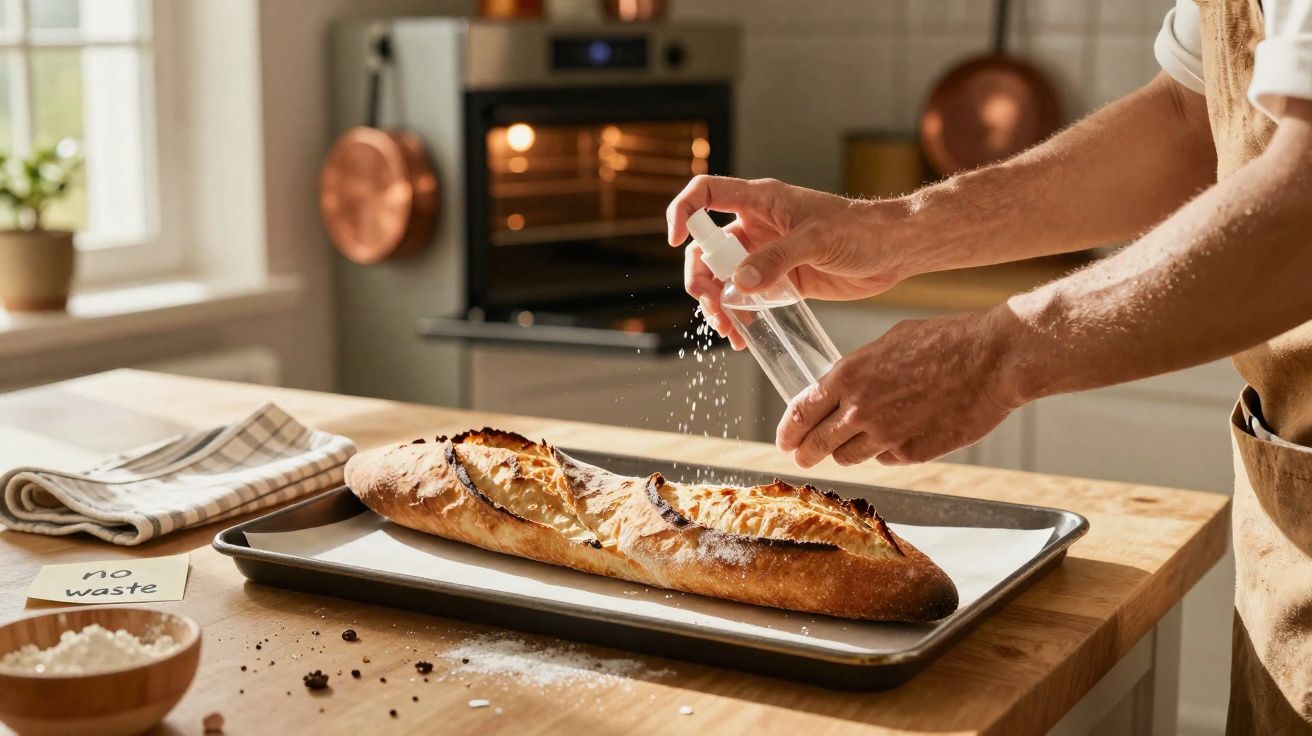
Here’s what the baker does - and what you can do at home. Take the stale baguette and run it quickly under a thin stream of cold water. Not a soak, not a dunk, not a bath. Just a swift rinse over the crust, turning the loaf as you would if you were washing a piece of fruit.
For a moment, it looks absurd: shiny and damp, like a dog caught in the rain. Then place it directly on the oven rack - not on a tray - and put it into a hot oven at 180–200°C, middle shelf, no fan required.
After 7–10 minutes, it comes out startlingly changed. The crust crackles again under your fingers, the crumb is warm and pliable, and that bakery smell fills the kitchen. It won’t be identical to a loaf bought an hour ago, but it gets impressively close.
There are a few easy ways to get it wrong:
- Over-wetting is the classic mistake. If the baguette is soaked rather than lightly moistened, the crust can turn rubbery before it has a chance to crisp, and the centre may stay strangely damp. Aim for a fine mist, not a rainstorm.
- Oven nerves are another. People worry about burning the bread and choose a low temperature for a long time - which simply dries it out further. You want a short, hot blast, like a baker loading a hot deck oven and pulling the loaf as it hits the edge of golden.
And yes, there are limits. If your baguette is three days old and has sat uncovered in a dry kitchen, it won’t spring back like a miracle. This works best on bread that’s 12–36 hours old, when there’s still a little life left in it - and if we’re being honest, most people don’t manage that routine perfectly every day.
“Bread isn’t ruined when it goes stale,” says François, a Lyon baker with flour seemingly permanent on his forearms. “It’s just waiting for a second bake. People forget that baguettes meet the oven twice in their lifetime.”
It sounds poetic, but it’s also practical. That thin layer of water becomes steam in the oven, rehydrating the outer crust and helping restore that fragile balance between crunch and softness. Inside, gentle heat relaxes the starches and loosens the crumb.
Quick checklist (so it works first time)
- Use cold water for the quick rinse - warm water makes it too easy to overdo it.
- Put the baguette straight on the rack so hot air can reach all sides.
- Start at 7 minutes, then check every 2 minutes; your nose will usually tell you when it’s ready.
Two habits that make “yesterday’s baguette” much easier to rescue
If you want to make this trick work more reliably, how you store bread matters. A baguette left fully exposed will dry hard; one sealed in plastic often goes soft and dull. A better compromise is to keep it at room temperature in a paper bag, or loosely wrapped in a clean tea towel, then refresh it in the oven when you want that crisp crust again.
Freezing is also underrated. If you know you won’t finish the baguette the day you buy it, freeze what’s left (whole or in chunks) as soon as it’s cool. Later, you can refresh it from frozen: a quick rinse on the crust, then into a hot oven until the outside is crisp and the inside is properly warmed through.
More than a trick: a tiny ritual against waste
Once you’ve watched a dull baguette come back to life in the oven, you stop seeing leftover bread as a lost cause. The mood in the kitchen shifts. That heavy choice between “fresh or nothing” suddenly has a practical middle ground.
On a weeknight it can lift a humble soup into something that feels complete, or turn a simple cheese plate into an actual dinner. On a Sunday it can save the last loaf from the bin and stretch a meal when an extra friend turns up unexpectedly.
At a deeper level, this small act chips away at the quiet guilt of food waste. One rinsed-and-rebaked baguette won’t change the world. But it does teach your hands and eyes to try something before giving up - to test, revive and adapt.
We’ve all stared at leftover bread thinking, “I’ll deal with it later,” knowing we probably won’t. This baker’s hack doesn’t just bring back the crust; it gives you a clear, quick action in that in-between moment where most food quietly gets abandoned.
| Key point | What to do | Why it helps you |
|---|---|---|
| Lightly rinse the baguette | Run it briefly under a thin stream of cold water over the entire crust | Turns a hard baguette back into bread with a crisp crust, with almost no effort |
| Reheat in a hot oven | 7–10 minutes at 180–200°C, placed directly on the rack | Restores a crackly crust and a supple crumb, close to “fresh from the bakery” |
| Avoid common mistakes | Don’t drench it; don’t bake too long at a low temperature | Keeps the bread enjoyable to eat and reduces household waste |
FAQ
- Can I use this trick on sliced bread or sandwich loaves?
Yes, but be more delicate: lightly brush water on the outer crust only, then warm it for a few minutes in the oven or in a hot pan. Don’t soak the cut sides.- Will this work on a baguette that’s several days old?
It can improve it slightly, but it won’t be as convincing. After about 48–72 hours, you’re usually better off making croutons or breadcrumbs.- Can I use a microwave to refresh my baguette?
You can, but the texture often turns chewy after a few minutes. A short burst in the microwave followed by a few minutes in the oven tends to work better.- Should I preheat the oven, or can I put the baguette in cold?
Preheat it. The impact of a properly hot oven is what rebuilds that crisp, lively crust and brings the aroma back.- Is it safe to refresh a baguette that has mould spots?
No. If you can see or smell mould, discard the bread. This method is for stale bread, not spoiled bread.





Comments
No comments yet. Be the first to comment!
Leave a Comment