
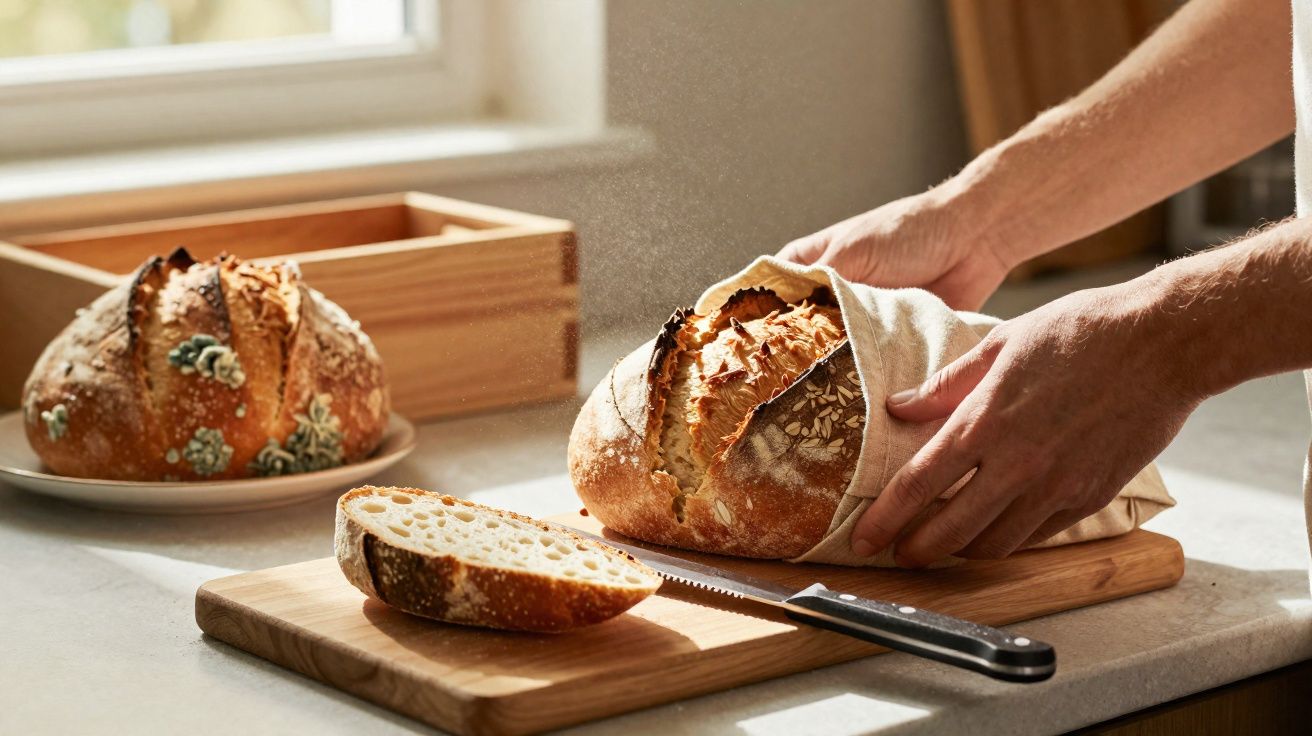
The heel of the loaf was still pillowy that morning, but the rest had started to look like a tiny lab project: faint green specks on the crust, a slightly off whiff the moment you opened the bag. It’s the sort of low-key betrayal that has you chucking three quarters of a perfectly decent sourdough and grumbling at the bin.
You’d only bought it two days ago, promising yourself you’d store it properly this time. Then real life intervened: the door went, the loaf landed on the counter, the plastic got a half-hearted twist, and that was that.
Bread can flip from comfort to waste so quickly it feels personal. But that little mouldy drama isn’t always inevitable.
The real reason your bread goes mouldy so fast
Bread doesn’t simply “go off” on its own schedule. In practice, it’s being gradually taken over. A loaf is packed with starch, a bit of moisture, and often some sugar-exactly the sort of environment mould enjoys. The moment bread comes out of the oven and meets normal room air, mould spores already in your kitchen begin to settle and search for the best place to grow.
That’s why the where and how of storage-temperature, airflow, and moisture-quietly determines whether your loaf is still good on day three… or still fine on day seven.
Picture a shared flat kitchen in July. One person keeps sliced white in a sealed plastic bag perched on top of the fridge near a sunny window. Another keeps a crusty bakery loaf in its paper bag, folded over and tucked into a dark cupboard. By day three, the plastic-bag loaf is often showing pale dots: warmth plus plastic creates a little greenhouse. Moisture from the crumb rises, condenses, and hands mould the water it needs. The loaf in the cupboard may have firmer edges, but it frequently still smells clean and properly bready. Same city, same supermarket run-completely different outcomes.
It can seem almost mysterious until you reduce it to basics. Mould needs three things: spores, moisture, and warmth. You can’t realistically eliminate spores-they’re in the air, on hands, and on worktops. What you can manage are moisture and temperature. Cooler spots slow growth dramatically. A drier surface gives mould less access to water. A bit of airflow helps prevent condensation building up.
Good storage isn’t one magical container. It’s a balancing act: keep enough moisture to stop bread turning into a brick, while avoiding the warm, steamy environment mould thrives in.
Bread storage: the best practical ways to store bread (and what actually works)
For most homes, the best approach is straightforward: keep bread at room temperature, out of direct sunlight, and wrapped in something breathable.
- Crusty sourdough or baguette: use a clean cotton bag, a tea towel, or the original paper bag, folded closed. Then place it in a bread bin or cupboard, away from the oven and away from dishwasher steam. This helps the crust stay reasonably crisp while slowing down surface drying.
- Soft sandwich bread: keep it in its original bag, squeeze out excess air, and seal it tightly. Store it in the coolest, driest part of the kitchen-not on top of the fridge, where heat tends to collect.
Freezing, though, is the understated hero most people overlook. Slice your loaf on the day you buy or bake it, make sure it has cooled completely, then freeze the slices in a freezer bag or container with as little trapped air as possible. After that, you can take out a couple of slices for toast or a lunchbox straight from frozen-no hacking at a rock-hard half loaf, and no depressing mouldy heel glaring at you a week later.
Let’s be honest: hardly anyone does this perfectly every day. But once it becomes routine, you’ll be surprised how rarely you end up throwing bread away.
A baker I spoke to in London summed it up neatly:
“Bread hates extremes. Too hot, too cold, too wet, too dry – that’s when it punishes you.”
His own method reflects that: keep bread at room temperature for 1–2 days, then freeze what’s left. No fridge.
If you want a quick guide for those half-awake Sunday mornings when you’re staring at yesterday’s loaf:
- Crusty bread: paper or cloth + bread bin, then freeze leftovers after 2 days
- Soft sliced bread: tightly sealed bag in a cool cupboard, or freeze part on day one
- Never: leave it on the oven, beside a sunny window, or anywhere steamy
One more practical detail that’s often missed: keep storage spaces clean and dry. A bread bin full of old crumbs, or a cupboard shelf that’s slightly damp, gives spores and moisture the head start they want. A quick wipe and a regular crumb-clear-out won’t sterilise your kitchen, but it does remove easy fuel for mould.
Why the fridge is not your friend (and what to do instead)
The fridge feels like the sensible fix, but it usually makes bread worse. Low temperatures speed up starch retrogradation: the starch in the crumb reorganises and pushes water out, which is why refrigerated bread turns firm and stale quickly-even if you don’t yet see mould.
So you end up with a loaf that may show fewer spots, but tastes like cardboard. It’s the worst trade-off: less visible mould, less enjoyment. If you’ve been putting bread in the fridge and wondering why it feels miserable the next day, the science isn’t in your favour.
A family I visited in Manchester had a routine that worked exceptionally well. They bought a fresh bakery loaf on Saturday, stored it in a cotton bag in a shaded spot, then sliced and froze whatever was left by Monday night. They also made a point of only buying what they could realistically eat within two days at room temperature. No fancy containers, no “preservation hacks”-just a simple rhythm and a freezer doing the heavy lifting. They told me they almost never discovered mouldy bread shoved at the back of a cupboard anymore-only the occasional leftover crust, which they turned into breadcrumbs.
There’s a small mindset shift that helps as much as any container: stop treating bread as one single item and start treating it in portions. Eat some fresh, freeze some, and turn the last dry bit into croutons or French toast rather than letting it sit until it turns.
As one home cook put it over coffee:
“The day I stopped trying to ‘save the whole loaf’ and just froze half on day one, I stopped binning bread. Simple as that.”
And because life does happen, it’s useful to have an “oops, forgot again” plan:
- If you see the first speck of mould: throw the whole loaf away; spores spread deeper than what you can see
- If it’s dry but not mouldy: toast it, blitz it into breadcrumbs, or soak it for soup
- If you know you won’t finish it: slice and freeze immediately-don’t wait until day three
If your bread is merely stale (not mouldy), you can also bring it back to life: a light splash of water on the crust and a few minutes in a hot oven can restore a surprising amount of crispness. It won’t reverse staleness forever, but it can rescue tonight’s bread for a proper meal.
Living with bread, not fighting it
Storing bread well isn’t about rigid rules; it’s more like making a quiet agreement with how a loaf behaves once it leaves the bakery. It does best in a cool, steady corner, with a little airflow, and not too many days ticking by.
When your habits match that reality-cloth rather than sweaty plastic for crusty loaves, freezer instead of fridge, smaller loaves instead of overbuying-mould stops being a weekly drama and becomes an occasional nuisance. On a normal weekday morning, that simply means opening the bread bin or cupboard, pulling out a slice that smells normal, and getting on with your day without thinking about microbiology.
On a human level, it’s also about waste and the small rituals around food. Most of us have had that moment of hauling out a green-speckled half loaf, feeling a flash of guilt, and binning it a bit too quickly. Better bread storage won’t save the planet overnight, but it does break that frustrating loop. You start trusting your kitchen again. And you might even buy that lovely bakery sourdough more often, because you know you won’t be scraping mould off the edges three days later and pretending it’s fine.
Once you settle into a rhythm, you also begin to notice your own patterns: which days you genuinely eat toast, how quickly children get through sandwiches, and which part of your kitchen stays coolest during a heatwave. In the end, bread storage is less about “the right container” and more about matching your choices to the way you actually live-rather than the way a label assumes you do.
| Key point | Detail | Why it matters to you |
|---|---|---|
| Avoid the fridge | Cold speeds staling without fully stopping mould | Better texture and flavour for longer |
| Prioritise freezing | Slice and freeze early, take portions as needed | Less waste and “fresh” bread on demand |
| Store at room temperature | Cool, dry place, out of sun, in breathable packaging | Slows mould growth without sacrificing crust or softness |
FAQ
- Should bread ever be kept in the fridge to avoid mould? Only in very hot, humid climates where room temperature is close to peak summer heat. Even then, expect it to stale faster and plan to toast it.
- How long can bread safely stay at room temperature? Most loaves keep for 2–4 days in a cool, dry spot before mould risk rises, depending on ingredients and humidity.
- Can I just cut off the mouldy part and eat the rest? No. Mould threads can spread invisibly through the crumb, so the safest option is to bin the whole loaf.
- What’s the best way to freeze and thaw bread? Freeze fully cooled slices in an airtight bag. Toast straight from frozen or leave slices for a few minutes at room temperature.
- Does homemade bread go mouldy faster than shop-bought? Often yes, because it usually contains fewer preservatives. Smart storage and early freezing matter even more for homemade loaves.


Comments
No comments yet. Be the first to comment!
Leave a Comment