
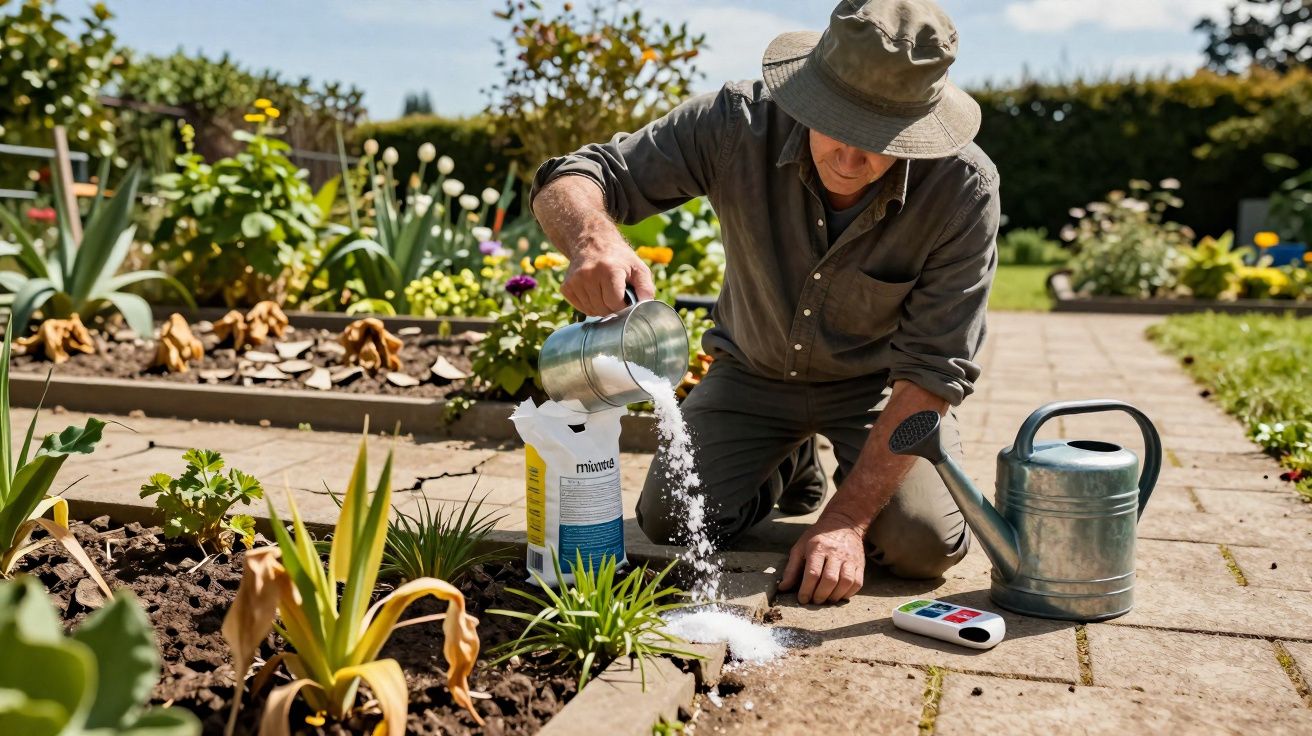
In gardening forums and TikTok “hacks”, an everyday cupboard ingredient is being repurposed as a back-garden “weapon”.
Hardly anyone stops to ask what the after-effects might be.
From patios and driveways to the edges of veg beds, more people are tipping table salt or rock salt onto weeds because it feels fast, cheap and almost risk-free. The demonstration is convincing: plants scorch, growth halts, and the area looks instantly tidier. But that DIY trick has a chemical footprint that can alter your soil for years - and rarely for the better.
Salt as a weed killer in UK gardens: why it works so brutally
Salt does not act like a mild, folksy remedy. It behaves like a potent stress chemical, which is why the early results can look so dramatic.
Salt kills plants mainly by drawing water out of their cells and interfering with how roots take up moisture and nutrients.
When salt sits on leaves or in the root zone, it creates an extremely concentrated solution around plant tissue. Water is pulled out of the cells towards that salty environment. Cells collapse, foliage desiccates, and growth grinds to a stop.
Meanwhile, sodium ions begin to crowd out essential nutrients - including potassium, calcium and magnesium - within the soil. Even if you keep watering or apply fertiliser, roots can struggle to access what they need. In practical terms, the plant is hit by osmotic stress and nutrient imbalance at the same time.
From a frustrated gardener’s perspective, it can feel like magic: dandelions flop, grass in paving cracks yellows off, and the surface looks “sorted”. The catch is that the same staying power that makes salt look “effective” is exactly what can turn it into a long-term headache.
How people actually mix home-made salt weed killers
Online search results and social media are packed with home-made recipes, often shared without any warnings. The measurements differ, but the ingredients tend to repeat.
| Common ingredient | Typical role |
|---|---|
| Table salt or rock salt | Main toxic agent for plants |
| Hot water | Helps it dissolve quickly and speeds the initial scorch |
| Vinegar (household strength) | Lowers pH and burns foliage |
| Washing-up liquid | Helps the mix cling to leaves |
Some mixtures are poured directly into cracks, joints or gravel. Others are sprayed across paving or gravel driveways. Combinations that use both salt and vinegar can look “natural” on paper, but they increase harm to soil life and are not selective - anything green in the spray path is likely to be damaged.
Calling a mixture “natural” does not make it gentle. Salt and vinegar can be harsher on soil than many regulated garden products.
What a salty weed killer really does to your soil
Unlike many organic weed control methods, salt does not conveniently break down into harmless by-products. It either remains where it was applied or moves with water - often lingering longer than the weeds it killed.
From living soil to compact, tired ground
Healthy soil is busy. Bacteria, fungi, small worms and micro-insects cooperate to break down organic matter and deliver nutrients to plant roots. Elevated salt levels disrupt that underground workforce.
- Micro-organisms can die back, which reduces natural fertility.
- Soil particles may clump together or disperse, altering the soil’s physical structure.
- Water soaks in less easily, and the surface can form a crust.
The end result is often dense, poorly aerated ground that roots cannot readily penetrate. People describe it as “dead soil” or “nothing grows there any more” - and that description is not far from the truth.
Repeated use of salt-based weed killers can leave whole patches close to sterile, turning a living bed into something more like a car park.
When salt travels beyond the weeds you targeted
Rain does not solve the problem; it tends to spread it. Showers dissolve salt and carry it downwards or sideways.
On a slope, salty run-off can reach borders or fruit trees well away from where you poured or sprayed. In sandy or shallow soils, sodium may move quickly into the rooting zone of hedges and shrubs. Even mature trees can start to show leaf scorch, premature leaf drop, or a gradual decline after a few salty seasons.
There is also a wider environmental concern. Salt washed from driveways and gardens can end up in drains, ditches, streams or groundwater. Amphibians, freshwater plants and soil invertebrates can be sensitive to changes in salinity.
Testing and recovery after salt-based weed killers (what many people miss)
One overlooked aspect of the salt-as-a-weed-killer trend is that damage can be hard to diagnose. If an area stops performing, many gardeners assume it needs more feed, more compost, or a different plant choice - when the underlying issue is salinisation.
If you suspect a problem, a soil test that includes salinity (often reported as electrical conductivity) can help confirm whether salt build-up is a factor. Where salinisation is identified, recovery is usually slow: adding organic matter, improving drainage, and careful watering practices may be needed over multiple seasons. In some situations, soil conditioners used to address sodium-related soil structure issues are considered - but the most reliable “treatment” is prevention.
Safer ways to keep paths and beds clear
Weed control does not need to become a kitchen chemistry experiment. Several alternatives are more labour-intensive, but they keep soil functioning rather than stripping it out.
On paths, patios and driveways
Hard surfaces are where salt is most tempting, because you may not intend to grow anything there. But roots under paving and run-off into nearby beds still matter.
- Manual removal: A joint scraper or long-handled weeding knife lifts weeds from cracks. Repeating the job every few weeks stops deep rooting.
- Boiling water: Pour it directly onto weeds on paving; it ruptures plant cells and leaves no lasting residue.
- Thermal weeders: Gas or electric flame tools briefly heat the tissue. A few seconds per plant is usually enough, with visible die-back over the following days.
- Repointing or sealing cracks: Filling joints with sand or mortar reduces the gaps where seeds can germinate.
In beds, borders and the vegetable garden
Where you grow ornamentals or food, the priority is maintaining rich, workable soil while steadily reducing unwanted plants.
- Mulching: Use wood chips, straw, leaf mould, or even cardboard to shade the surface, conserve moisture and suppress germination.
- Regular hoeing: On dry days, a sharp hoe skimmed over the top layer severs seedlings before they establish.
- Stale seedbed technique: Prepare the soil, water it, wait for weeds to sprout, remove them, and only then sow or plant your crop.
- Ground-cover plants: Low, dense options such as thyme or clover can outcompete many weeds and help protect the soil surface.
The more bare soil you leave, the more “spare seats” there are for weed seeds to occupy.
When salt might still be tempting – and what that implies
Some gardeners argue there are “sacrificial” areas - an old gravel parking space, or a narrow strip along a fence - where nothing will ever be planted, so salt feels justified. The logic is simple: if the ground is already useless, what’s the harm?
The problem is that salt is difficult to contain. A season of heavy rain, a blocked gutter, or a change in how water drains across the garden can redirect salty run-off towards your lawn or a neighbour’s vegetable plot years later. Shrubs overhanging that supposedly “dead” strip may decline gradually, without an obvious cause.
Anyone considering even a one-off application should think carefully about proximity to trees, ponds, wells, septic systems and property boundaries. What starts as a bargain fix can end up costing real money in replanting and soil restoration.
Key gardening terms behind the debate
Two ideas make it easier to understand what is happening when salt is applied to soil.
- Salinisation: The build-up of soluble salts in soil. In agricultural settings, salinisation from irrigation can remove land from production. On a domestic scale, the same process can undermine beds, lawns and hedges.
- Soil structure: The way mineral particles and organic matter form stable crumbs or clods. Good soil structure allows air and water to move freely. Excess sodium can break down these aggregates, leading to crusting and compaction.
Both changes can take a long time to reverse. Rainfall alone often fails to flush salt fully, particularly in heavier clay soils. Restoring a damaged patch may require years of adding organic matter and managing water carefully.
Imagining a “salted garden” five years on
Picture a small urban garden where salt has been scattered each spring along the patio edge and beside a gravel path. In year one, the weeds disappear and the owner is delighted. By year three, the border closest to the path looks sparse. A lavender at the corner loses vigour, and one plant dies after a hot, dry summer.
By year five, shifting rainfall sends more run-off towards a raised veg bed. Lettuce refuses to thrive, beans sulk, and even with generous compost the soil bakes hard when dry and turns tacky when wet. Nothing about these setbacks screams “salt” - but sodium left behind from a few handfuls years earlier can still be part of the chain of cause and effect.
This pattern is already unfolding quietly in many gardens. It rarely makes headlines, yet it leaves people baffled that their once-productive plots no longer respond to feeding or careful watering.
Rethinking quick fixes in the age of climate stress
With hotter summers, unpredictable downpours and higher food bills, home gardens are being asked to do more - cooling neighbourhoods, supporting pollinators, and topping up household meals. In that context, approaches that reduce soil resilience are increasingly out of step.
Salt weed killers sit squarely in the category of short-term wins with long-term costs. Slower, more physical weed control - and tolerating a few dandelions - may feel less satisfying in the moment, but it keeps the ground healthy enough to recover after heatwaves or heavy rain.
In gardening, the real power move is not eliminating weeds at any price, but keeping the soil underneath rich enough to cope with whatever you choose to grow next.




Comments
No comments yet. Be the first to comment!
Leave a Comment