
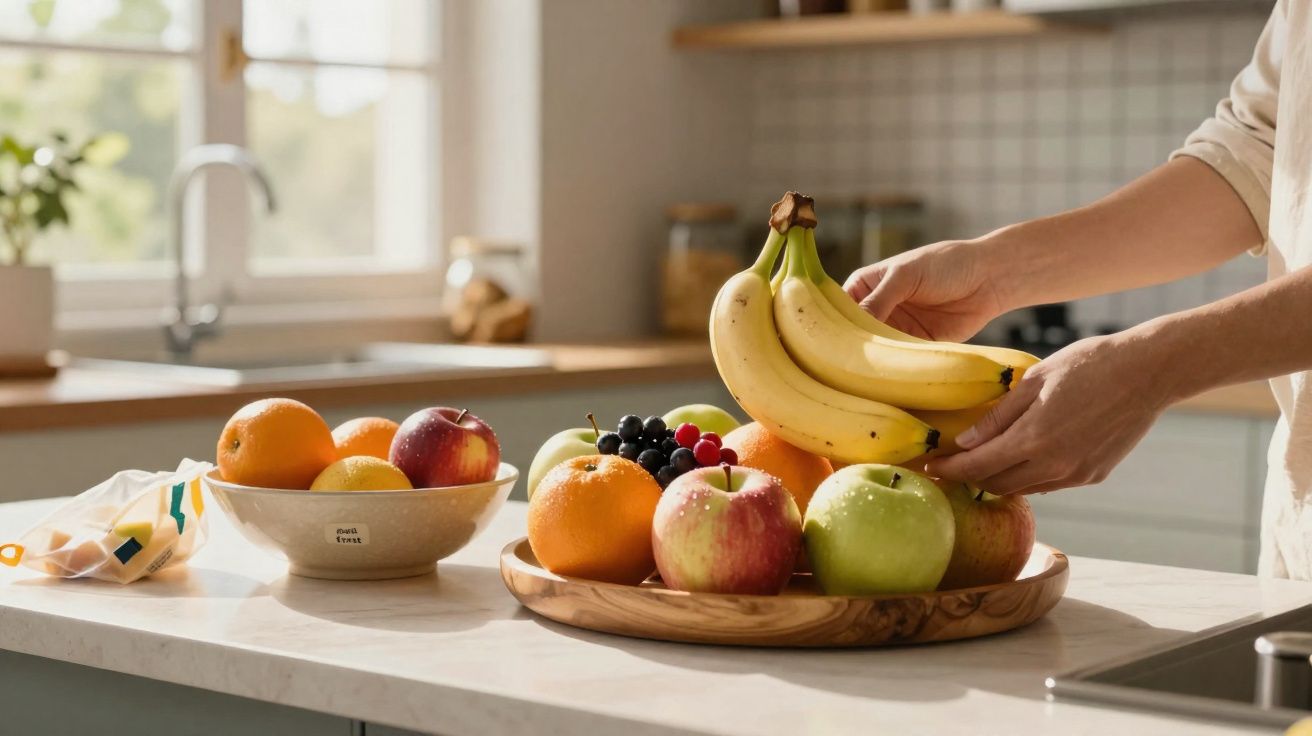
You put the shopping away, heap the fruit into one pile “to keep the worktop tidy”, and feel faintly smug. Fresh. Organised. Healthy.
Three days later, your fruit bowl looks like evidence. Bananas are freckled brown, avocados have turned to paste, oranges smell slightly fermented, and something down at the bottom is seeping onto the chopping board. You’re convinced it all went off twice as quickly as it did last week.
You check the fridge. You blame the supermarket. You partly blame yourself. Yet you’ve done what almost everyone does: you’ve put the fruit in one neat, attractive place.
There’s one tiny habit, hiding in plain sight, that quietly accelerates the whole mess.
Fruit storage and ethylene: the hidden mistake rotting your fruit from the inside out
Most people assume fruit spoils simply “because time passes”. Time matters, yes-but the real troublemaker in most kitchens is a gas you can’t see and usually can’t smell: ethylene. Certain fruits naturally give off lots of ethylene as they ripen. Those lovely bananas and apples you stack together? They sit there, steadily releasing ripening gas into the air around them.
That’s why putting all your fruit into one decorative bowl effectively turns your worktop into a miniature ripening chamber. Ethylene‑sensitive produce-berries, citrus, grapes, and even cucumbers sitting nearby-starts ageing at high speed. What looks like good housekeeping is, in practice, slow-motion self-sabotage.
Whether it’s on a shelf, in a bag, or in a big ceramic bowl, the principle doesn’t change: one keen ripener starts “talking”, and everything else is forced to listen.
Retail research has shown that mixed fruit displays lose saleable stock far faster than separated ones. Shops hate waste, so behind the scenes they space produce out-and keep those pretty mixed displays small and shallow.
At home, we tend to do the opposite. We stack fruit deep. We wedge soft pears under heavy oranges. We let bananas press up against everything. Then, by midweek, we’re throwing away half a punnet of strawberries and wiping sticky juice off the tiles.
On a family level it’s miserable. On a national level it’s enormous: UK households throw away hundreds of thousands of tonnes of edible fruit every year. A chunk of that is lost early because we’ve accidentally created the ideal conditions for a fruit pile‑up.
Post‑harvest scientists often call ethylene the “ripening hormone”. Climacteric fruits-bananas, apples, pears, mangoes, kiwis, peaches, avocados-release ethylene in bursts as they near ripeness. That gas kicks off a chain reaction: starches convert to sugars, the flesh softens, and colours change.
Non‑climacteric fruits-berries, grapes, citrus, pineapples-don’t ripen after picking in the same way. They behave more like sponges. Expose them to ethylene and they don’t gently improve; they simply get older faster. Texture goes first, then flavour follows. Mushy, sour, bland: that’s ethylene doing damage at the wrong time, in the wrong place.
The common kitchen error is simple: mixing major ethylene producers with ethylene‑sensitive fruit, crammed into warm spots with poor airflow. You’re not just storing fruit-you’re effectively steeping it in ripening gas.
It’s also worth remembering that one damaged piece can speed everything up. A bruised apple or split nectarine leaks moisture and microbes, and in a crowded bowl that turns a single weak link into a quick domino effect.
How to fix it today: the “fruit zoning” trick
You don’t need an elaborate fridge set-up or expensive gadgets. The fix is straightforward: zone your fruit the way a supermarket’s back room effectively does. As soon as you unpack, sort your haul into three mental groups: “gas‑givers”, “gas‑sensitive”, and “the easy crowd”.
- Gas‑givers: bananas, apples, pears, avocados, kiwis, mangoes, peaches, plums, nectarines
- Gas‑sensitive: berries, grapes, citrus, cucumbers, fresh herbs
- The easy crowd: melons, pineapples, pomegranates (larger, slower to change)
Give each group its own place-even if that just means different shelves, or two bowls instead of one.
That single change, done consistently, can very nearly halve how quickly your most fragile fruit deteriorates.
Next, use temperature to your advantage. Put berries and grapes straight into the fridge in a shallow container lined with a piece of kitchen roll, with the lid slightly ajar so air can circulate. Keep bananas and whole avocados at room temperature until they’re just ripe, then transfer them to the fridge to slow the clock.
Oranges, lemons and limes generally last much longer chilled than they do in a warm fruit bowl. Tomatoes are a matter of preference, but they also dislike ethylene‑heavy neighbours-especially bananas. So if you keep tomatoes on the worktop, at least give them their own corner.
And don’t underestimate airflow. A packed bowl holds onto ethylene and moisture; a shallow tray or loosely spaced fruit lets both escape. If you’ve only got one bowl, make it wider and keep the pile low.
Let’s be honest: nobody does this every day with military precision. Life gets busy, worktops get cluttered, and someone dumps the shopping wherever there’s room. That’s why visual prompts help: a dedicated bowl for “fast fruit”, a small tray in the fridge door with a sticker, or a banana hook so they aren’t sitting on top of your peaches.
A food-waste campaigner I spoke to put it bluntly:
“We spend money on the best fruit, then kill it off by where we put it. Moving a banana literally 30 cm can buy you two extra days.”
Here’s a quick kitchen crib sheet you can screenshot and stick inside a cupboard:
- Hang or separate bananas once they start to spot, and keep them away from other fruit.
- Keep berries and grapes cold, dry and in shallow layers.
- Store apples and pears together, but not with citrus or cucumbers.
- Move ripe avocados into the fridge-don’t return them to the fruit bowl.
- Use one bowl for “eat first” fruit you want to ripen, and another for fruit you want to “keep longer”.
The quiet pleasure of fruit that actually lasts
In a “zoned” kitchen, the week feels different. Strawberries make it beyond Wednesday. Grapes stay crisp when you wander in for a late-night snack. Monday’s bananas don’t look like they’ve aged a decade by Thursday.
There’s a psychological benefit as well. When food isn’t constantly dying on the worktop, that low-level guilt about waste fades. You’re more willing to buy fresh again because it no longer feels like you’re tipping half your shop into the bin each weekend.
At a deeper level, it’s simply about paying attention-not the perfectionist, colour-coded, Instagram pantry kind. Just noticing what sits next to what, what softens too soon, and what reliably spoils before you even touch it.
Everyone has had that moment: you find three peaches that have liquefied behind the bread bin, and you just close the lid for a second. Changing where fruit lives won’t eliminate those moments entirely, but it will make them rarer-and cheaper.
Small domestic tweaks rarely sound like headline news. But if one simple habit makes fruit last longer, taste better, and saves money, it matters more than it looks. Next time you put the shopping away, glance at that pretty fruit bowl and ask yourself a slightly odd question:
Who’s gassing who?
| Key point | Detail | Why it matters to you |
|---|---|---|
| Don’t mix all fruit together | Ethylene‑producing fruit (bananas, apples, avocados, etc.) makes ethylene‑sensitive fruit age faster | Cuts waste and extends the life of what you buy |
| Create storage “zones” | Separate gas‑givers, gas‑sensitive items and more neutral fruit, using the fridge and room temperature where appropriate | Simple organisation, no special equipment, immediate day-to-day benefit |
| Match temperature and container | Keep fragile fruit cool in thin layers; keep stone fruit and bananas out first, then refrigerate once ripe | Better flavour, fewer mushy or tasteless pieces, more flexibility on when to eat them |
FAQ
- Should bananas be kept in the fridge or on the worktop?
Keep them on the worktop until they’re ripe and lightly spotted, then move them to the fridge to slow further ripening. The skins may darken, but the flesh stays firm for longer.- Is it bad to store apples and oranges together?
Apples release lots of ethylene, while oranges are more sensitive to it. Keeping them together can make citrus age faster, so it’s better to give each its own spot.- How long can berries actually last in the fridge?
Stored in a shallow container with a dry piece of kitchen roll, most berries keep for 3–5 days. Raspberries are the most delicate; blueberries are the most forgiving.- Do “anti‑ethylene” fridge sachets really work?
Some can absorb a little ethylene, but they aren’t magic. Separating fruit and ensuring decent airflow does far more than any gadget alone.- What’s the best way to store avocados?
Let them soften at room temperature. Once they yield slightly to gentle pressure, refrigerate them whole to hold that perfect stage for several more days.
Comments
No comments yet. Be the first to comment!
Leave a Comment