
The woman ahead of me at the herb stall didn’t look like anyone selling a lifestyle online. She wore washed-out jeans, an office pass still clipped on, and the sort of under-eye shadows that say “inbox overload, sleep deficit”. She rolled a small brown paper bag between her fingertips, breathed in its sharp, woody aroma and asked the vendor, almost under her breath: “Is it true this does more than those tablets?”
The bag held dried rosemary.
Around us, shoppers hurried by for punnets of strawberries and bargain avocados. A few metres away, a chemist’s window glowed with slick posters for anti-inflammatory gels and “memory support” capsules.
The side-by-side felt faintly ridiculous.
On one side: an unassuming Mediterranean shrub our grandparents casually threw into casseroles. On the other: multi‑billion‑pound products backed by marketing budgets that could dwarf the GDP of some countries.
And the question sitting between those two worlds was straightforward:
What if rosemary has been quietly doing things the pharmaceutical industry would rather you didn’t notice?
Why rosemary (Rosmarinus officinalis) makes Big Pharma uncomfortable
In most supermarkets, rosemary sits there like an afterthought-wedged between basil and a limp-looking thyme-sold in a plastic tub for about £1.99. Nothing glamorous. Yet behind that low price is a plant loaded with compounds researchers discuss with the kind of serious terminology you won’t find on a spice packet: rosmarinic acid, carnosic acid, and 1,8-cineole.
These molecules don’t respond to branding, loyalty schemes or TV adverts. They simply do what their chemistry allows: influencing inflammation, helping defend cells against oxidative stress, and gently shifting brain activity in ways laboratories are still piecing together.
No supermarket label will spell that out.
But plenty of people report they can sense something.
At Northumbria University in the UK, scientists ran an experiment that was almost disarmingly basic. They released rosemary essential oil into a room, brought volunteers in, and set them memory tasks. No tablets. No injections. No intimidating equipment-just a light herbal aroma in the air.
The outcome: participants exposed to the rosemary scent scored better on certain measures of memory and alertness. Blood tests also indicated changes in 1,8-cineole-a plant compound that made its way into the bloodstream simply through inhalation.
Elsewhere, research groups have explored rosemary extracts in lab animals for anxiety, depression-like behaviour, and neuroprotection. The findings so far are encouraging. Not mystical. Not miraculous. But notably strong for something you can grow in a terracotta pot on a windowsill or balcony for next to nothing.
If you’ve clocked hundreds of adverts for synthetic “brain boosters” but virtually none urging you to “try rosemary first”, the explanation usually isn’t a shadowy plot. It’s dull, unforgiving economics.
You can’t patent a shrub that’s been in use since ancient Greece. You can’t “own” rosemary in the way you can own a lab-adjusted molecule protected by years of exclusivity.
So the financial incentive nudges Big Pharma towards isolating, modifying and standardising compounds-often plant-inspired-and then selling them as blockbuster medicines.
Meanwhile, the plant itself stays out of the spotlight.
Not prohibited. Not scrubbed from history. Simply under-researched, under-funded, under-marketed-and left to grandmothers, gardeners and “alternative” enthusiasts.
How to use rosemary as a quiet daily ally (without overdoing it)
Ignore the curated, picture-perfect recipes for a moment. The most realistic way to benefit from rosemary is to fold it into ordinary life in small, regular amounts. Not as a wonder cure-as a steady, background support.
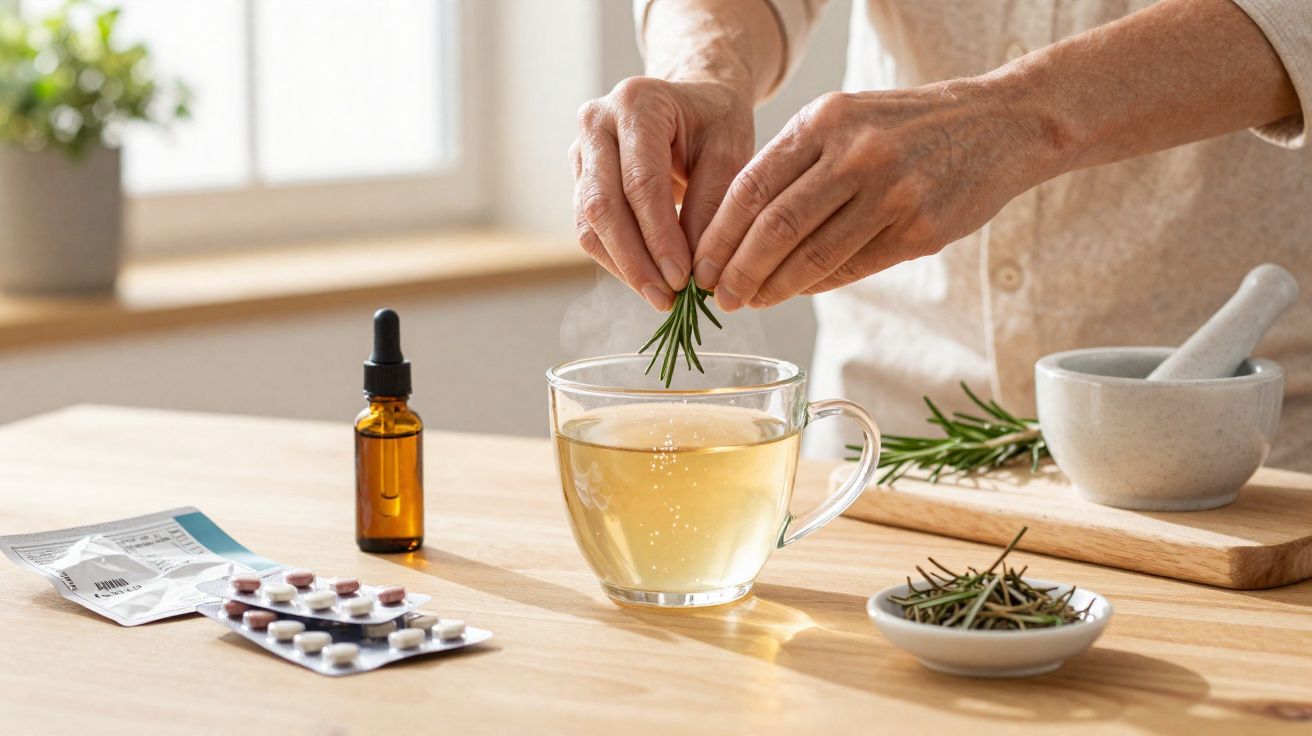
One simple method: drop a fresh sprig into a teapot or mug, cover it with hot water, and leave it to infuse for 5–10 minutes. The flavour is assertive-piney, resinous, a touch bitter. If it’s too much, add a slice of lemon or a little honey to round it out.
Cooking works just as well. Add whole sprigs to roasted vegetables, tray-baked potatoes, or chickpeas warmed in a pan. Dietary fat helps draw out fat‑soluble constituents such as carnosic acid, which has been associated with antioxidant and neuroprotective effects.
A low-effort habit many people find manageable: a cup of rosemary infusion after lunch on workdays to take the edge off the mid-afternoon dip.
It’s also worth thinking about quality and handling, because rosemary isn’t identical in every form. Fresh sprigs tend to be more aromatic, while dried rosemary can be convenient but variable in strength depending on how long it’s been stored. If you buy dried, keep it sealed, cool and out of sunlight; if it smells dusty rather than fragrant, it’s probably past its best.
And if you grow it yourself, you don’t need fancy kit. Rosemary likes light, well-drained soil and hates waterlogged roots. A bright windowsill and sensible watering often beats any “superfood” supplement regimen for consistency.
Essential oil isn’t sweets: use rosemary essential oil carefully
Many people hear “rosemary supports the brain” and immediately jump to buying a high‑strength essential oil-then treat it like something you can swallow by the drop.
That’s where trouble starts.
Rosemary essential oil is extremely concentrated. For many, a couple of drops on a tissue for inhalation is more than enough. If you want to use it on skin, it should be diluted in a carrier oil.
Swallowing undiluted essential oil can cause burning, irritation and genuine harm-especially if you’re pregnant or have health conditions.
The more sustainable route is often the gentlest: use the plant itself, cook with it, drink mild teas, and pay attention to how your body responds.
And let’s be realistic: hardly anyone manages this flawlessly every day.
So instead of aiming for perfection, aim for steadiness across weeks. That’s when rosemary begins to move from “a herb I occasionally use” to “a form of support I actually notice”.
What people notice over time (and why it makes sense)
After months of quiet experimenting, some people describe changes that clinicians-pressed for time-don’t always get the chance to explore.
“I didn’t wake up reborn,” a 52-year-old teacher in Marseille told me. “But I stopped forgetting my keys all the time. And my headaches calmed down. It’s like my brain fog thinned a bit.”
When you look at what rosemary is known for, that kind of gradual, low-level improvement isn’t hard to understand.
- Anti-inflammatory potential: associated with rosmarinic acid and carnosic acid, which influence inflammatory pathways.
- Antioxidant support: helps counter free radicals that harm cells, including neurons.
- Digestive boost: its bitter, aromatic character may gently stimulate digestion and bile flow.
- Possible cognitive lift: research suggests benefits for memory, alertness and mental fatigue.
- Emotional tone: smell links directly into the limbic system; for some people, rosemary signals clarity and grounding.
What rosemary says about how we treat health
Spend five minutes on the boundary line between a supermarket aisle and a chemist and you’ll see a modern pattern play out: processed food on one side, chemical relief on the other. It’s so common it reads as normal.
Rosemary sits in an awkward middle ground. It’s too familiar to be treated as “proper medicine”, yet-chemically-it’s too active to be dismissed as mere garnish. And it highlights an uncomfortable reality: what improves wellbeing doesn’t always align with what produces the highest profit.
Most of us recognise the moment: you’re standing in front of a shelf of medicines, worn out, thinking, “I just need something that works.” In that mindset, you’re not going to trawl studies on carnosol or weigh up infusions versus NSAIDs. You reach for the fastest fix.
The blunt truth is that rosemary asks for what modern life often refuses to give: time, repetition and a willingness to trust small natural inputs.
That doesn’t mean binning prescriptions or sneering at researchers who genuinely save lives with advanced treatments. Reality is more layered than that. Some of the most effective medicines ever made began with plant research, then had their molecules refined and scaled in safer, more consistent forms.
The sharper question isn’t “plants or pills?”. It’s this: who gains when we lose touch with the plants that set the whole process in motion? When research funding and publicity favour patentable compounds, whole‑plant approaches slip down the priority list-even when early evidence looks hopeful for mild anxiety, early cognitive decline or low-grade inflammation.
Rosemary will never come with a PR department. You won’t see a glossy campaign saying “ask your GP about Rosmarinus officinalis”. So the conversation spreads differently: through family habits, word of mouth, curious readers, and people willing to put a sprig in a teapot and actually notice what happens.
Perhaps that’s what the pharmaceutical world finds most inconvenient-not that rosemary will “replace” medicines, but that it quietly reminds us we’re not meant to be passive consumers. We can take part. We can observe our bodies. We can be people with a garden, balcony or windowsill-not just patients with a record number.
So the next time you pass the herbs, take a second look at that hardy little shrub. It has outlasted droughts, wars, plagues, diet trends and corporate rebrands. It doesn’t sell miracles. It simply offers its chemistry to anyone willing to make room for it.
The question becomes less “does rosemary work?” and more: are we prepared to rediscover what a straightforward plant can do when we give it time, curiosity and a small place in daily life?
| Key point | Detail | Value for the reader |
|---|---|---|
| Rosemary is more than a spice | Rich in compounds associated with anti-inflammatory, antioxidant and cognitive effects | Helps you reframe an inexpensive kitchen herb as a genuine wellbeing tool |
| Use gentle, everyday forms | Infusions, cooking with fresh sprigs, and cautious aroma use rather than heavy essential oil dosing | Offers safe, practical ways to use rosemary without radical lifestyle changes |
| Economic forces shape visibility | Non-patentable plants rarely receive the same promotion as synthetic medicines | Helps you read health marketing more critically and broaden your options |
FAQ
- Can rosemary really improve memory?
A handful of small studies suggest rosemary aroma and extracts may modestly support memory and alertness, particularly for short-term tasks, but it is not a replacement for medical care in serious cognitive conditions.- What’s the safest way to start using rosemary for health?
Start with food and gentle tea: steep a sprig in hot water, or cook fresh rosemary with vegetables, fish or beans a few times a week, then monitor how you feel.- Is rosemary essential oil dangerous?
It is potent. Used correctly in tiny, diluted amounts for inhalation or on skin (with a carrier oil), it can be useful; however, swallowing neat drops or using it during pregnancy, epilepsy, or alongside certain conditions can be risky.- Can I replace my medication with rosemary?
No. Rosemary can be a complementary habit for general wellbeing or mild issues, but any change to prescribed medicines should be discussed with your GP or pharmacist.- How often should I drink rosemary tea?
For most healthy adults, 1–2 light cups daily for a few weeks is a reasonable trial. If you feel unwell or notice discomfort, stop and speak to a health professional.





Comments
No comments yet. Be the first to comment!
Leave a Comment