
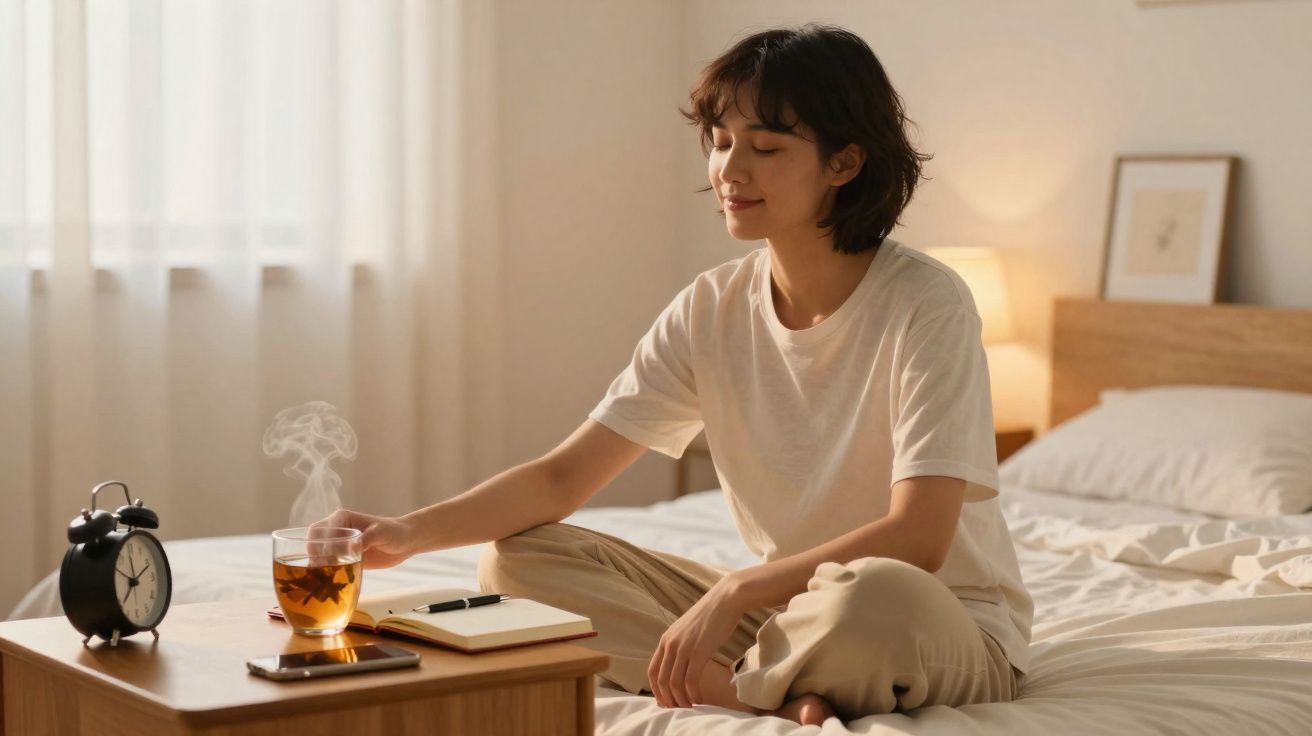
The kitchen is already half in shadow, with only the warm, yellowish lamp above the sink still glowing. On the hob, a mug of herbal tea is gently simmering-somewhere between chamomile and “please let me sleep better than I did last night”. Your phone sits face-down on the table, as if you have to physically restrain it to stop one final notification pushing through. In the living room, the air purifier hums quietly while a candle flickers-vanilla, of course, labelled Sleep & Calm. It’s a familiar scene, straight out of an advert or your own evening.
Yet a different question keeps running underneath it all: do these rituals genuinely work-or do we believe in them so strongly that our bodies fall into line?
Maybe the most powerful sleep “drink” isn’t in the mug at all, but in the mind.
Why expectations can soothe you more than any herbal blend
Most of us recognise the moment you take that first sip of an evening tea and feel an almost immediate sense of relief: Right, I’m winding down now. Your body hasn’t “switched off” yet, but your brain has already pressed play. Shoulders drop slightly. Your gaze softens. The to-do list stops shouting. You reach for the same glass or mug, sit in the usual spot, put on the familiar playlist.
Nothing especially chemical has happened-yet everything already feels calmer.
A sleep researcher once described a study to me where two groups were given the same neutral herbal tea before bed. One group was told: “This is a powerful, sleep-promoting specialist tea.” The other was told: “It’s just a standard herbal tea with no particular effect.” The result was striking: the “specialist tea” group later rated their sleep as noticeably more restorative, felt they fell asleep faster, and reported waking up fresher. In objective measurements, the gap was tiny. What changed dramatically was the experience of sleep.
The takeaway is blunt: often it isn’t the blend that does the heavy lifting-it’s the story we attach to it.
From a neurobiology point of view, that tracks. When you begin a routine that your brain has firmly linked with “sleep is coming”, your nervous system starts preparing. The parasympathetic system-your rest-and-digest mode-gets a kind of green light. Heart rate eases, breathing deepens, thoughts slow down. And it can be triggered by surprisingly simple cues: a particular lamp, a certain scent, even the same sentence you say to yourself each night. The brain craves patterns far more than miracle ingredients.
Rituals are like switches; expectations are the electricity. Without the current, the switch is just decoration.
Building an evening ritual for sleep that makes your brain say “Right, night mode”
Think of your evening routine like a short episode that follows the same script every time. Not a glossy, high-production film-more like a simple series your body learns to recite by heart. Three or four uncomplicated steps are enough: dim the lights, wash your face, drink tea or water from a specific mug, take three slow breaths by an open window. The key move is mental: link that chain to a clear message such as, From this point, I’m moving into night mode.
Repeat it often enough and, eventually, your brain starts to downshift the moment your hand reaches for the mug: Got it-we’re powering down.
What trips many people up is doing the opposite: creating an elaborate ten-step routine-mindfulness app, stretching sequence, journalling, diffuser, supplements-and then feeling exhausted by their own “relaxation plan” after a week. Let’s be honest: hardly anyone keeps that up every single day. Then frustration appears: I didn’t manage my ritual, so no wonder I’ll sleep badly.
That’s the moment expectations flip-from calm trust to tight control. And a tightly controlled mind is rarely a sleepy one.
You could almost argue the most effective sleep aid is a small, radically unremarkable ritual you genuinely believe in.
- Fewer steps, more repetition
Three tiny actions you actually do every night beat the perfect Pinterest routine that dies on day four. - Always the same starting signal
For example: the moment you dim the living-room lights, the “evening mode” officially begins. Your body responds well to clear cues. - Add one symbolic gesture
Close a notebook, draw the curtains, leave your phone in another room. Small action, big internal message. - Content is secondary; meaning comes first
Chamomile tea or water from your “sleep glass”-the signal matters more than the ingredients. - Quiet that doesn’t need to be perfect
A few calmer minutes are plenty. No pressure, no strained “I must relax right now”. Just turning the volume down a notch.
Why honesty with yourself works better than any “sleep wonder”
In the end, it comes down to a simple-slightly uncomfortable-truth: your body often reacts more strongly to what you expect than to what a label promises. If you climb into bed each night thinking, Oh no, I hope my brain finally sleeps today, you are effectively instructing your nervous system to stay on alert. If, instead, you live inside a straightforward, familiar routine and think, This is the quiet part of my day, you gradually reduce the inner noise.
Not because the world becomes quieter, but because you stop giving every thought the same weight at night.
It becomes even more powerful when you stop hunting for the next magic ingredient and start observing your own patterns with curiosity. What does a coffee at 6 pm do to your expectations? What does scrolling in bed actually stir up in you-comfort, agitation, FOMO? How does your breathing change when you turn the light off? These questions are not glamorous. They’re almost boring. And that’s precisely why they work: they pull you out of myth and into something you can influence.
Two practical additions help many people support their ritual without turning it into a performance. First, keep your wake-up time reasonably consistent-even at weekends-because the body learns rhythms faster than it learns rules. Second, treat light like a lever: brighter light in the morning, softer light in the last hour before bed. This isn’t about perfection; it’s about making “night mode” easier for your brain to recognise.
And if your ritual includes products-tea, a scent, a spray-use them as symbols, not as salvation. When you rely on them as the only way you can sleep, they can quietly become another source of pressure.
| Core message | Detail | Benefit for the reader |
|---|---|---|
| Expectations shape the experience of sleep | Studies suggest the subjective quality of sleep shifts strongly with the promised effect of a ritual, not only with ingredients. | Understands why some “miracle” solutions seem to help-and how to use that effect intentionally. |
| Simplicity beats perfection | Short, repeatable evening routines tend to be far more effective for the brain than complex programmes people rarely maintain. | Can build a realistic ritual that still works on stressful days. |
| Meaning matters more than the product | Symbolic gestures, familiar sequences and internal cues often outperform teas, sprays or supplements. | Saves money, reduces pressure, and strengthens the sense of influence over sleep. |
FAQ
- How long does it take for a new evening ritual to work?
Many people notice a shift in how bedtime feels after about a week. After roughly 2–4 weeks, the routine is often familiar enough that the body begins to settle automatically as soon as it starts.- Do I need specific sleep-promoting products?
Not necessarily. If a particular tea, scent or spray gives you a reassuring feeling, it may help-but what matters most is the meaning you attach to it, not an alleged “power formula”.- What if I still sleep badly despite a ritual?
The ritual can still be useful because it creates a protected container for your evening. If poor sleep persists for a long time or feels distressing, speak to your GP or a sleep specialist.- Can I use my phone as part of the ritual, for example for a meditation?
It can work if you use your smartphone deliberately as a “ritual tool” and don’t slide straight back into chats or feeds afterwards. A clear, fixed ending moment is especially helpful.- How can I tell whether something truly helps or is “just placebo”?
Strictly speaking, it’s often beside the point: if you feel calmer, safer and more rested, the effect is real. The body doesn’t neatly separate “genuine” relaxation from expectation-based relaxation.






Comments
No comments yet. Be the first to comment!
Leave a Comment