
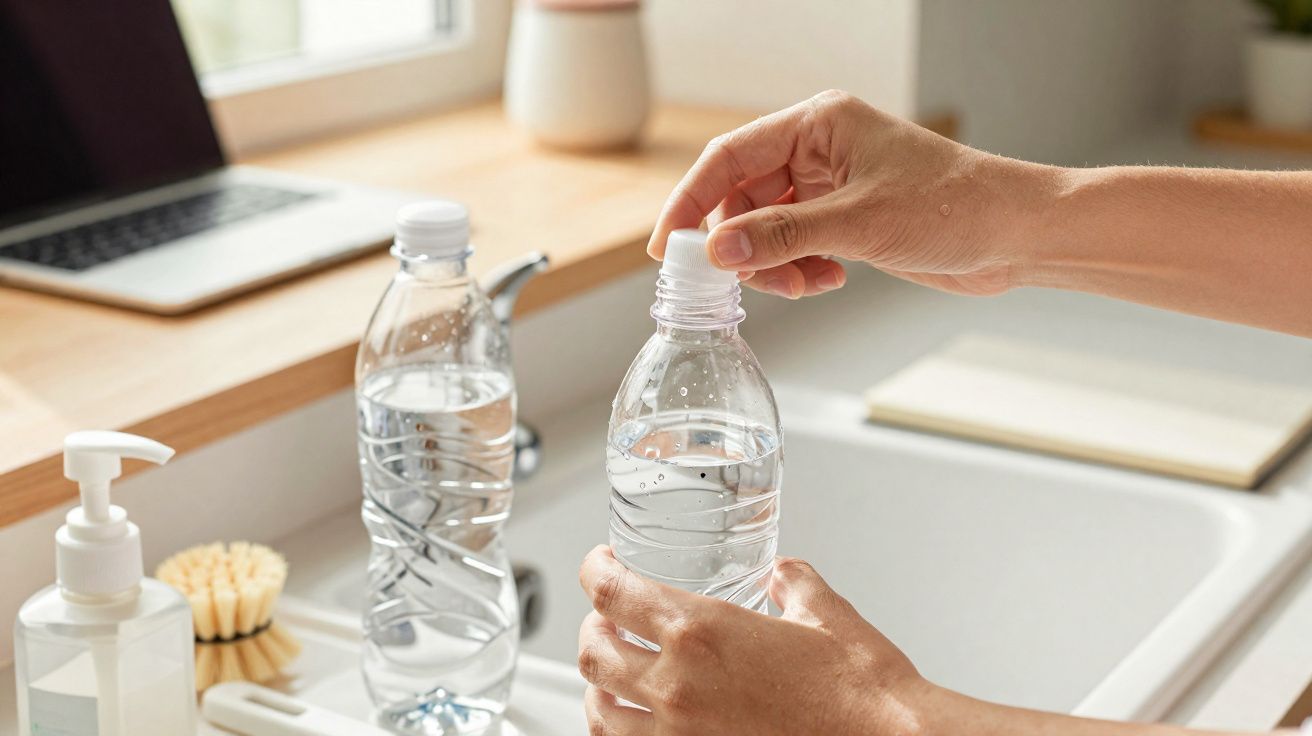
It’s 3 pm. Your head’s a bit woolly, and on the desk sits the same crumpled plastic water bottle you’ve topped up all week. You pick it up on autopilot, twist the lid with that familiar crackle and take a drink. The water tastes… acceptable. Not lovely, not awful-just water. You think, “It’s only water. Harmless.”
What you can’t see is the fine residue gathering beneath the cap. You can’t see bacteria settling into the tiny scuffs inside the plastic, clinging on like holidaymakers who refuse to leave their sunbed. You pop the bottle back in your bag, it rolls under the car seat, warms up, cools down, then gets refilled again from the office tap water. Same routine, new day.
By Friday, it’s practically the most dependable thing you own.
And inside it, something else has been getting comfortable too.
That “innocent” bottle on your desk isn’t as clean as you think
We tend to treat a plastic water bottle like a faithful sidekick-gym, commute, meeting room, bedside table-quietly refilled over and over. It looks clear and clean, which makes it feel safe. But bacteria aren’t impressed by appearances; they care about conditions: dampness, darkness, and a surface that’s repeatedly touched by your mouth.
If there’s one hotspot, it’s the cap. The threads, the ridges, the little grooves you never properly reach-this is prime territory for microbes. Add warm breath, saliva and a touch of backwash, and your “fresh” drink is now passing through a microscopic neighbourhood you’d rather not tour.
Hygiene researchers have repeatedly found that some reused bottles carry bacterial levels comparable to (and sometimes worse than) everyday household items people consider filthy-think dog toys or kitchen sponges. It sounds over the top until you replay the bottle’s day: baking in a hot car, sitting on a shared meeting table, rattling around a gym bag next to sweaty kit and shoes.
Most of us recognise the moment: you retrieve a half-full bottle from under the passenger seat and think, “It’s just water.” You drink, the cap touches your lips, and the cycle continues-not with one or two germs, but with whole colonies that double and redouble in the warm, damp spaces around the cap.
The science is bluntly straightforward. Bacteria thrive on three ingredients: moisture, warmth and nutrients. Your bottle supplies all three. Water provides moisture; your hands and breath provide warmth; and tiny traces of saliva, food, lip balm or lipstick provide nutrients. Once microbes lodge in cap grooves and small scratches, they can build biofilms-slippery, invisible layers that shelter them and make them harder to shift over time.
That’s also why a bottle can smell “off” while the water still looks crystal clear. Your eyes won’t spot what your nose (and sometimes your stomach) may pick up later: a sour taste, mild stomach upset, throat irritation, or that vague “I feel a bit grim” feeling after drinking from a bottle that’s done one day too many.
Plastic water bottle hygiene: why the cap is the real problem
The cap gets handled constantly and rarely cleaned properly. It touches your hands, desks, car cup holders and bag linings, then goes straight to your mouth. Even if the water source is perfectly safe, the bottle itself-especially the cap and threads-can be the weak link.
How to refill without turning your bottle into a germ factory
The most effective fix is also the one people most often skip: washing properly between uses. Not a quick swill. A real wash with hot water, a drop of washing-up liquid, and deliberate attention to the cap and the neck of the bottle. Remove the cap, scrub inside it with a small brush (or a clean sponge you reserve for this job), then rinse until it no longer feels slick. Leave it to air-dry with the cap off.
If you insist on reusing a plastic water bottle, treat it like crockery rather than like disposable packaging. A daily wash disrupts the biofilm that forms under the cap. For an occasional deeper clean, soak the bottle and cap in a mix of water and white vinegar, then rinse thoroughly. The “3 pm you” later in the week will appreciate it.
People don’t overlook this because they’re sloppy; they overlook it because life is busy and a bottle feels trivial. You get in late, drop it on the counter, and in the morning you’re already out the door-grabbing the same bottle without thinking. Realistically, hardly anyone manages perfect daily cleaning forever.
A practical workaround is to create a simple rule that doesn’t require willpower. For instance: use the same plastic water bottle for one day only, then wash it-or replace it with a reusable bottle designed for easy daily cleaning. Another low-effort system is keeping a second clean bottle at work or in your bag, so you can rotate rather than “stretch it one more day”. Small systems beat vague promises to “be better”.
“People assume the risk is the water source, but very often it’s the bottle itself,” says a hospital infection-control nurse I spoke to. “The cap is warm, moist, and exposed to your mouth all day. From a bacterial point of view, it’s a brilliant place to set up camp.”
To stop that camp becoming a city, these habits make a genuine difference:
- Wash or replace plastic water bottles daily-especially if you drink directly from them.
- When possible, take the cap apart and clean the threads, ridges and grooves carefully.
- Don’t leave bottles in hot places such as cars or on sunny windowsills.
- Avoid sharing bottles, even “just a sip”, particularly during colds, flu or stomach bugs.
- Consider switching to a sturdy reusable bottle that’s dishwasher-safe.
Extra tip: if your bottle has a sports cap or flip-top, assume it needs more cleaning, not less. More moving parts means more crevices where moisture and debris hide.
Rethinking a “harmless” habit most of us have adopted
Once you start viewing a reused bottle as a tiny ecosystem rather than a neutral object, you notice details you used to ignore: how long it’s been living in your bag, how often the cap touches your desk or the gym floor, how it smells when you open it after a warm afternoon. That brief moment of hesitation is useful.
This isn’t about panicking or binning every bottle after a single drink. It’s about paying attention to a small action you repeat dozens-maybe hundreds-of times each month, and making a quiet upgrade.
There’s also a point where cleaning isn’t enough. If the plastic is heavily scratched, cloudy, or permanently tainted with smells, those surfaces make it easier for biofilms to hang on. At that stage, replacing the bottle (or moving to a better-designed reusable bottle) is often the simplest, most hygienic choice.
Next time you unscrew a bottle you’ve been carrying for days, try a different default: tip it out, wash it, and start fresh. Your health is shaped more by these small, unseen decisions than by grand, once-a-year resolutions.
| Key point | Detail | Value for the reader |
|---|---|---|
| Cap area breeds bacteria | Warm, moist grooves and threads trap saliva and particles | Helps you understand why “looks clean” doesn’t mean “is clean” |
| Daily washing is non‑negotiable | Hot water, washing-up liquid, and attention to cap and neck of bottle | Gives a simple routine to cut bacterial growth quickly |
| Set limits on reuse | Use plastic bottles for one day or switch to washable reusables | Offers a clear, realistic rule you can follow without thinking |
FAQ
Can reusing plastic bottles cause serious illness?
Most of the time, reuse is more likely to lead to mild problems such as stomach discomfort or throat irritation. However, for people with weaker immune systems, higher bacterial loads can contribute to more serious infections.Is it safe to refill a bottle with tap water multiple times in one day?
Yes-provided it’s the same day, the bottle is reasonably clean, and it hasn’t been left somewhere very hot, such as a parked car.Do sports caps and flip-tops collect more germs than screw caps?
Often, yes. They tend to have more parts and crevices where moisture and debris can get trapped, so they require more thorough cleaning.Can I just rinse with water instead of using soap?
A rinse helps a little, but without washing-up liquid you’re unlikely to break up the biofilm that protects bacteria on inner surfaces and under the cap.What kind of bottle is safest for daily reuse?
A stainless steel or sturdy BPA‑free bottle that comes apart easily and is dishwasher-safe is usually the simplest and safest option for everyday use.
Comments
No comments yet. Be the first to comment!
Leave a Comment