
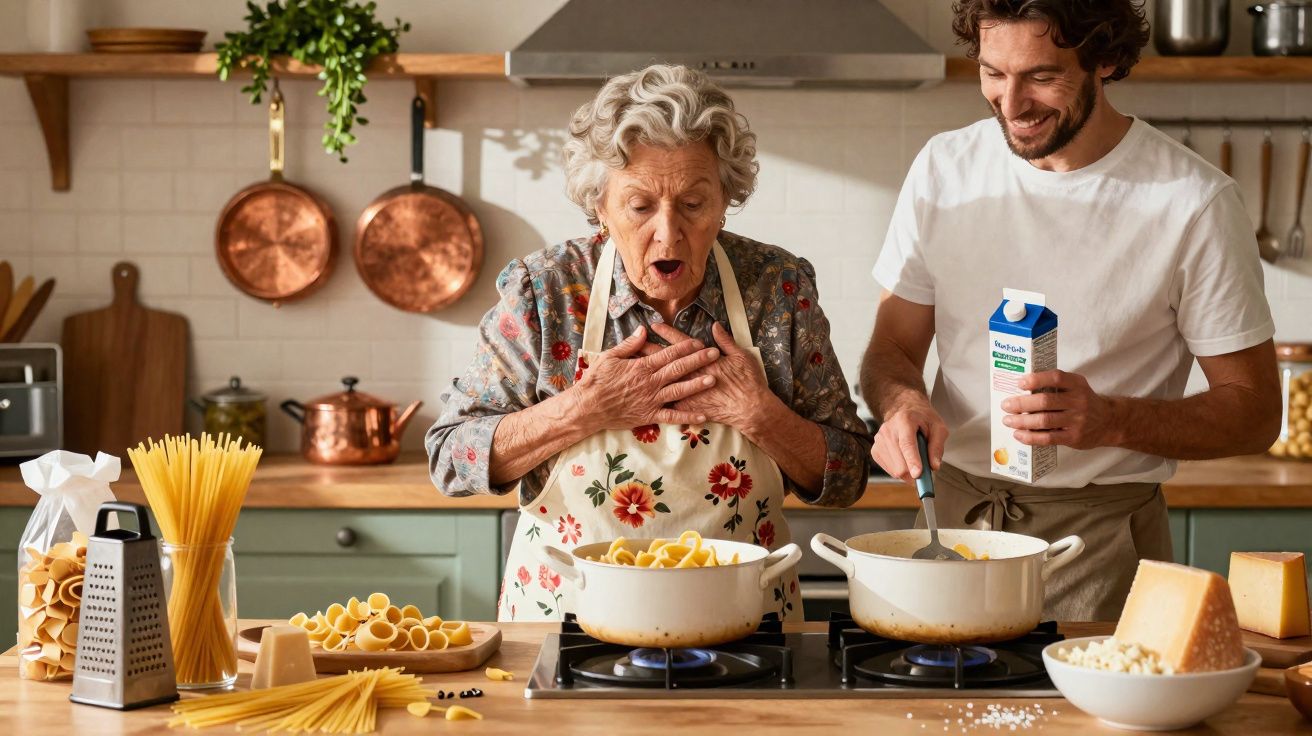
In a compact flat in Lyon, a saucepan of pasta is bubbling away on a gas hob. The television chatters in the background, a half-drunk glass of red wine rests on the worktop, and someone scrolls through TikTok with one hand while stirring with the other. Salt? Possibly. Timing? Judged by eye. The spaghetti is left until it collapses into softness, then smothered in a thick cream sauce poured straight from a carton.
Somewhere in Italy, an Italian grandmother has just stopped mid-stir.
Why Italian cooks lose their minds over French pasta habits
For many Italians living in France, the first jolt comes in the supermarket rather than the kitchen. Next to the olive oil you can find aisle after aisle of pouring cream, and plenty of home cooks have genuinely learned a simple formula: pasta begins with boiling water and ends with cream plus cheese plus maybe bacon pieces. To an Italian, that doesn’t feel like a recipe so much as a culinary identity wobble.
The disagreement is not only about flavour. It is about what pasta is supposed to mean.
French social media leans into it. Videos celebrate “French-style pasta”: spaghetti cooked until it droops, then baked with grated mild Swiss-style cheese, soured cream, and whatever happens to be in the fridge. These clips rack up millions of views, with comments like “So comforting!”, “The kids devour it!” and “Ideal for a lazy evening.” From the French angle, it is efficient, warming, and tied to childhood.
In Italian comment threads, the mood is noticeably less forgiving.
On Italian food forums, screenshots of these recipes get passed around like evidence in a case file. People call it “blasphemy”, argue about whether the pasta was “overdone twice” (in the pot and in the sauce), and talk about texture, starch and wheat as though they are non-negotiable values. For them, cooking pasta until it turns floppy is like deliberately scorching a steak and insisting it is fine dining.
Under the jokes sits something genuine: two different relationships with food-speed and convenience on one side, habit and ritual on the other.
How pasta is really cooked in many French kitchens (and why it makes sense there)
Step into a typical student flat in Toulouse at about 8pm and the scene is familiar. A large pot-often only half-filled-sits at a gentle simmer rather than a full rolling boil. Spaghetti is pushed in, frequently snapped in half so it “fits”. Salt might go in late, or not at all.
The target is not perfection. The target is a quick, cheap, filling meal before the next thing on the day’s list.
At the table, the pasta is usually cooked very soft. A fork slides through it with hardly any resistance-no bite, no firmness, no “slight chew”. Then come the recognisable finishing touches: a generous spoonful of soured cream, a scattering of diced ham, and a handful of grated mild Swiss-style cheese that melts into a stretchy layer the moment it hits the heat. For many households, that flavour is pure nostalgia.
On a cold weeknight, nobody wants a lecture about starch. They want another helping.
From a French point of view, this is pasta made domestic-practical and flexible. It becomes a blank base like rice or potatoes, ready for cream, cheese, leftover roast chicken, frozen vegetables, or anything that needs using up. Italians tend to treat pasta differently: the pasta itself is the main character, and the shape, the wheat, and the cooking time are taken seriously.
That is why an ordinary bowl of French “cream pasta” can feel, to an Italian, like a small scandal across the Alps.
A note on ingredients: pasta shape and cheese choices matter more than people admit
One detail that often gets missed in these debates is that the shape of pasta changes everything. Long strands behave differently from short tubes; ridged shapes hold sauce in ways smooth ones cannot. When pasta is cooked very soft, shapes lose the qualities they were designed for, and sauces end up doing all the work.
Cheese selection also plays a bigger role than most quick dinners allow. Mild Swiss-style cheese melts beautifully but can flatten flavours; harder, saltier cheeses deliver more taste with less quantity. Even if you keep a creamy style, changing the cheese can shift the dish from “heavy” to “balanced” without making it more expensive.
What Italians would actually change in a French kitchen
If a patient Italian chef were allowed to make quiet adjustments to typical French pasta habits, they would begin with the water. Use a bigger pot, fill it properly, and wait for a proper rolling boil. Salt it decisively-about 10–12 g per litre-rather than relying on a token pinch. Then they would tackle habits one at a time: stop snapping spaghetti, and stop leaving pasta sitting in the water “while the table is cleared”.
Timing would become deliberate rather than guessed.
Their second intervention would focus on the sauce. Less pouring cream, more starchy cooking water. Instead of drowning the pasta on the plate, they would finish it in a pan with the sauce, adding a ladle of that cloudy pasta water and a handful of grated cheese. The creaminess comes from an emulsion, not from a carton. Let’s be honest: almost nobody does this every day.
Even so, trying it once or twice can reset what “good pasta” tastes like at home.
One Italian food writer put it plainly:
“Treat the pasta with respect and it will reward you. Cook it to mush and smother it in cream, and it will take revenge on your digestion and your pride.”
Behind the punchline is a simple idea: attention changes the outcome.
To keep it practical, here is what an Italian guest secretly hopes you will try at least once:
- Use a larger pot and more water than you think you need.
- Salt the water properly before the pasta goes in.
- Start tasting 2 minutes before the packet time.
- Drain while it still has a gentle bite, then finish cooking in the pan with the sauce.
- Replace half your usual cream with hot pasta water and notice the difference.
Cooking for mixed Italian–French guests: the easiest compromise
If you are feeding people with different expectations, you do not need to pick a side. Cook the pasta with better water, better salting and better timing, then offer two finishing routes: one pan finished with cheese and pasta water for a lighter, silkier result, and another with a small splash of cream for those who want that familiar comfort.
The surprising part is that improving the basics (water, salt, timing) usually makes both versions taste better, without turning dinner into a rules-based argument.
When “sacrilege” becomes a real conversation about taste
At a deeper level, these pasta arguments reveal how we cook when nobody is performing. Online, we posture: flawless egg-and-cheese pasta, cured pork cut just so, pepper ground with theatrical flair. In many real French kitchens, dinner is a practical compromise between time, money and children who are already asking what is for pudding.
Everyone recognises the gap between what looks impressive on a feed and what happens on a Tuesday night.
There is also a generational thread simmering in the background. Older Italians often carry precise rules learned at home, almost like family law. Many younger French adults grew up with supermarket deals and multipacks of cream, with pasta as the universal back-up meal. On a weeknight, “cream pasta” feels like comfort, not a offence.
Then, on a relaxed Sunday with friends, that same person might attempt a proper cheese-and-pepper pasta and suddenly understand why Italians insist on texture.
Most of these fights are not truly about the food. They are about identity, pride, and the sting of being judged by strangers for how you feed your household. On a rough day, a video of overcooked spaghetti becomes proof that “the French cannot cook any more”. On a kinder day, it is simply tired people making dinner with what they have.
On a very good day, it becomes the moment someone starts boiling water properly.
Quick reference table: small changes, big difference
| Key point | Details | Why it matters to readers |
|---|---|---|
| Salt the water properly | Use roughly 10–12 g of salt per litre of water so the pasta is seasoned from the inside, not only by the sauce. | Adds flavour without over-salting the sauce, and makes even simple tomato pasta taste closer to what you would get in a restaurant. |
| Stop overcooking the pasta | Begin tasting 2 minutes before the packet time; drain when the centre still has a gentle bite, then finish in the pan with the sauce. | Turns “mushy” weeknight pasta into something satisfying and lighter, without changing your ingredients or budget. |
| Use pasta water instead of more cream | Keep a mug of starchy cooking water and add it gradually to bind cheese, fat and sauce into a silky emulsion. | Lets you reduce pouring cream while keeping comfort, avoiding heavy, cloying sauces that sit in the stomach. |
FAQ
Is using cream in pasta always wrong from an Italian perspective?
Not entirely. Some Italian regional cooking uses a small amount of cream, but typically far less than many French versions. The “sacrilege” reaction tends to appear when cream smothers all other flavours and replaces technique. If you use less, choose a more flavourful cheese and add a little pasta water, you can keep the comforting style while landing closer to Italian expectations.Why do Italians insist so much on pasta being cooked with a slight bite?
It is not just snobbery. Pasta with a gentle firmness is often easier to digest, holds sauce better, and lets the wheat flavour come through. When pasta is overcooked, it absorbs too much water, turns gluey, and can feel heavy. Once you get used to that bit of resistance, very soft pasta can start to feel like nursery food.Is snapping spaghetti in half really that bad?
For Italians, yes, because the long strand is part of how it is meant to be eaten and coated in sauce. Practically speaking, shortened strands cook and cling differently. Still, if your pan is small and you are feeding exhausted children, nobody is going to knock on the door. Try a larger pot once and you may find you prefer that long, satisfying twirl.Can I keep my “cream pasta” and still improve it?
Absolutely. Cook the pasta slightly less, salt the water confidently, then reduce your usual cream by about a third and replace it with hot pasta water. Toss everything in a pan for a minute with the cheese. Same basic ingredients, better texture-and suddenly the dish feels both familiar and far more “Italian-friendly”.



Comments
No comments yet. Be the first to comment!
Leave a Comment