
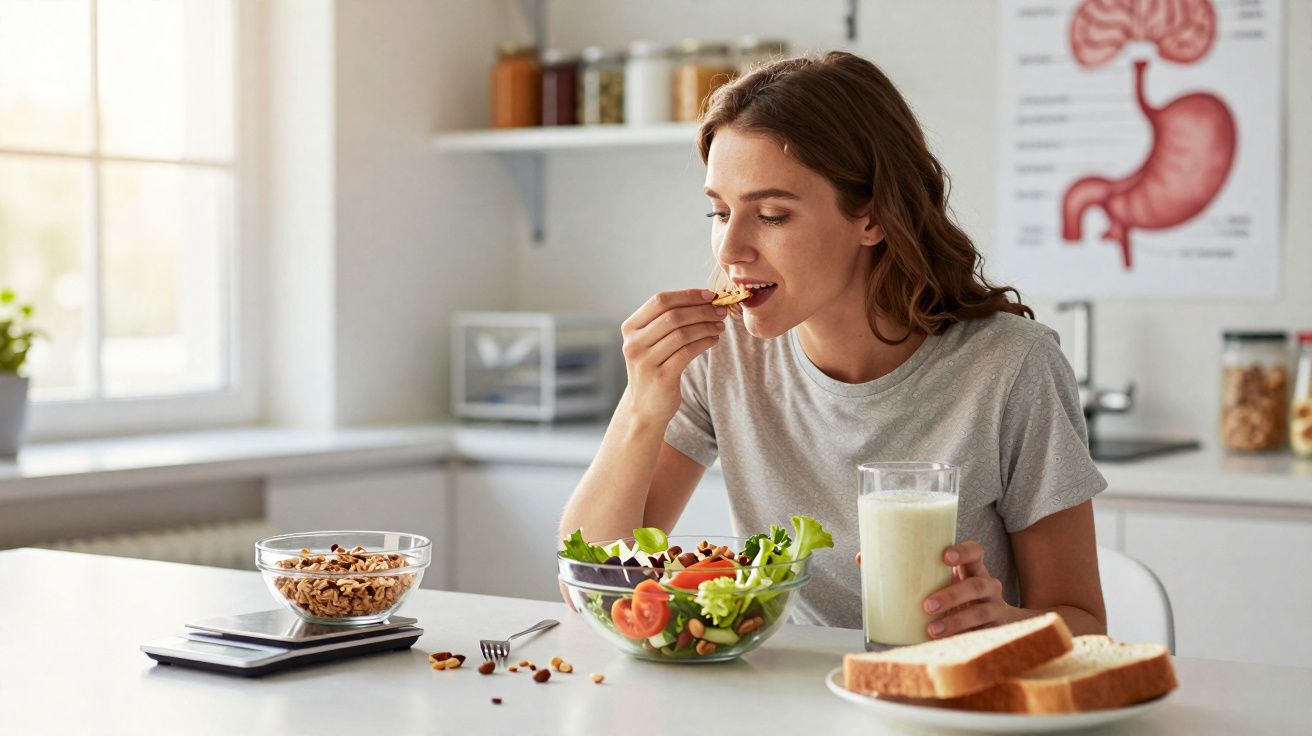
Not the mild “I could pick at something” sort of hungry, but the “where’s my snack gone, and why do I want another?” kind. The strange thing is you’ve just eaten roughly the same number of calories as a proper lunch. The label might match, yet your body’s response doesn’t.
Food scientists argue the gap isn’t only what you eat, or even how much. It’s the crunch, the chew, the thickness, and the quiet, barely-noticed cues your teeth and tongue pick up long before your brain catches on. Texture is the background player that steers appetite without asking for credit.
Once you clock it, you start seeing it everywhere.
Why crunch fills you up more than calories do
Imagine two weekday breakfasts. Option one: a thick slab of toasted sourdough with crackly edges, topped with mashed avocado and a fried egg that offers a little resistance when the knife goes through. Option two: a vanilla protein shake-smooth, sweet, and finished in eight gulps while your inbox loads. By 11 a.m., one still feels like a meal; the other feels like hearsay.
Researchers have a straightforward term for what’s happening: oral processing. The minutes your mouth spends biting, tearing, grinding and moving food around act like a hidden dial on hunger. Foods that are firmer or more chunky require more work. More work typically creates more time. And more time gives gut hormones the chance to send the message upstairs: “We’re fine, thanks.” Very soft or drinkable textures often bypass that entire back-and-forth.
In laboratories, the evidence looks clinical: electromyography sensors on jaw muscles, cameras counting bites, scales weighing food before and after each mouthful. In everyday life, it’s the difference between demolishing a muffin in three bites and spending ten minutes with a nutty, seedy granola. Researchers at Wageningen University found that people naturally eat less when the same foods are made harder and chunkier-even when they’re free to eat as much as they want. Same recipe, same flavour, simply more chewing.
That extra chewing doesn’t just slow the pace. It alters how your body interprets the meal. With more chewing, taste and aroma stay in play longer, keeping sensory nerves active. More saliva blends with the food, helping digestion get going and supporting the release of satiety hormones such as GLP‑1 and PYY. Food also reaches the stomach in slightly larger, more structured pieces, which can stretch the stomach wall a bit more and strengthen “I’m filling up” signals. When everything goes down as one smooth, uniform purée, your gut receives the load quickly but your brain tends to “log” the meal later. The bowl is empty; the appetite hasn’t got the memo.
How texture shapes appetite in real life (and how it can fool you)
If you want a quick demonstration of texture’s influence, you’ll find it in the snack cupboard. Crisps, chocolate bars and biscuits are often engineered for what scientists describe as “optimal crunch” and a “clean bite”. Think of the snap as you break off a square of chocolate, or the ideal shatter of a crisp that cracks and then melts away in seconds. Your teeth get a satisfying sense of effort, while your stomach receives near-instant mash.
That pairing is a problem for satiety. Oxford studies have shown that when the sound of crunch is amplified through headphones, people tend to eat more. The more enjoyable and prominent the crunch, the more bites they take. Crunch can signal “substantial” to the brain even when the food dissolves almost immediately after you swallow. It’s texture cosplay: all the sensory theatre, very little lasting fullness.
Now compare that with a bowl of lentil stew or a chunky vegetable curry. It doesn’t perform-no dramatic snap, no showy crackle. But each spoonful asks for light chewing; each piece holds its shape briefly on your tongue. In appetite research settings, these “structured” meals reliably come out ahead. People report greater fullness, stay satisfied for longer, and-without being instructed-reach for fewer snacks later on. It can be the same number of calories as a creamy pasta dish (or fewer), yet it produces a completely different afternoon.
On a physiological level, it adds up. Pulses, whole grains, crunchy vegetables and nuts keep a tougher internal architecture even after cooking. Your stomach acid has more work to do, which can slow gastric emptying. At the same time, your brain is tracking the eating event: more bites and mouthfuls build a stronger internal story of “I’ve properly eaten.” When most things on the plate share one soft, slippery texture-white bread, mashed potato, creamy sauce-the comfort may be real, but hunger can drift back in as if it never left.
One extra angle worth noting: texture interacts with how fast you can eat in the first place. Many ultra-processed foods are designed to be easy to chew and swallow quickly, which makes it simple to overshoot fullness before your body catches up. By contrast, meals that make you pause-because they require actual chewing-give satiety signals time to rise.
Simple texture tweaks that genuinely change how full you feel
Begin with your next meal by keeping the ingredients the same and adjusting the mouthfeel. If you’re having yoghurt, add a handful of nuts or seeds rather than relying on fruit purée alone. If you’re making soup, leave about a third of the vegetables in pieces and blend the rest, so each spoonful includes something you have to chew. This approach is often called texture layering: combining smooth bases with crunchy or fibrous elements that slow your fork and engage your jaw.
Scientists also talk about expected effort. When your brain can see chunks, grains, seeds or obvious fibres, it anticipates work. That expectation can prime satiety responses even before the first bite. Preparation matters too. Carrots chopped into thick coins take more chewing than the same weight shaved into paper-thin ribbons. Toasting bread until it properly resists your teeth can transform the satiety of a sandwich.
There’s a pacing tip as old as family advice: put your cutlery down between bites. Let’s be honest: almost nobody does that every day. But adding texture creates a smaller, more realistic version of the same effect. You can’t tear through a salad loaded with chickpeas, almonds and shredded cabbage at the same speed as a bowl of mash. Your mouth dictates the tempo.
On the other hand, very soft foods do have a role. When you’re unwell, stressed, very tired or pushed for time, a smoothie or instant noodles can feel like a lifeline. The issue starts when those textures become the default. Drinkable breakfasts, spoon-only lunches, snacks that disappear before you’ve really tasted them-your satiety system simply gets fewer opportunities to do its job.
A food scientist I spoke with in London summed it up without any softness:
“If your teeth are bored, your brain will be hungry. We keep blaming willpower, when half the problem is that our food barely asks our mouth to show up.”
Texture is emotional as well as physical. Some people reach for creamy foods when anxious because they’re easy, quiet and undemanding. Others gravitate to loud, crunchy snacks because working the jaw helps discharge tension. Neither response is “wrong”. What helps is spotting your pattern, then adding more variety in texture around those cravings rather than trying to fight them head-on.
If you want a simple set of experiments to try:
- Add one hard or fibrous element to every soft meal (nuts on porridge, whole vegetables in curry, seeds on soup).
- Swap at least one drinkable snack each day for something you must bite and chew.
- Change cuts and cooking times: slightly undercooked vegetables, well-toasted bread, al dente grains.
Letting texture-and satiety-reshape how you feel after meals
Once you start paying attention, texture becomes a quiet filter over your entire eating pattern. That late-night cereal spiral isn’t only sugar or stress; it’s also the oddly compelling cycle of crunch-then-soggy that makes you chase the “perfect” bite before it collapses in the bowl. That settled, satisfied feeling after a Sunday roast? It isn’t just portion size; it’s the full orchestra of crisped edges, fibrous vegetables and slow-chewed meat.
At a very human level, texture is tied to memory. The crisp top layer of a lasagne your mum made. The snap of peas straight from the pod in summer. The dense chew of the first wholemeal loaf you actually enjoyed. Those sensations anchor meals in your mind, and your body often reads them as “real food”. When everything is endlessly smooth, whipped, refined and effortless, eating can turn ghostlike: plenty of volume, not much presence.
For anyone hoping to eat less without obsessing, texture offers a surprisingly gentle lever. You’re not weighing, counting or restricting. You’re nudging meals from mushy to slightly resistant, from sip to bite, from gulp to chew. Over time, those small physical shifts can change how satisfied you feel after completely ordinary food-no biohacking, no miracle ingredient. Just paying a little more attention to your teeth, and letting them do the job they were built to do.
Quick summary table
| Key point | Detail | Why it matters to you |
|---|---|---|
| Oral processing | More chewing time supports satiety hormones and slows eating | Helps you feel fuller on the same calories |
| Structured foods | Harder, chunkier textures keep their shape in the mouth and stomach | Extends fullness and reduces grazing between meals |
| Texture tweaks | Adding nuts, seeds, whole veg or toasting changes mouthfeel | A practical way to manage appetite without dieting |
FAQ: Texture, crunch and appetite
Does eating crunchy food always mean I’ll feel fuller?
Not necessarily. Crisps and some cereals are crunchy yet designed to melt quickly, so they can feel surprisingly “empty”. Aim for foods that remain chewy or fibrous in the mouth, such as nuts, raw vegetables, pulses or whole grains.Can smoothies ever be satisfying, or are they always bad for satiety?
Smoothies can be filling if they’re thick, contain fibre (for example oats or flax), and you eat them slowly with a spoon. Drinking a thin smoothie quickly is usually far less satisfying than a textured bowl that you genuinely chew.What’s the best texture if I’m trying to lose weight without feeling restricted?
Food scientists often highlight “hard” or “coarse” textures: crunchy vegetables, whole fruit, dense wholemeal bread, beans, lentils, nuts and seeds. These slow eating and help you stay full for longer without needing to count each bite.Is soft food always a bad idea for appetite control?
No. Soft foods can be useful when you’re recovering from illness, exhausted or short on time. The problem is relying on them for most meals. Balancing soft dishes with at least one element that requires real chewing is a simple, effective adjustment.How quickly can texture changes affect my hunger?
Many people notice a difference within a few meals. A more textured lunch-such as a grain bowl with chickpeas and crunchy vegetables-often leads to fewer afternoon snacks than a smooth soup or a white-bread sandwich.
Comments
No comments yet. Be the first to comment!
Leave a Comment