
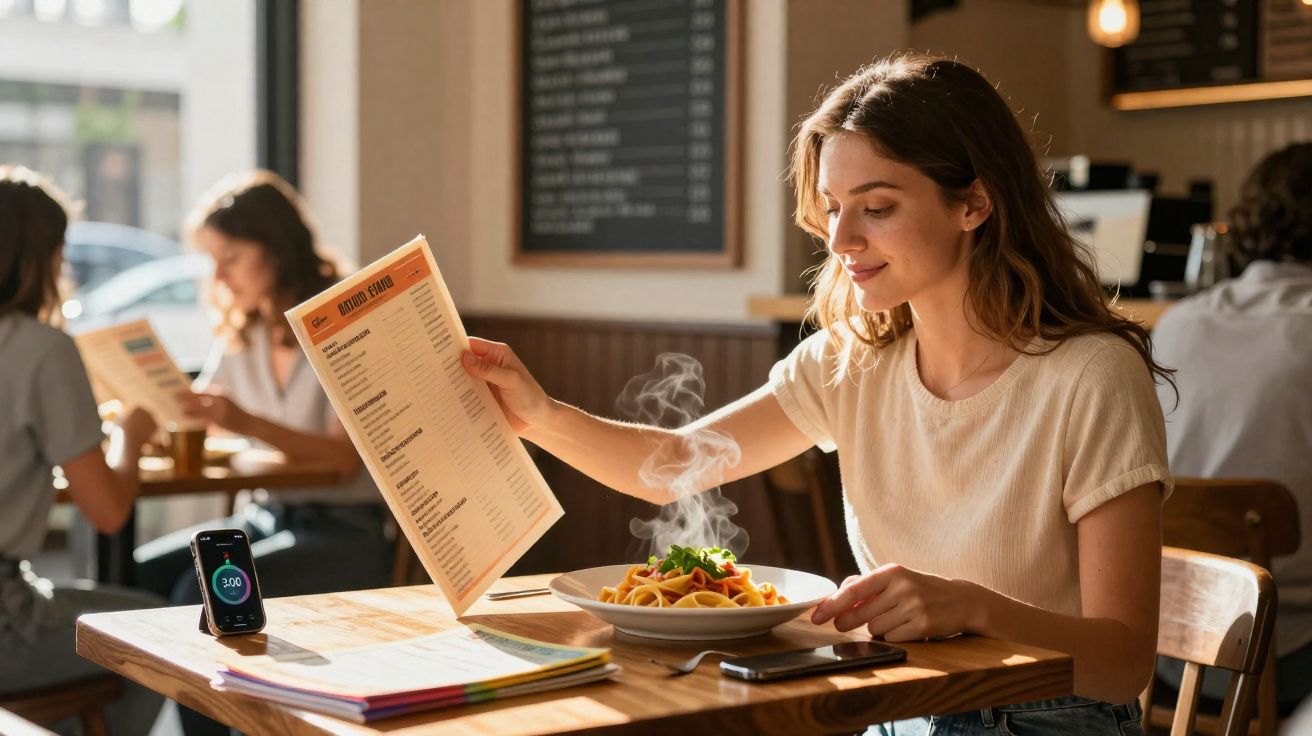
The waiter is hovering a couple of paces away, order pad ready, doing their best impression of calm.
Your mates have already snapped their menus shut.
You’re still torn between the slow-braised short rib, miso salmon, truffle pasta, and a wild-card vegan bowl tucked away under the “chef’s special”.
You flick through a never-ending stream of food photos on your phone, then plunge back into the menu as if it’s a spreadsheet crying out to be optimised.
You’re not after dinner; you’re chasing the perfect dinner.
And when your plate finally arrives, a small doubt settles in beside the chips:
Did you pick the wrong thing?
The paradox of choice: why more options leave you less satisfied
Modern menus can feel faintly ridiculous. What used to be a single sheet with half a dozen dishes has, in many places, become a glossy booklet listing thirty, forty, sometimes even more.
There are pages of burgers, a dedicated vegetarian section, sushi sharing platters, chef “tastings”, gluten-free substitutions-the lot.
On the surface, it looks like freedom. Anything is possible.
In practice, your mind can start behaving like a laptop with too many tabs open: slow, hot, and increasingly uncooperative, while the waiter keeps smiling just a touch too brightly. A choice that should feel empowering quietly turns into another task.
Psychologists call this the paradox of choice. A well-known illustration comes from a supermarket study where shoppers were offered either 6 jams or 24. With the small display, people chose happily and carried on. Confronted with a wall of jars, many didn’t choose at all-they simply walked away.
The same pattern shows up at the dinner table. Spend ages analysing a huge menu and your expectations rise with every minute. In your head, you assemble an imagined, flawless dish that no real plate can fully live up to. When the food arrives, you’re not only tasting what you ordered; you’re mentally measuring it against every other option you declined.
Underneath all of this is usually fear-less about going hungry, more about missing out. Each extra dish becomes a path you didn’t take, a small, nagging version of: “What if the other choice would have been better?”
That might sound over the top, but your brain doesn’t neatly separate steak-versus-pasta from larger decisions such as jobs or relationships. Too many options strain the same mental circuits. So you keep rereading descriptions, trying to outsmart regret before it happens.
That hunt for the “best possible choice” is exactly what flattens satisfaction once you finally decide.
How to order in three minutes and actually enjoy your food
A straightforward ritual helps more than you’d expect.
When the menu lands, set yourself a time budget: three minutes, no more. Look over the entire menu once, from top to bottom, without stopping.
Then ask one clean question: “What would future-me be glad to have eaten-not what would be perfectly maximised?”
Mark the first two or three dishes that spark a genuine, physical yes. Close the menu, take a sip of your drink, and choose from that short list. You’ve shrunk a sprawling universe back down to a size your brain can cope with.
Where many of us get stuck is treating the menu like a problem we can solve. We reread every description, search reviews, and ask the waiter long, anxious questions about portion sizes and sauces. We check what everyone else is getting, just in case.
That’s often the moment enjoyment quietly drains away. Once you start auditing your decision like a tax return, your mind stays in evaluation mode even when you’re meant to be eating. To be fair, nobody does this every day-but on special evenings we can turn dinner into a performance review. The move that helps is accepting “good” as good enough, especially when it’s just Tuesday-night lasagne.
A small mindset shift makes it easier: decide, then switch from “chooser” to “appreciator”. You can even say it to yourself like a line of code: decision made, mode changed.
“Choice is good up to a point,” psychologist Barry Schwartz, who popularised the paradox of choice, often explains.
“Beyond that point, it produces paralysis and misery.”
Once you’ve ordered, demote the rest of the menu to background noise-not missed opportunities.
- Set a time limit – Three to five minutes, then decide.
- Use a “good enough” rule – Ask what will satisfy you, not what will impress anyone.
- Stop reading once you’ve chosen – Don’t reopen the menu, not even for “just a look”.
- Own your order – No apologies, no “I should have got what you got”.
- Shift into enjoyment – Notice flavours, not hypotheticals.
If you’re genuinely stuck, add a constraint that narrows the field without overthinking: pick by mood (comforting vs. light), by protein (fish vs. vegetarian), or by how hungry you are (something hearty vs. something smaller). Constraints don’t reduce freedom-they reduce noise.
And if the menu is still sprawling, ask the waiter one targeted question instead of five anxious ones: “If you were ordering for yourself tonight, what’s the one dish you’d pick?” A single confident recommendation often cuts through the mental fog far better than collecting more data.
Why less mental noise makes food taste better
There’s a particular kind of relief in walking into a small local place where the menu fits on one page. You glance at it, decide in under a minute, and then you’re done.
No toggling between fifteen variations of chicken.
Your attention returns to the table: the conversation, the background music, the smell drifting out from the kitchen. By the time your meal turns up, you’re not worn out from negotiating with yourself. You just start eating.
Oddly, that simplicity can make an ordinary plate of pasta feel more satisfying than the most photogenic tasting menu-because you arrive at the first bite with your mind free, not still comparing parallel universes.
| Key point | Detail | Value for the reader |
|---|---|---|
| Big menus increase anxiety | More options overload your brain and push expectations higher | Explains why you can feel strangely disappointed after “optimising” your choice |
| Fast decisions feel better | Choosing within a few minutes reduces regret and second-guessing | Offers a practical way to enjoy meals more without changing where you eat |
| Adopting a “good enough” rule | Putting satisfaction ahead of perfection | Lowers pressure not only at dinner, but in other everyday choices as well |
FAQ
- Question 1: Does the paradox of choice mean I should always pick the first thing I see?
- Question 2: Why do I feel jealous of other people’s orders even when mine is good?
- Question 3: Is a big menu always bad?
- Question 4: How can I handle food courts or buffets with endless options?
- Question 5: Can practising this at restaurants help with bigger life decisions?

Comments
No comments yet. Be the first to comment!
Leave a Comment