
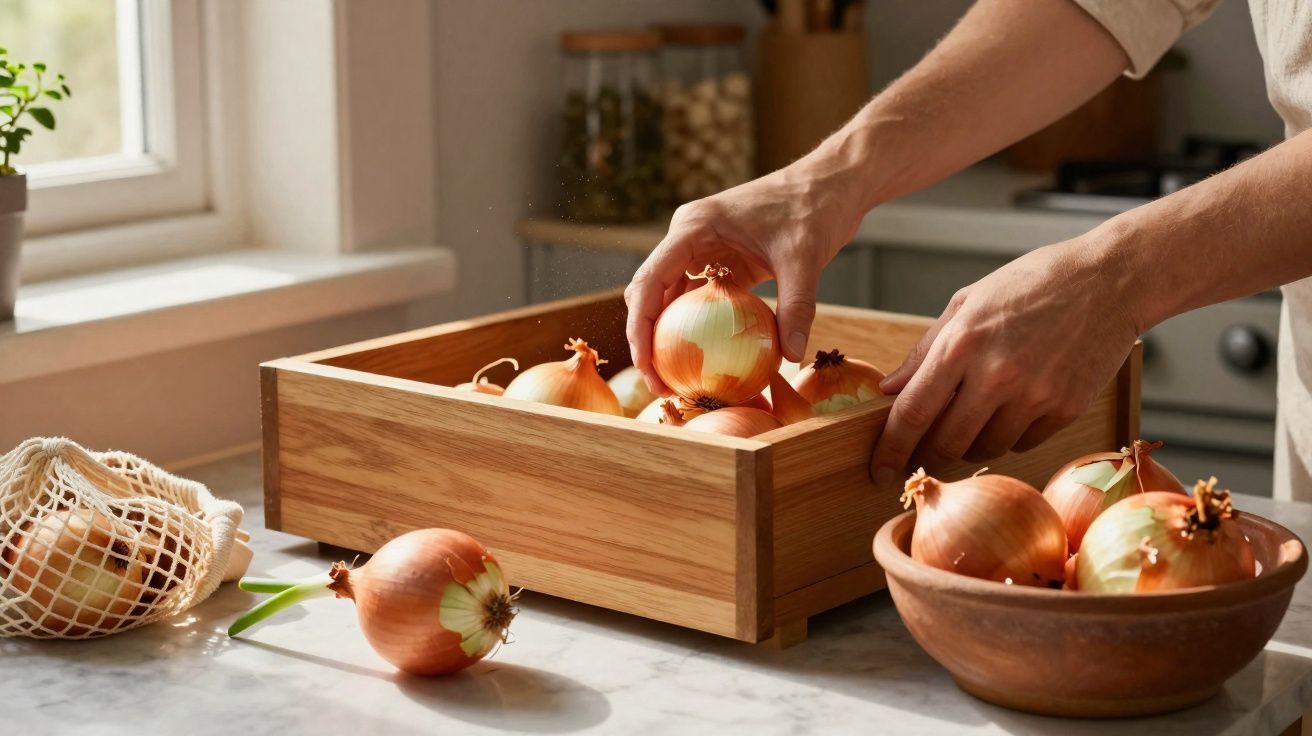
Soft patches, tiny white points nudging through the papery skin, and that faint sweet-and-sour whiff that says “past its best”. You picked up a large bag on offer, felt pleased with yourself for about a week… and then forgot about it. Now several bulbs are sending up little green shoots like miniature aerials, and you’re peeling away more and more layers, binning what should have been dinner and feeling mildly annoyed (and a bit guilty).
Elsewhere, in another kitchen not far away, someone empties onions into a simple box, slides it into a cool, unlit pantry, and doesn’t give them another thought for weeks. When they return, the onions are still firm, dry and ready to cook. Same supermarket. Same variety. Completely different outcome.
The gap between those two stories often comes down to one unglamorous factor: darkness.
Why onions reach for the light – and go downhill once they do
If you’ve ever opened a drawer to find onions with long green shoots, you’ve watched the bulb doing precisely what it was built for. An onion is a storage organ: a compact reserve of energy and moisture, waiting for the right cue to start growing. Light is one of those cues. Leave onions on a bright windowsill or beneath strong kitchen lighting and their internal “timer” effectively speeds up.
The bulb starts to interpret those conditions as a sign that it’s time to grow. It responds by pushing out a sprout in search of more light-and that’s when your cooking onion begins to change. Sugars and moisture are diverted from the layers you want to eat into the new green shoot. The onion gradually loses firmness, becomes softer at the base, and its flavour dulls. By the time you reach for it, a sizeable share of the bulb’s stored energy has been spent on a plant you never intended to cultivate.
In darker conditions, that chain reaction slows. Without light, the onion “assumes” it’s still underground and remains in a resting stage. It holds on to its moisture and stays crisp, instead of transforming into a half-started houseplant on your worktop. Simply keeping onions out of light can extend that quiet, dormant phase for weeks.
Imagine two flats in the same building.
In the first, a ceramic bowl sits beneath a bright LED strip. Onions mingle with potatoes and lemons, fully on display. Ten days later the onions begin to sprout, the potatoes are not far behind, and the bowl turns into a slow-motion spoilage scene. Without noticing, the household ends up throwing away a significant chunk of what was bought that month-money and food slipping away together.
Next door, someone uses an ordinary cardboard box tucked under the counter where daylight never reaches. The onions sit loose, perhaps in a mesh bag, with air circulating around them. Three weeks later the bulbs are still solid: no dramatic green shoots, no soggy bottoms. Food researchers looking at everyday storage patterns regularly find that low-light storage can stretch onion life from days to many weeks, particularly when paired with cooler temperatures.
What looks like a small domestic habit quickly becomes something practical: less waste, fewer last-minute dashes to the shop, and more reliable onions when you actually need them.
The quiet science: light, hormones and onion dormancy
There’s a real biological mechanism behind this “keep them in the dark” advice. Onions-like other bulbs-respond to a blend of signals: light, temperature and moisture. Light doesn’t only help leaves photosynthesise; it also stimulates growth hormones inside the bulb. Those hormones tell cells to divide and elongate, which is how that pale shoot forces its way up from the centre.
Once sprouting begins, the bulb’s priority becomes feeding the shoot.
In darkness, hormone activity slows and the leap into active growth is much less likely. Temperature still matters, but without bright light acting as a trigger, onions tend to remain in what growers call dormancy-essentially a suspended state. This is why onions are traditionally cured in shaded, airy places: the aim is to “pause the clock”. Your dark cupboard is a smaller version of that, especially if it’s dry and not overly warm.
Think of darkness as a “do not disturb” sign for an onion’s internal engine.
Onion storage in the dark: turn your kitchen into a mini onion cellar
You don’t need a rustic underground cellar-or a picture-perfect pantry-to store onions well. Start with a single choice: pick a spot that stays cool and properly dark most of the time. A low cupboard away from the oven, a pantry shelf, or even an under-stairs space can work. The key is that daylight isn’t hitting the onions whenever you walk past.
Next, make sure the bulbs can breathe. Choose a mesh bag, wire basket, or a colander (even lined with newspaper). If possible, keep onions in a single layer; if not, at least avoid a tight, compact heap. Airflow helps skins stay dry, which reduces mould, softening and early sprouting.
Then think about what’s nearby. Keep your onion area for onions, garlic and shallots rather than mixing them with other produce. Potatoes, apples and many fruits release moisture and gases that can encourage bulbs to break dormancy sooner.
Of course, real life rarely matches the ideal.
You get home with shopping, drop everything on the counter, and shove the onions into the first half-empty drawer you see. A week later, you vaguely recall the “cool and dark” rule while pulling out a bulb that feels suspiciously soft. Let’s be honest: nobody runs a flawless pantry every day.
That’s exactly why small, repeatable tweaks beat grand systems. If you only do two things-move onions away from window light and take them out of plastic-you’ll usually reduce early sprouting straight away. Swap plastic for paper or cloth so moisture doesn’t build up. If your storage space is very enclosed, open the door briefly every couple of days to refresh the air. Watch how the next few batches behave and adjust from there; your kitchen conditions will tell you what works.
One more habit that helps: when you unpack shopping, quickly sort the onions. Any bulbs with bruises, damp patches or visible green tips are best used first, because damage and active growth shorten storage life.
It’s also worth buying in a way that matches your routine. If you rarely get through a large bag before it turns, smaller quantities can be cheaper in the long run-even if the unit price looks higher.
Every cook ends up learning their own onion rules. One home cook put it neatly:
“Once I stopped treating onions like decorations and started treating them like living things, they stopped turning on me.”
That shift matters. You’re not merely hiding onions away; you’re choosing conditions that suit what a bulb is. An onion isn’t inert-it breathes, responds and changes even when you’re not paying attention. Storing onions in the dark isn’t so much a hack as working with their nature.
Here’s a simple checklist to keep in mind:
- Light: do the onions ever sit in direct sun or under strong lights?
- Air: are they trapped in plastic, or can they genuinely breathe?
- Neighbours: are potatoes or fruit sharing the same bowl or cupboard?
- Touch: do any bulbs feel soft, damp, or already sprouting?
- Heat: is the cupboard warmed by an oven, radiator or dishwasher?
Answer those calmly, one by one, and the sprouting problem usually shrinks quickly. Small, boring adjustments often outperform complicated storage “systems”.
Living with onions, not battling them
On a quiet Sunday, you might find yourself unpacking a fresh bag of onions with a different mindset. Some bulbs feel heavier and tighter, with clean, dry skins-those are your best keepers. A couple may already show green tips or slight softness near the root; those are the ones to turn into tonight’s soup or tomorrow’s omelette. The rest go into your chosen dark spot, not as an afterthought, but as a deliberate routine.
As the weeks pass, patterns become obvious. Onions bought during humid summer spells often deteriorate faster than those from colder months. In many homes, red onions can sprout sooner than yellow ones if the kitchen runs warm. You may also notice that the cupboard near the fridge stays cooler than the one above the kettle. None of this has to feel like homework-it’s simply learning how your home treats the ingredients you bring into it.
At a deeper level, the “store onions in the dark” rule is a reminder of how thin the line is between ingredient and living thing. The onion you chop is a plant paused between seasons: layers of stored energy waiting for the right signal. Keeping it dark maintains that pause for longer, giving you less waste, fewer surprise sprouting bulbs, and dependable flavour when you need it.
And it’s oddly satisfying. You open a dim cupboard after three weeks, lift a firm, dry onion, and get a small, private win. No drama, no sprouty mess-just food that stayed usable. In a world where so much is wasted, that modest success matters more than it seems. It begins with one simple choice: let your onions sleep in the dark until you’re ready to wake them with a knife.
| Key point | Detail | Why it matters to you |
|---|---|---|
| Store onions in the dark | Light triggers growth hormones and encourages sprouting | Fewer green shoots and a noticeably longer shelf life |
| Choose airflow over plastic | Use baskets, nets or paper bags so bulbs can breathe | Less trapped moisture, mould and softening |
| Keep away from potatoes and fruit | Avoid sharing a bowl with foods that give off moisture and gases | Reduced risk of early sprouting and less food waste |
FAQ
- Why do my onions sprout so fast on the counter? Because they’re exposed to light and warmth and are often kept in plastic or crowded bowls. The bulbs read those signals as “time to grow” and send up green shoots.
- Can I still eat an onion that has started to sprout? Yes-if it’s still firm and not mouldy. Remove the sprout and any soft centre; the onion may taste milder and feel slightly drier.
- Is the green part of a sprouted onion safe? Generally, yes. It’s a bit like a strong spring onion, though it can be tougher and sharper, so many people discard it.
- Where is the best place in my home to store onions? A cool, dry, dark cupboard or pantry with some airflow, away from ovens, radiators, dishwashers and direct sunlight.
- How long can onions last when stored in the dark? Whole, cured bulbs kept in a dark, ventilated, cool spot often last several weeks and sometimes up to a couple of months, depending on the variety and your home conditions.
Comments
No comments yet. Be the first to comment!
Leave a Comment