
The bananas you set on the kitchen counter always seem blameless on day one: firm, bright yellow with a faint green tinge, ready for breakfasts and smoothies all week. Then normal life takes over. You glance away to deal with a few emails, lose time to your phone, and-somehow-they’re speckled, softer than you remember, and teetering on the brink of banana-bread territory. You give one a sniff, press the skin a bit too hard, and wonder how they managed to age an entire week overnight.
Some people point the finger at the supermarket. Others blame room temperature. The real reason is less obvious than either.
It’s sitting right at the top of the bunch.
Why your bananas all ripen at the same time
Take a proper look at a bunch of bananas in your kitchen. Every banana is attached at the top, held together by that thick, slightly tacky crown where the stems meet. That little hub is where the speed of ripening is set-helpful if you eat quickly, annoying if you don’t.
Bananas are classed by scientists as climacteric fruits, meaning they carry on ripening rapidly after they’ve been picked. As they ripen, they give off a natural plant hormone called ethylene, and a lot of that ethylene is released from the crown area. The more ethylene that lingers around the bunch, the faster everything shifts from greenish-yellow to yellow, and then on to brown.
It often plays out the same way: you buy a generous bunch on Sunday feeling virtuous and organised. Day two looks ideal. Day three brings the first freckles. By day four, the banana on the end has gone a bit squishy and the rest seem to be sprinting to keep up. It’s not that the fruit gods have cursed your kitchen-it’s simply that ethylene gas doesn’t stay loyal to one banana. It drifts, pools, and spreads along the crown, then moves back down into the fruit.
In plain terms, the crown acts like a central station where ethylene gathers and circulates to every banana in the bunch. The tighter the bananas are clustered, the more they “communicate” via that gas. One banana that’s slightly riper can trigger the rest, which is why a single bruised one can feel like a time bomb. If it seems like they all turn on you on the same morning, you’re not imagining it.
To slow things down, you don’t need a gadget-you need to interrupt that conversation at its source.
The plastic-wrap trick that actually buys you time
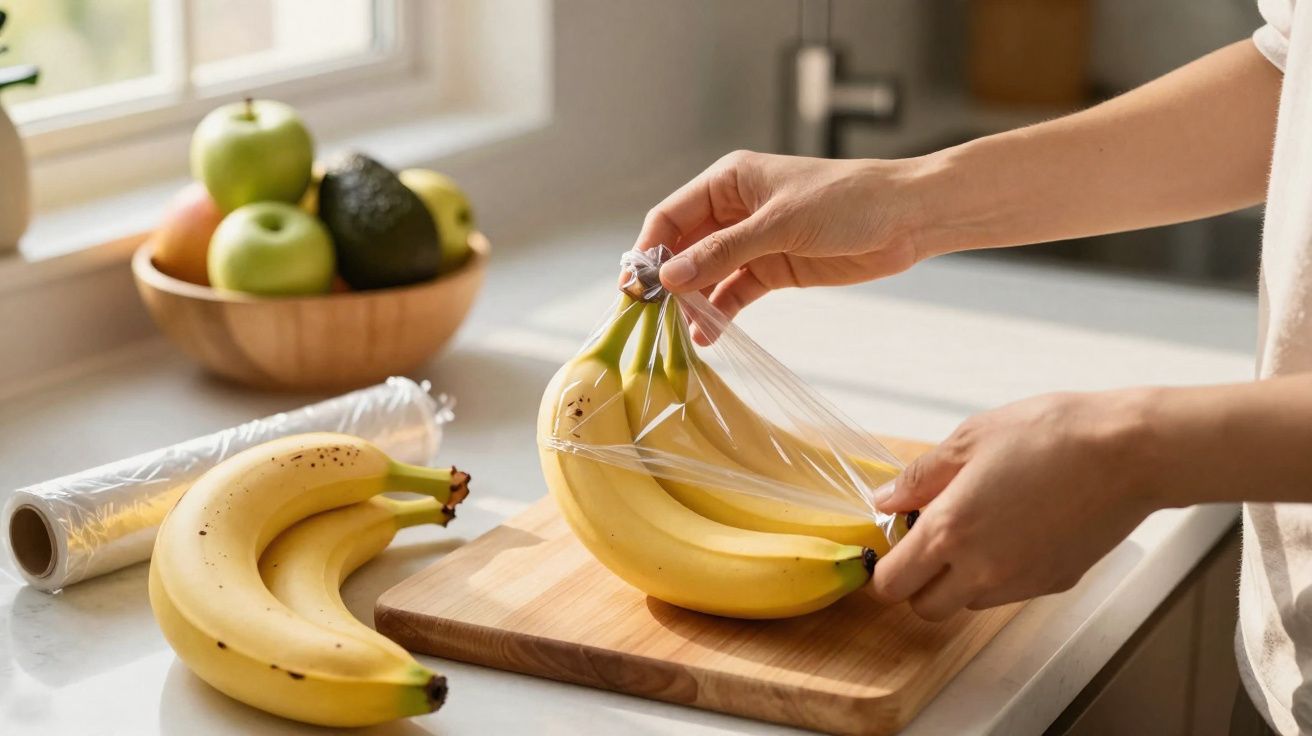
The move is straightforward: as soon as you bring your bananas home, tear off a small piece of plastic wrap and wind it tightly around the crown of the bunch. Nothing complicated-no app, no thermometer, no special storage container. Just a snug little cover on the top where all the stems join.
The idea is to keep a good portion of the ethylene right where it’s produced, rather than letting it drift freely down into every banana quite so quickly.
People who do this consistently report a very practical benefit: bananas stay in that “sweet but not mushy” stage for a couple of extra days. Not weeks. Not indefinitely. Just long enough to fit real life-when the kids skip breakfast, you’re out two evenings on the bounce, or the smoothie phase ends without warning.
We all know that moment: you look at the fruit bowl and think, “I’m sure these were fine yesterday.” With the crown wrapped, that moment arrives later. The change from green to yellow slows, and the jump from yellow to heavily spotted takes longer too-giving you more time to eat them when you actually want to.
What’s happening behind the scenes is simple cause and effect. Plastic wrap works as a barrier that reduces how quickly ethylene gas spreads from the crown to the rest of the bunch. The gas still exists, but it’s partly trapped, slightly redirected, and less available to accelerate ripening lower down each banana. That small delay can mean an extra one to three days of good texture-which, in banana time, is a big deal.
And yes, hardly anyone remembers to do this perfectly every single week. But once you notice it creates just enough breathing room to avoid the sad, almost liquid banana lurking at the bottom of the bowl, it stops feeling like a “hack” and starts feeling like a tiny, useful habit.
How to wrap bananas properly (and what people get wrong)
Start with a piece of plastic wrap slightly larger than the crown. You don’t need to mummify the bunch-just cover the exposed stem area where the bananas connect. Press the film firmly around the crown so it clings and seals. Aim for snug and secure, not loose and flappy.
If your bunch is particularly large, you can split it into two smaller clusters and wrap each crown separately. That way, one half can ripen sooner for the next couple of days, while the other half stays in slow motion.
The most common error is wrapping the wrong bit. Some people cover the bananas themselves, assuming it will “keep them fresh”. In reality, that can trap moisture and lead to odd marks or mould. The peel needs to breathe; the crown is the part you want to contain. Another mistake is waiting until the bananas are already heavily brown-spotted-by then, the ripening race is almost over.
This works best at the start, when bananas are still greenish-yellow. And if the plastic wrap slips off once, it’s not a disaster-just press it back into place and carry on.
Banana researchers and produce managers have been saying it for years: “Control the ethylene around the crown, and you control the tempo of ripening.”
- Wrap only the crown
Keep the plastic on the stem area where the bananas connect, not on the fruit itself. - Use a small, tight piece
A modest amount of wrap is enough if it’s pressed on firmly. - Start early in the week
Wrap as soon as you get home from the shop, before serious spotting appears. - Combine with cooler spots
Store bananas away from ovens, sunny windowsills, and heaters to slow ripening gently. - Separate for timing
Split the bunch in two: leave one half unwrapped if you want some bananas to ripen faster.
If you’re trying to reduce single-use materials, the same principle applies with alternatives: a reusable beeswax wrap or snug silicone cover can work, as long as it fits tightly around the crown and stays in place.
And if you do end up with bananas that outrun your plans, you can still reduce waste: peel and freeze ripe bananas for smoothies later, or mash them for baking. Slowing ripening is helpful-but having a back-up plan makes the fruit bowl feel far less like a weekly gamble.
A tiny kitchen habit that changes how you buy fruit
Once you settle into this small wrapping ritual, it can quietly shift how you think about the fruit bowl. Bananas stop feeling like a race against the clock and start feeling more like a rhythm you can manage. A bunch becomes less of a countdown and more like flexible stock you can stretch across the week.
For some households, that means buying bigger, cheaper bunches without the low-level guilt of watching half of them turn into counter-top waste.
There’s also a strangely satisfying moment on day five when you walk past and see mostly yellow, still-edible bananas instead of an emergency pile destined for banana bread. It won’t fix every food-storage challenge in your kitchen, but it does deliver one small, tangible win where food, money, and day-to-day chaos collide.
Your bunch, your pace-thanks to that unassuming little crown.
| Key point | Detail | Value for the reader |
|---|---|---|
| Wrap the crown, not the fruit | Cover the stem area where bananas join with snug plastic wrap | Slows ethylene spread and extends the “perfect to eat” window |
| Start early in the ripening | Apply the wrap when bananas are still greenish or just yellow | Gains 1–3 extra days before heavy spotting and mushiness |
| Combine with smart storage | Keep bananas away from heat, and separate part of the bunch if needed | Reduces waste, saves money, and gives more control over ripening |
FAQ:
Question 1 Does wrapping the crown completely stop bananas from ripening?
Answer 1 No-it only slows the process. Bananas still ripen naturally, just at a gentler pace.Question 2 Can I use something other than plastic wrap?
Answer 2 You can use reusable beeswax wrap or silicone covers, as long as they fit tightly around the crown.Question 3 Should I put wrapped bananas in the fridge?
Answer 3 You can refrigerate ripe bananas; the peel will darken, but the inside stays firmer for longer. Wrap the crown first if you want extra slowdown.Question 4 Does separating each banana work better than wrapping the crown?
Answer 4 Separating can help a bit, but wrapping the crown of small clusters is often more practical for everyday use.Question 5 Is this trick useful if I eat bananas very quickly?
Answer 5 If you finish them in a day or two, you may not notice a big difference. It helps most when bananas usually sit on the counter for longer.

Comments
No comments yet. Be the first to comment!
Leave a Comment