
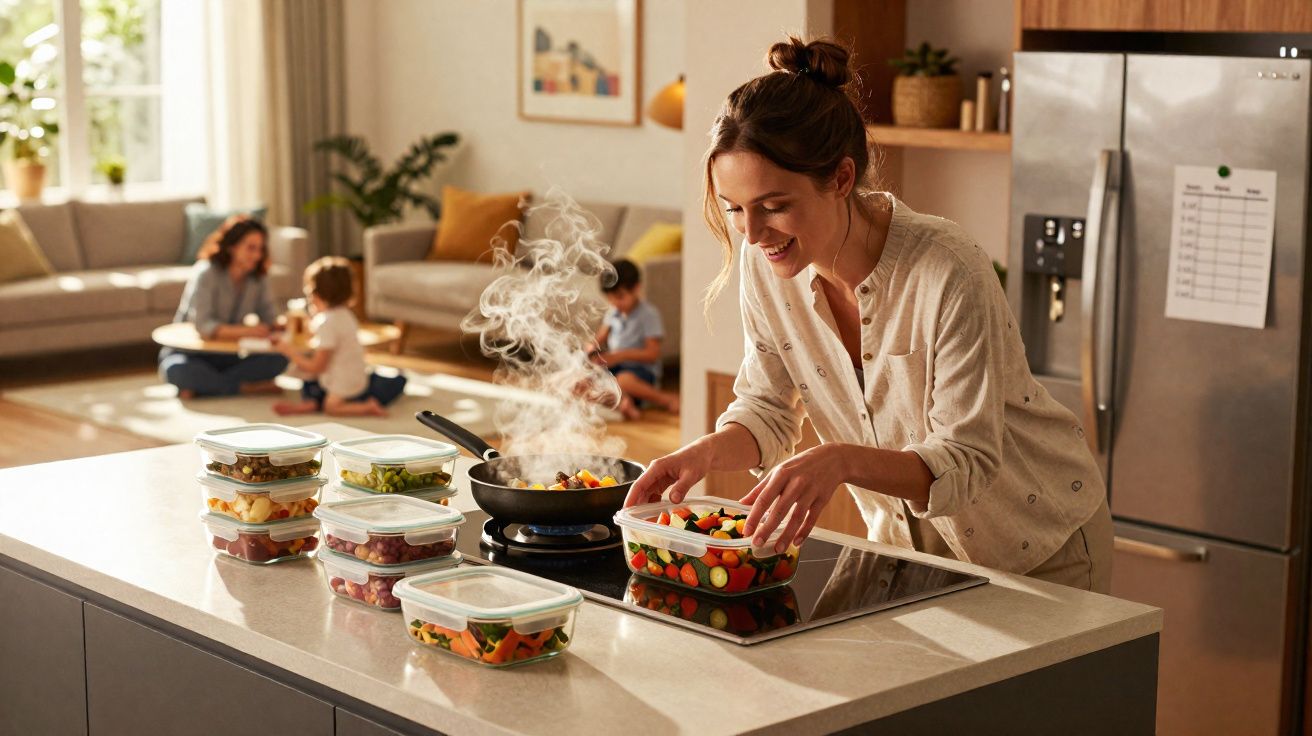
The laptop clicks shut, dusk is already pooling between the buildings, and your stomach announces-loudly-that it would like attention now.
You swing open the fridge door. Half an onion. One solitary carrot. A jar of suspicious sauce that looks like it might have gone out of date in a previous government. You reach for the delivery apps, watch the time slip, and feel the evening disappear before it’s properly begun.
On paper, weekday nights look roomy: finish at 6, lights out at 11, a generous five-hour stretch. In real life, those hours get nibbled away by commuting, overdue emails, laundry, and the ever-present question: “What’s for dinner?” By the time food finally reaches the table, the energy for chatting, playing with the kids, or simply sitting in quiet has already been used up.
A growing number of people have found a calm, almost sneaky way through the chaos. It begins on a Saturday morning, smells like roasted vegetables, and feels a bit like you’ve found a loophole in time.
Why your weekday evenings keep disappearing
Most weeknights aren’t ruined by major crises. They’re eroded by tiny, repetitive delays: hovering in the supermarket at 7 pm weighing up frozen pizza versus “something healthy”; rummaging for a clean pan; realising the rice needs 20 minutes when you’re already starving. Each moment is minor. Together, they swallow the best part of the evening.
You come home with a plan. “I’ll make something quick, then we’ll watch that series, maybe read for a bit.” Forty-five minutes later you’re eating standing up, phone in one hand and emails in the other. The evening has technically started, but it doesn’t feel as if you’ve actually arrived.
Meal batching doesn’t make your job simpler, your children calmer, or your manager kinder. What it does do is remove one of the biggest weekday friction points: deciding what to cook, prepping it, and cooking from scratch when you’re already running on empty. That single knot of effort is what quietly steals your nights.
There’s also a dull-but-powerful psychological piece: our brains dislike open loops. “What are we having?” is one loop. “Do we have what we need?” is another. “Do I even have the energy to cook?” is yet another. After a full working day, these micro-decisions stack up like mental clutter. By 8 pm you can feel oddly depleted-and you still haven’t done anything enjoyable.
Emma’s Thursday turnaround with weekend meal prep and meal batching
Take Emma, 34, a project manager with two children. A year ago, Thursdays were predictably chaotic: a meeting that overran, traffic that crawled, then the 6:45 pm chorus of “What’s for dinner?” She’d dash into the kitchen, drag out whatever happened to be in the fridge, and end up serving pasta with “any old sauce” three weeks out of four. She’d eat quickly, then collapse on the sofa scrolling until bedtime, mind buzzing and body heavy.
One Saturday she tried something she’d seen on TikTok: cooking several dinners in one afternoon. She roasted two trays of vegetables, made a large saucepan of quinoa, grilled chicken, and put together a lentil stew. Everything went into glass containers. The following Thursday, she walked in, reheated the stew, sliced some bread, and had dinner on the table in 10 minutes. Her kids stared. She did too.
Three months later, Emma describes Thursdays as “almost chilled”. Her days are still packed. The drive home is still irritating. But dinner is no longer a question mark. It’s simply step three in a calm sequence: get in, warm up, sit down, breathe.
How meal batching on weekends closes the loops (before they drain you)
Weekend meal batching shuts those loops early. When you cook four or five base dishes on Saturday or Sunday, you’re not only preparing food-you’re making the decisions once for the entire week. You’re removing the daily bargaining with yourself, with the fridge, and with everyone else at home. Let’s be honest: nobody wants to do the full “what’s for dinner?” routine every single day.
That’s why weeknights suddenly feel lighter. The gain isn’t only the 25 minutes you’re not actively cooking. It’s the headspace you stop burning on “What now?” That quiet mental space is where conversations, board games, short walks, or even silence can finally fit.
How to batch meals on weekends without turning your kitchen into a factory
The aim isn’t to sacrifice your whole Sunday to the hob and the oven. The aim is to build a focused 90-minute session that quietly reshapes the week ahead. A simple framework works well: choose three flexible bases (such as grains, proteins, and roasted vegetables) plus two ready-to-heat complete meals (such as soup and a curry). Mixed and matched, that’s enough variety to cover five dinners.
Here’s a workable example: cook a large pot of brown rice or quinoa; roast two baking trays of mixed vegetables with olive oil and spices; and prepare a batch of chickpeas or chicken. Then make a hearty soup and one sauce-based dish such as dal or bolognese. Tuesday becomes: reheat rice, add roasted veg and chickpeas, finish with yoghurt or hummus. Thursday becomes: warm soup, add bread and cheese. Ten minutes. No drama.
After you’ve done this a couple of times, you’ll know how much your household actually eats and you can tweak quantities. The point isn’t Instagram-perfect meal prep boxes. The point is decent food with minimal friction, waiting for you when you walk through the door.
The quickest route to hating meal batching is overreaching. You choose six complicated recipes, shop for 37 ingredients, and end up exhausted before you’ve even started. Or you prepare salads that turn limp by Wednesday, and the whole plan feels like a flop.
Begin with dishes you could almost make on autopilot: chilli, roasted vegetables, sheet-pan chicken, tomato soup, lentil curry, frittata. They’re simple, forgiving, and reheat well. Pick flavours you genuinely want on a tired Thursday-not just ideas that look good on Pinterest.
And if you miss a weekend, don’t treat that as proof the system “isn’t for you”. It only means life got in the way. On a hectic weekend, even pre-chopping onions, carrots, and garlic can cut weekday cooking from 40 minutes down to 15.
“Weekend meal batching is less about food and more about energy,” a nutrition coach told me. “You’re not just cooking-you’re deciding that the weekday version of you deserves to come home to something already sorted.”
That mindset changes the way you plan. You’re not performing for your fridge. You’re helping Thursday-you. Tired-you. The-you-who-just-wants-to-sit-down. That person is worth 90 minutes on a slow Sunday afternoon, a podcast on in the background, and the oven gently humming.
- Start small: two bases plus one complete meal is plenty.
- Repeat meals: most people are happy to eat the same chilli twice in a week.
- Freeze portions you won’t eat before Thursday.
- Use clear containers so you can see your options straight away.
- Schedule one “lazy night” with frozen pizza or a takeaway-guilt-free.
Storage and food safety for meal batching (so it stays easy)
A little planning around storage keeps weekend meal prep enjoyable rather than stressful. Let hot food cool before sealing it away, and label containers with what’s inside and the day you cooked it. If you know you won’t eat something within a few days, freezing it early usually preserves flavour and texture better than leaving it to linger at the back of the fridge.
It also helps to separate components when you can. Keep sauces apart from grains, and store crunchy toppings (like seeds or croutons) away from anything steamy. That way, your batched food still feels fresh on Thursday rather than like a sad reheated compromise.
The quiet freedom that arrives on a Tuesday night
Once dinner stops being an emergency, something surprising happens: evenings feel longer. There’s an obvious practical benefit-more time to talk, move, and breathe. But there’s also a subtle emotional shift: you feel more in charge of your life, rather than constantly reacting to it.
In a batched week, you might step through the door, drop your bag, and put music on instead of preheating the oven. A stew warms while your child tells you about a drama at school, and you actually hear the story. You eat before 8 pm. You might still feel tired, but you’re less frazzled. The night stops feeling like a sprint.
Everyone knows that moment: you glance at the clock, realise it’s 9:30 pm, and wonder what you’ve done with the evening. Meal batching doesn’t manufacture spectacular, show-off nights. It makes room for small, ordinary, deeply human ones: a slow walk, an extra episode, a call to someone you miss, or getting to bed on time without resentment.
And that may be the real secret. Weekend meal prep isn’t about becoming a hyper-organised person with colour-coded tubs and flawless routines. It’s about quietly lowering the number of weekday battles. One fewer decision. One less rush. One less reason to say, “I’m too tired-maybe tomorrow.”
So what would your evenings look like if dinner were already handled for the next five days? Not as a concept, but as something real: ready in your fridge, waiting for you to come home and simply live.
| Key point | Detail | Benefit to you |
|---|---|---|
| Batch once, decide once | Plan and cook several bases at the weekend | Cuts mental load and daily decision-making |
| Simple, comforting recipes | Chilli, soups, curries, roasted vegetables, grains | Fast, filling meals that reheat well |
| Protect weekday evenings | Less time cooking, more quality time | Helps you actually enjoy the end of the day |
FAQ
How many meals should I batch on the weekend?
Begin with three dinners plus a few flexible bases (grains, roasted veg, and a protein). You’ll quickly learn whether you need more or less.Won’t it feel boring by Thursday?
Use neutral bases and switch the toppings and sauces. The same rice and veg can become bowls, wraps, or side dishes with completely different flavours.How long does a batching session really take?
For most people, 60–90 minutes of focused cooking is enough to support four to five evenings, particularly with traybakes and one-pot meals.What if I don’t like reheated food?
Batch components instead of full meals: wash and chop vegetables, cook grains, marinate proteins. You still halve the weekday effort.Is meal batching compatible with a tight budget?
Yes-often it saves money. Buying in bulk, leaning on pulses, and reducing last-minute takeaway orders can noticeably lower weekly food spending.





Comments
No comments yet. Be the first to comment!
Leave a Comment