
The first time I watched a mum pull a scrunched-up packet of Haribo from her coat pocket at 8:15 in the morning, I made an instant judgement. We were stood by the school gates, the children still bleary-eyed, and her five-year-old was cheerfully chewing a gummy bear as if it were breakfast. I looked down at my neatly packed apple slices and felt, smugly, that I was doing it “right”. Sweets before the first lesson of the day-seriously?
About a week after that, I saw her again. Her child was relaxed, chatting away, school bag on, no drama at all. Mine, meanwhile, was in full meltdown because I wouldn’t hand over a second cereal bar. She met my gaze, gave a small smile, and said, “He knows he gets a few sweets every day, so he doesn’t argue about it anymore.”
That moment lodged in my head.
And it led to a question that sounded wrong the first time I thought it:
Could daily sweets actually make children… healthier?
Daily sweets for children: when “forbidden” sugar becomes just another food
At a birthday party recently, I watched a group of six-year-olds orbit a three-tier chocolate cake the way seagulls circle a chip shop. A few of them were visibly wound up-hands hovering, eyes wide, buzzing with anticipation. The cake wasn’t just pudding; it was the “special” thing they’d been waiting for all week. You could almost feel the pressure building, the kind that ends in tears, tantrums, or someone being sick on the bouncy castle.
Off to one side, though, a little girl did something completely different. She took a single slice, sat down, ate about half of it, then wandered off to play. When I mentioned it to her dad, he told me she has dessert every day-sometimes fruit, sometimes ice cream, sometimes a couple of sweets. “So cake isn’t treated like the biggest event on the calendar,” he said, as if it were obvious.
That’s the point where this idea starts sounding less far-fetched.
Researchers have a name for what happens when sugar is tightly controlled: restriction. When certain foods are heavily limited or branded as “bad”, they often become more tempting. Several studies with children suggest that strict limits around sweets can make kids think about them more, talk about them more, and then go harder when they finally get access. Unlimited sweets can create obvious problems-but making sweets totally forbidden can create a different set of problems too.
Now picture sweets appearing in a predictable, low-key way. Not as a bargaining chip. Not as a rare prize. Just as a small, ordinary part of the day. When that happens, the drama tends to fade. The fixation softens. Sweets can lose some of their “power”.
There’s also an element parents don’t always say out loud: the stress of constant treat battles wears everyone down. When sugar becomes a daily, calmly managed presence, arguments often reduce or vanish. Parents stop feeling like the Sweet Police; children stop feeling watched. That calmer emotional atmosphere around food can matter more than any perfectly designed nutrition chart.
And, honestly, most of us aren’t weighing out sugar gram by gram, every single day. When children feel less pressure, they’re more able to notice their own hunger and fullness. One day they’ll eat every last gummy sweet; another day they’ll leave dessert untouched because they’d rather have pasta or chicken. Over the long run, that internal “listening” is worth far more than any one packet of sweets.
How a daily sweet can become a lesson, not a loophole
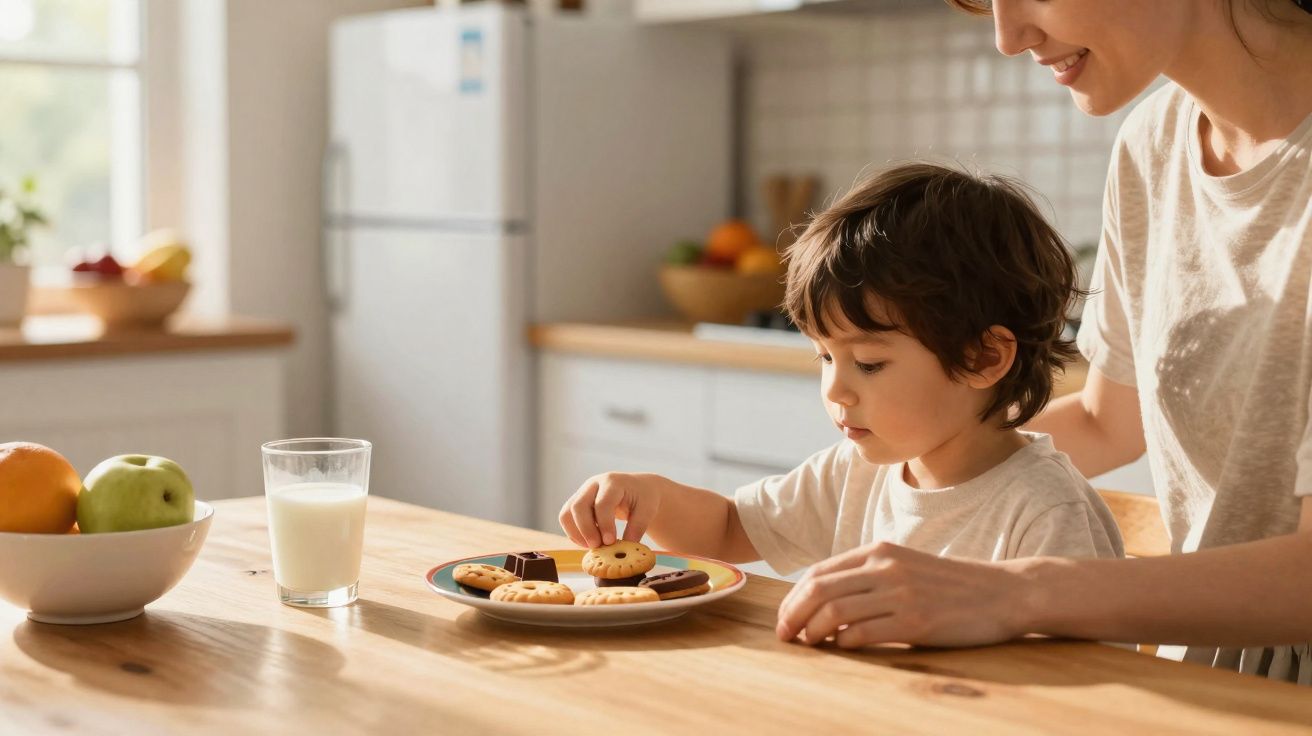
If you want to test this approach, it tends to work best with one straightforward principle: sweets are permitted, but they’re contained and clear. Not used as a bribe. Not hidden away like contraband. Instead, you create one small sweet moment each day-roughly the same time-plus a couple of calm ground rules.
That could look like:
- two squares of chocolate after a snack
- a small bowl of ice cream after dinner
- a couple of gummy bears on the walk home from school
The important part is that it’s predictable, consistent, and enforced without fanfare. No speeches, no guilt, no dramatic “this is a treat” voice. You offer it the way you offer toothbrushing: normal, routine, not something to haggle over. The goal isn’t more sugar; the goal is less drama.
Where many of us stumble is when we use sweets tactically. “If you eat your veg, you can have a biscuit.” “Stop crying and you can have a lolly.” In that setup, sugar stops being food and turns into a tool for control or comfort. The child learns that sweets are what you earn by being “good”, or what you use to shut down feelings. That’s a lot of emotional weight to attach to a marshmallow.
A daily sweet works differently when it isn’t conditional. It arrives whether your child nails spellings or has a wobble at 3 p.m. That can feel unsettling at first-but it also removes a layer of emotional charge. Sugar stops acting like the scoreboard for the day.
One nutritionist I spoke to put it like this:
“The healthiest relationship with sugar isn’t zero. It’s understanding what it is, enjoying a little, and then carrying on without guilt or obsession.”
You can also make daily sweets a quiet little learning lab:
- Offer a choice between two sweet options, so your child practises decision-making.
- Sometimes serve sweets alongside everyday food (not always afterwards) to reduce the “treat on a pedestal” effect.
- Use simple body-check language: “Is your tummy starting to feel full?” or “Does that taste extra sweet today?”
- Rotate what’s on offer so it doesn’t become a mindless automatic habit.
- Include the occasional “nothing special” day with a tiny sweet, to show that treats can be modest and still satisfying.
Handled this way, the sweet isn’t only sugar-it becomes a practical lesson in self-regulation.
Health isn’t only about sugar grams on a label
Here’s the awkward truth that charts and labels can’t fully capture: a child who eats a broadly balanced diet, moves their body, sleeps well, and feels safe around food can usually cope with a small daily sweet. The bigger risk shows up when sugar becomes secret, highly charged, or used to plug emotional gaps. That’s when sneaking, hiding, and bingeing can creep in-often long before adults realise it’s happening.
Interestingly, some paediatric dietitians now suggest that a stable, predictable sweet habit can guard against those extremes. Not because sugar “fixes” anything, but because the pattern is steady and non-dramatic. A child who experiences sweets as “just food” is less likely to bounce between rigid restriction and chaotic overeating later on, as a teenager or adult.
There’s a social piece here too. Children live in a world full of party bags, classroom cupcakes, and ice cream after football practice. A total sugar ban can quickly turn into isolation or quiet shame: your child becomes “the one who’s not allowed”. They may start swapping snacks behind your back, or feeling deeply different in a way that lingers far longer than their love of jelly beans.
On the other hand, a child who knows they’ll have something sweet every day often feels less desperate at parties and playdates. They can still enjoy cake-but they’re less likely to act as though it’s their last sugar on earth. Ironically, that calmer behaviour can look a lot like health.
There’s also a practical reality many doctors admit privately: real families don’t live on perfect meal plans. Parents are balancing shifts, budgets, mental load, and a food environment built around convenience. For some households, a small, limited daily sweet helps the rest of the day run more smoothly. It gives children a firm reference point: “Yes, you’ll have something sweet later.” That tiny certainty can prevent supermarket snack ambushes or relentless 4 p.m. pleading.
Over time, another pattern often appears. Children who feel trusted around food are more likely to trust their bodies. They learn that no single food is magic and no single food is poison. For many families, that’s one of the most meaningful forms of health on offer.
One extra consideration worth naming is what counts as the sweet. Drinks can be the sneakiest route to high sugar intake, and they’re much easier to consume quickly than a couple of sweets. If you’re adopting daily sweets, many parents find it helps to keep sugary drinks rare, prioritise water and milk, and keep the “sweet moment” something you can portion and eat mindfully.
It can also help to model the tone you’re aiming for. When adults talk about sweets without moral language (“naughty”, “bad”, “being good”), children pick up that neutrality. If you can show, in your own eating, that you can enjoy something sweet and then move on without guilt or obsession, you’re teaching the lesson twice: with structure and with example.
Where this leaves us as parents
At first glance, “giving children sweets every day might make them healthier” sounds upside down. We’ve been told for years that sugar is the enemy, that good parents remove it, and that strong willpower means constant refusal. But slogans rarely match real life. Real children live in busy kitchens, loud playgrounds, and a world where treats are everywhere.
So the question often becomes less “Should my child ever have sweets?” and more “How can sweets exist in our home without running the place?” For some families, daily sweets-clearly defined and calmly shared-end up being the answer. Not a loophole. Not giving up. A simple structure that reduces battles and anxiety, and creates room for bigger conversations about hunger, pleasure, and balance.
You may still decide that daily sweets aren’t right for your situation. Your child might have specific health needs, or your own history with food may make this feel complicated. That’s fine. The deeper takeaway remains: children generally need less fear and more trust around eating. Whether sweets are allowed twice a week, only at weekends, or in a small daily portion, the tone matters most-calm, clear, and non-moralising.
Imagine, for a moment, a generation that isn’t frightened of sugar-and also isn’t controlled by it. Teenagers who can walk past a vending machine and genuinely think, “Not hungry right now.” That kind of quiet health won’t appear on any packet, but it can echo for decades.
| Key point | Detail | Value for the reader |
|---|---|---|
| Daily sweets can reduce obsession | Small, predictable portions can make treats feel like ordinary food rather than forbidden treasure. | Helps parents reduce sugar drama and binge moments at parties or days out. |
| Structure beats strict bans | Clear, consistent boundaries around sweets tend to work better than emotional bargaining or total restriction. | Offers a realistic, lower-stress strategy families can actually stick with. |
| Emotional climate matters most | Children who feel trusted (and not shamed) around food are more likely to develop healthier lifelong habits. | Supports long-term wellbeing beyond calories and labels. |
FAQ
Question 1: Won’t a daily sweet make my child crave sugar all the time?
Often the reverse happens. When sweets are predictable and limited, they stop feeling like rare treasure. Many parents find begging and sneaking reduce rather than increase.Question 2: How much is “safe” for a daily sweet?
Keep it small and straightforward: a mini chocolate bar, a couple of biscuits, a few gummy sweets, or a small ice cream. The overall daily diet matters far more than any single treat.Question 3: Should I use sweets as a reward for good behaviour?
Ideally, no. Tying sugar to performance or emotions gives it too much influence. Offer the sweet regardless of behaviour, and use other rewards (time together, games, praise) when you want to reinforce behaviour.Question 4: What if my child has dental problems?
Speak with your dentist about timing and brushing. Having sweets with meals (rather than constant grazing), alongside solid brushing habits, can help protect teeth.Question 5: My child goes wild around sugar. Is this still a good idea?
Start slowly. Offer a small, clearly defined portion at a calm point in the day and watch what happens. If you need tailored support, a paediatric dietitian can help shape an approach to your child’s specific responses.



Comments
No comments yet. Be the first to comment!
Leave a Comment