
The steak had been resting on the kitchen worktop for an hour, beading with moisture and staining the chopping board with a dark red ring. There was still a faint trace of garlic in the air from last night’s meal, and the low, late sunshine cut a bright strip across the tiles. In your mind you could already hear the pan crackle, already imagine the ideal crust and that warm pink centre. It all felt normal-almost cinematic in how everyday it was: meat on the side, a glass of wine within reach, music murmuring in the background.
In that moment, nobody is picturing bacteria quietly multiplying.
Why room-temperature thawing feels “normal” - and why it’s quietly risky
In many homes, the way we handle frozen meat is less “best practice” and more inherited routine. Something comes out of the freezer, goes straight on the counter, and sits there while the rest of life takes over: schoolwork, emails, errands, a quick scroll on your phone. When you remember it again, the meat is soft and flexible-apparently ready to cook.
It seems practical. It seems faster. It feels like what “everyone does”.
On a busy weeknight, that shortcut can look completely harmless. You’re tired, you’re hungry, and a frozen pack of chicken thighs appears to defrost far more quickly on the worktop than tucked away in the fridge. So you peel back the packaging, pop it on a plate, and tell yourself it’ll only be “a minute”. Three hours later the chicken is fully thawed, glossy with surface moisture-and the problem is still invisible.
The kitchen looks spotless. The risk doesn’t.
What’s going on while that meat sits at room temperature is straightforward and unpleasant: once the surface rises above 5°C, it enters the danger zone-roughly 5°C to 60°C-where bacteria can grow rapidly. Pathogens such as Salmonella and Campylobacter don’t wait for you to notice; on a damp, protein-rich surface they can double, then double again, every 20–30 minutes. The middle may remain icy for quite a while, but the outside has effectively become a warm incubator.
Cooking does kill many germs, yes-but it can’t reliably undo every toxin that may have been produced while the meat sat in the danger zone.
Safe thawing with the fridge-thaw method for meat (and why it works)
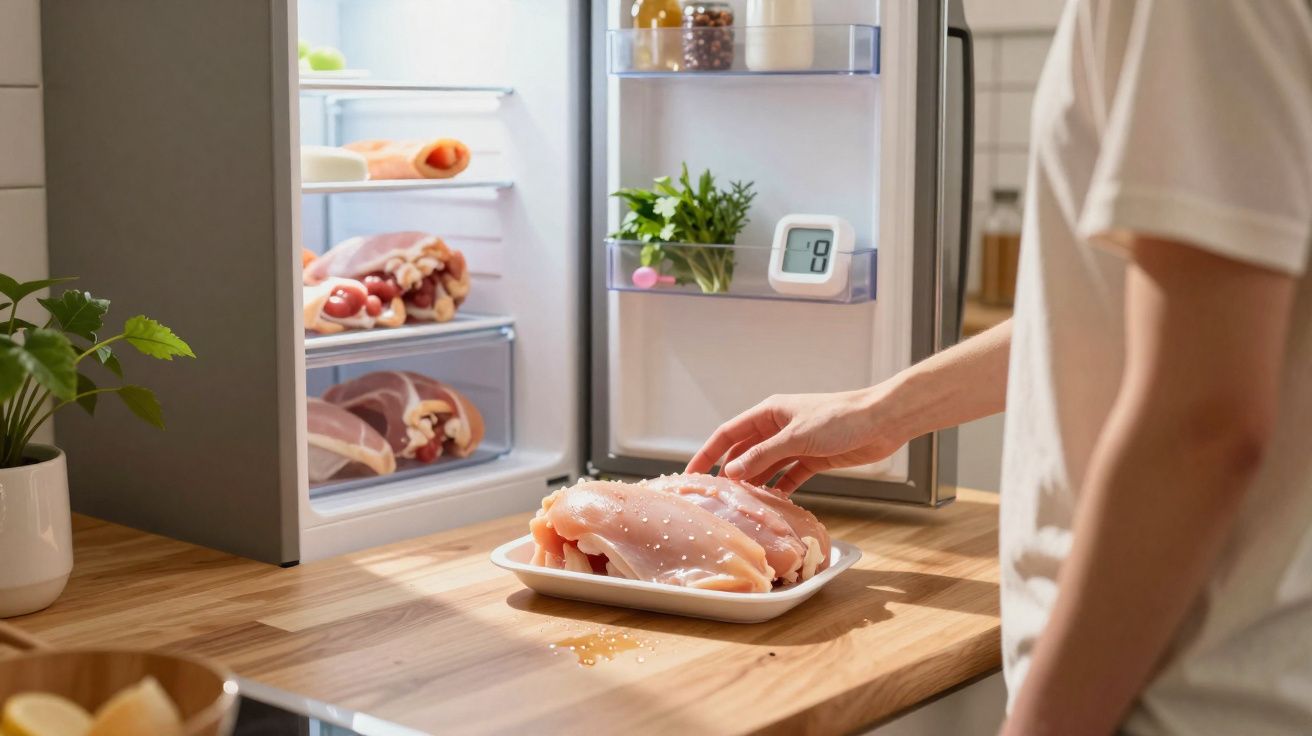
The fridge-thaw method sounds almost dull, which is precisely the point: it’s deliberately uneventful. Move the frozen meat from the freezer to the fridge, set it in a shallow dish or on a tray to catch any drips, and leave it for several hours or overnight. Because the meat stays below the danger zone, bacteria don’t get the chance to take off in the first place.
It’s slow on purpose-a safety net you put in place ahead of time.
Once it becomes routine, fridge thawing subtly reshapes how you cook. You start thinking a meal or two in advance: transfer tomorrow’s chicken into the fridge the night before, and let time do the work quietly. If you’re organised on a Sunday, you might set up the week: chicken for Monday, minced beef for Tuesday. Then on Wednesday morning you’ve got a steak that’s thawed safely and ready to sear-without the last-minute scramble.
Let’s be honest: nobody manages this perfectly every day.
But on the days you do, dinner feels calmer, simpler, and safer.
There’s a second benefit people often overlook: cross-contamination. Meat left to “sweat” on the worktop can leak juices onto boards, cloths, taps, and utensils-spreading bacteria to places you won’t notice until much later. With fridge thawing, the meat stays contained in one cold area, sitting in a dish that captures any liquid. That means fewer contaminated surfaces, fewer stray smears on door handles, and fewer unseen risks on little hands.
The science is uncomplicated; the effect is bigger than it looks.
A useful backup when you’re short on time (without returning to room-temperature thawing)
Real life doesn’t always allow for perfect planning. If you need meat sooner than the fridge-thaw method allows, a safer alternative is cold-water thawing: keep the meat sealed, submerge it in cold water, and change the water regularly so it stays cold. This speeds thawing while limiting how long the outer layers sit in the danger zone.
What doesn’t help is warm or hot water, which can bring the surface temperature up quickly-exactly what bacteria like.
Everyday tips to make fridge thawing genuinely doable
The simplest way to stick with fridge thawing is to attach it to a habit you already have. Check the freezer while the kettle boils, when you set up the coffee machine, when you pack a school bag, or as part of brushing your teeth before bed. Take out tomorrow’s meat, place it in a bowl or lidded container on the lowest shelf of the fridge, and then stop thinking about it.
Let cold air and the clock do the “work” while you sleep.
Another practical approach is to portion large packs before you freeze them. Split bulk buys into single-meal amounts in freezer bags or containers. Smaller portions thaw far more quickly in the fridge, so you’re not stuck with a rock-solid 2 kg joint that needs roughly two days to defrost safely. When your schedule is tight, thinner items-steaks, fillets, burger patties, or small packs of mince-are your friends: they can thaw in hours rather than days.
As a bonus, this habit also reduces food waste when plans change at the last minute.
“Food poisoning rarely looks dramatic in your kitchen. It looks like a quiet plate of dinner, and the consequences arrive long after the dishes are done.”
There’s also a human, emotional side to this. On a screen, bacteria are statistics; in real life, they can be the difference between a relaxed family meal and a night spent miserable in the bathroom. No one wants to be the person who served the dinner that made everyone ill.
- Thaw meat in the fridge on a tray or in a dish-never directly on a shelf.
- Store raw meat below ready-to-eat foods to prevent drips.
- Use thawed meat within 1–2 days, particularly poultry and mince.
- Throw away meat left at room temperature for more than 2 hours.
- Wash hands and clean surfaces after handling raw, thawing meat.
A small habit that changes how you feel about your kitchen
On paper, the rule is easy: don’t thaw meat on the worktop at room temperature; use the refrigerator instead. In practice, it collides with tired evenings, unexpected invitations, and forgotten packs shoved to the back of the freezer. That gap between what we know and what we do shows up in almost every kitchen.
At a deeper level, it’s about managing invisible risks in the one place that’s meant to feel safe.
Most people recognise the dilemma: you find a pack of chicken that’s been out “too long”, and you hover, debating. It smells fine. It looks fine. But the clock is telling a different story, and you’re stuck between appetite and doubt. Switching to fridge thawing won’t erase those moments overnight, but it makes them rarer. Over time, it shifts the inner question from “Will this be alright?” to “I know exactly how this was handled.”
That quiet confidence is a kind of comfort you can feel-even though you can’t see it.
Talk to friends or family about food poisoning and you’ll hear familiar tales: the grim weekend after a barbecue, the so-called “24-hour bug” that likely wasn’t a virus, the child who was ill while everyone else seemed fine. People remember these episodes even when they never connect them to thawing habits or room-temperature shortcuts. Safe thawing is not about fear; it’s about matching small daily choices to what science-and lived experience-has been telling us for years.
One tray in the fridge is one less silent gamble on your plate.
| Key point | Detail | Why it matters to you |
|---|---|---|
| Danger zone | Bacteria multiply quickly between 5°C and 60°C, especially on meat left at room temperature. | Explains why the worktop feels convenient yet genuinely increases the risk of food poisoning. |
| Fridge-thaw method | Slow thawing below 5°C keeps meat out of the danger zone and limits microbial growth. | A simple, repeatable method that fits real life and unexpected changes of plan. |
| Practical organisation | Portion before freezing, move meat into the fridge the night before, and use a tray to contain juices. | Turns theory into everyday habits you can actually stick to. |
FAQ
Can I ever thaw meat on the counter if my kitchen is cool?
Even in a cool room, the outside of the meat can warm into the danger zone long before the centre has thawed. Fridge thawing remains the safer option in every season.Is it safe to thaw meat in warm water?
Warm water speeds thawing, but it also heats the outer layers into ideal conditions for bacteria. If you use water, it should be cold, the meat should be sealed, and the water should be changed regularly.How long can thawed meat stay in the fridge before cooking?
Most thawed meat will keep for 1–2 days in the refrigerator, with mince and poultry best cooked sooner rather than later.Can I refreeze meat that was thawed in the fridge?
If it was thawed safely in the fridge and kept cold, you can refreeze it, although the texture may deteriorate slightly.Doesn’t cooking kill all the bacteria anyway?
Cooking at sufficiently high temperatures kills many bacteria, but some toxins produced while meat sits in the danger zone can be heat-stable and still make you ill.

Comments
No comments yet. Be the first to comment!
Leave a Comment