
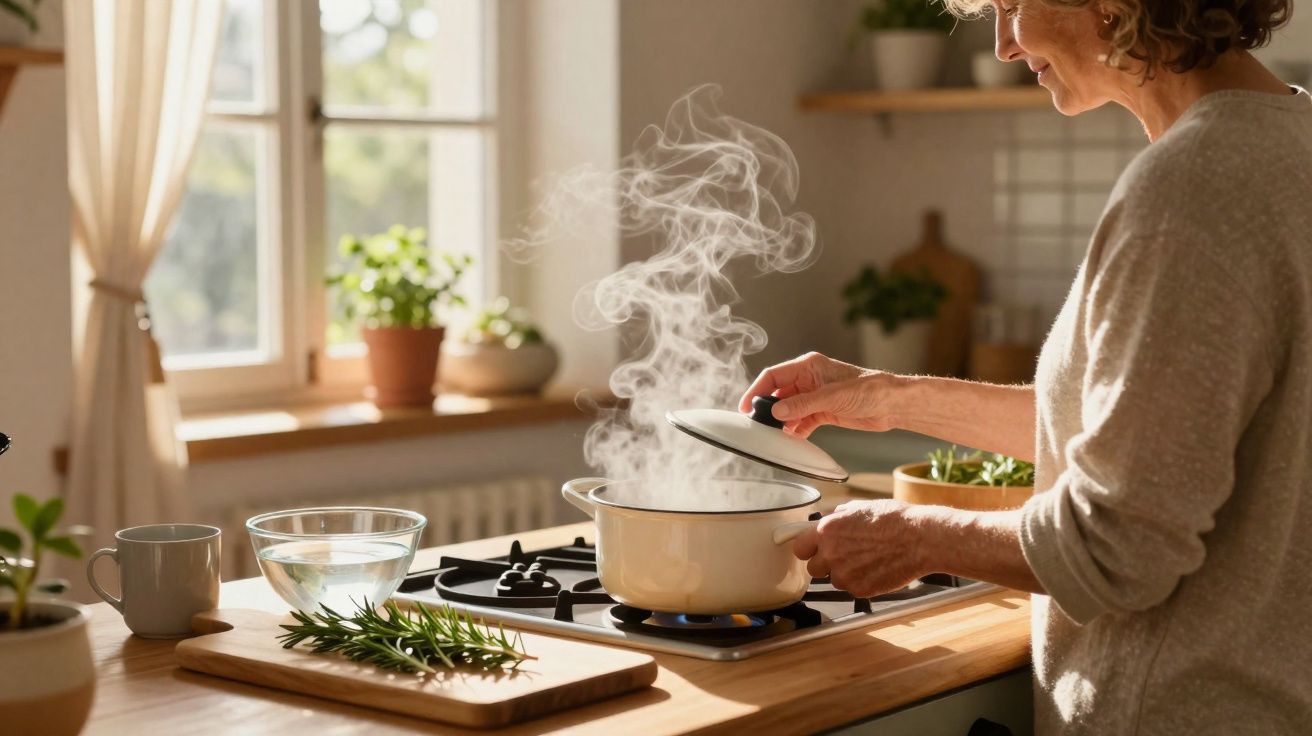
The first time I watched my grandmother fling a fistful of rosemary into a pan of boiling water, I genuinely assumed she’d missed the potatoes. The kitchen was already packed with the usual Sunday commotion: chairs dragging on the floor, the radio crackling, cousins bickering over who was meant to lay the table. Then something else arrived - faint at first - a crisp, green, slightly resinous scent that sliced through the stale mix of fried food and cigarette smoke.
She would lift the lid, let the steam drift into the sitting room, and murmur - half to herself - “There. The house can breathe again.” No plug-in diffuser. No candle pretending to be a woodland. Just a herb, a bit of water, and a few minutes.
At the time, it sounded like an old wives’ tale.
Now, the research is finally catching up with that small kitchen habit - and the evidence is more convincing than you might expect.
Why boiling rosemary can change the feel of an entire room
Walk into a home where something was fried the night before and you know straight away. The smell lingers in curtains, coats and even hair, like an invisible layer that refuses to budge. My grandmother understood that problem well; she lived in a small flat where “airing the place out” in winter was easier said than done.
So she’d step out to her balcony pots, snip a few rosemary sprigs, rinse them under cold water, and drop them into a pan at a gentle simmer. After only a few minutes, the atmosphere would seem less heavy. The greasy odour would retreat, replaced by a clean, sharp herbal note that prompted the familiar question: “What’s on? It smells so fresh in here.”
I remember one evening in particular, after everyone had crowded into that little flat. The windows were misted up, the radiators were hissing away, yet the air didn’t feel as stifling as it should have. The only difference was that rosemary bubbling quietly on the hob.
Much later, I started reading about indoor air quality, volatile organic compounds (VOCs), and plant essential oils. Researchers have measured how aromatic plants emit volatile molecules that can interact with airborne odours, some pollutants, and even certain microbes. Rosemary appeared again and again, alongside compounds such as camphor, 1,8-cineole, and alpha-pinene - terms my grandmother never used, but which neatly describe what she seemed to notice with her nose and chest.
What she was doing, without calling it that, was shaping a small indoor “microclimate”. As rosemary boils, its essential oils hitch a ride on tiny droplets of steam and spread through the room. Those volatile compounds can help mask and disperse unpleasant smells, gently stimulate the nervous system, and (in laboratory conditions) demonstrate antimicrobial and antioxidant activity.
The water vapour itself plays a part as well: humidity can encourage dust and fine particles to clump and settle sooner, instead of hanging in the air for hours. It’s a decidedly low-tech way of influencing the air - long before anyone talked about PM2.5 and VOCs. Her ritual wasn’t mysticism; it was everyday chemistry performed in an apron and slippers.
Boil rosemary at home: a practical method that actually works
This is almost embarrassingly straightforward to copy. Use a medium saucepan, fill it about halfway with water, and bring it up to a gentle boil. Add a generous handful of fresh rosemary sprigs (give them a quick rinse, and lightly bruise them between your fingers to help release more aroma). Turn the heat down so it simmers steadily, and leave the lid off so the steam can circulate.
After around 5–10 minutes you’ll notice the change: the kitchen shifts first, then the hallway, then the sitting room. In a small flat, one pan usually does the job; in a larger home, you can repeat the same approach in another room later on.
There is a common mistake, though. Some people try it once, expect it to “fix” everything instantly, and never bother again. Others simmer rosemary for hours and end up turning the place into a damp greenhouse. Too much moisture creates its own headaches - condensation on windows, and even mould in corners that nobody regularly cleans.
Realistically, hardly anyone does this daily. It works best as an occasional, deliberate habit - after cooking strong-smelling food, after having guests over, or during winter spells when you can’t leave a window open for more than a few minutes without the room turning icy. Think of it as a reset, not a permanent filtration system.
Choosing rosemary (and using it safely) for your simmer pot
If you’re cutting rosemary from the garden, pick sprigs that look vibrant rather than woody and dry, and rinse off any dust before they go anywhere near heat. Keep the pan on a stable ring, don’t let it boil dry, and treat it like any other hot liquid around children or pets - the aroma may feel gentle, but the water is still scalding.
Once you’ve finished, you can simply strain and discard the sprigs, or let the rosemary water cool and use it to wipe down kitchen surfaces (it won’t replace proper cleaning products, but it can be a pleasant final wipe after washing up).
“My patients rarely describe their homes in terms of ‘indoor pollution’ or ‘airborne particles’,” an environmental physician told me in an interview. “But many traditional habits - simmering herbs, opening windows even briefly, drying laundry outdoors when possible - match closely with what we recommend now to reduce indoor contaminants.”
To build on the effect without turning it into an obsession, a few small tweaks help:
- Use fresh rosemary where possible; the scent is fuller than dried.
- Keep the simmer to 15–20 minutes maximum to avoid over-humidifying the air.
- Pair it with a quick, purposeful airing: open windows on opposite sides for about 5 minutes.
- Avoid synthetic room sprays straight afterwards; let the natural scent stand on its own.
- Swap in other herbs now and then - thyme or bay leaves - to vary both aroma and potential benefits.
What this modest rosemary habit reveals about modern living
When I think about that pan steaming on my grandmother’s hob, it isn’t only about rosemary. It’s also a reminder of a generation that made do with less, improvised more, and somehow arrived at routines we now “confirm” with studies, charts and technical language. Their homes were often smaller, their windows less sealed, their cupboards less full of products - yet they had these tiny rituals that kept odours manageable, air moving, and the mood slightly brighter.
Today we’re surrounded by gadgets and sprays promising “pure” air in seconds, often by replacing one smell with another manufactured one. Boiling rosemary works in the opposite direction: it forces a slower pace. You wait for water to heat, for the scent to rise, and for the room to shift.
That may be the real benefit hiding in plain sight. Yes, there’s the science - volatile compounds, humidity, a modest antimicrobial effect under lab conditions, and a little lift in alertness from that sharp herbal note. But there’s also something quieter: paying attention to the air you live in, the invisible shared space between everyone under your roof.
You don’t need to turn your kitchen into a laboratory. You need a herb, a pan, ten minutes, and enough curiosity to notice the difference. Somewhere between tradition and research - between memory and molecule - that small cloud of rosemary steam still has plenty to teach.
| Key point | Detail | Value for the reader |
|---|---|---|
| Boiling rosemary releases active molecules | Camphor, cineole and other compounds spread with steam and can interact with odours and some microbes | A natural way to refresh indoor air without relying solely on synthetic sprays |
| The method is simple and low-cost | Water, a saucepan and a handful of rosemary sprigs, simmered for 10–20 minutes | Easy to try at home, even in a small flat or on a tight budget |
| Best results come from broader habits | Brief ventilation, rotating herbs, and avoiding excess humidity | Helps create a realistic routine for cleaner, more pleasant indoor air quality |
FAQ
Does boiling rosemary actually clean the air, or does it just cover up smells?
It primarily helps disperse and mask odours, but some molecules released from rosemary show antimicrobial and antioxidant activity in laboratory settings. In practice, you get a strong sensory improvement plus a small, genuine chemical nudge in the right direction.Can I use dried rosemary instead of fresh?
Yes. Fresh rosemary usually smells brighter and more complex, but dried sprigs still release useful volatiles when simmered. Use a smaller amount, as dried herbs are more concentrated.How long should I boil rosemary for indoor air quality?
Around 10–20 minutes of gentle simmering is typically enough for a standard room or small flat. Beyond that point, you’re mostly adding humidity, so it’s better to switch off the heat and let the remaining steam drift through naturally.Is it safe for children, pets, or people with asthma?
For most households, yes - provided the room isn’t filled with excessive steam and nobody is specifically sensitive to rosemary or strong scents. If someone reacts to fragrances, keep it brief and add a little ventilation.Can boiling rosemary replace an air purifier?
No. A purifier with a HEPA filter removes fine particles and allergens in a way a simmer pot cannot. Boiling rosemary is best viewed as a complementary, traditional comfort measure rather than a technical substitute.





Comments
No comments yet. Be the first to comment!
Leave a Comment