
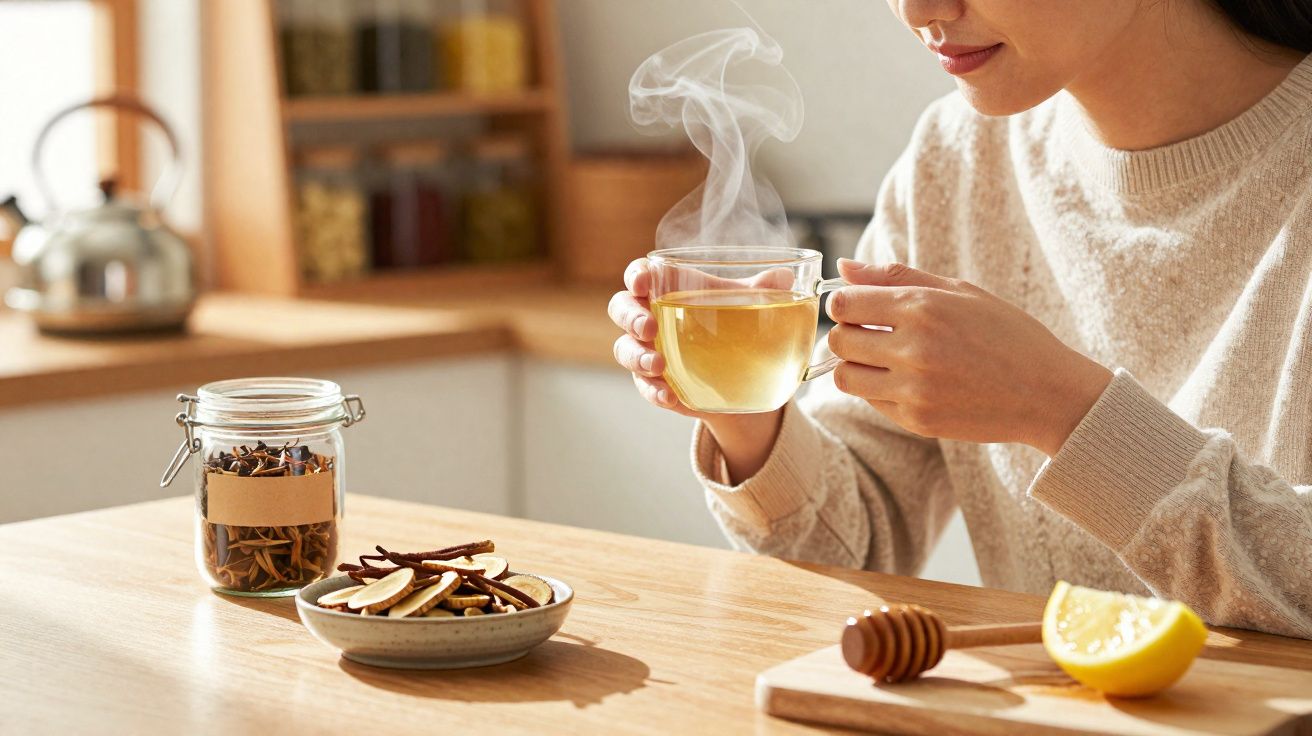
Third appointment in six weeks: the same blocked nose, the same scratchy throat, the same drained look in the mirror. She didn’t actually say “again?”, but her eyebrows did the talking. On my way home, another box of tablets in my pocket, I ducked into a tiny herbal shop I must have walked past a hundred times without noticing. The shelves were lined with jars, their labels written in fading ink, and the air carried that quiet scent of dried leaves and earth.
Behind the counter, an elderly woman asked a single thing: “You get ill often, yes?” I nodded, a little self-conscious. Without fuss, she pulled down a jar I didn’t recognise, pinched out a small handful of woody slices and tiny yellow flowers, and told me: “Drink this. Every day for three weeks. Not only when you feel unwell.”
The label read: Astragalus root tea. A name that sounds like it belongs in a spellbook.
Astragalus root tea: the “mystery” brew hiding in plain sight
Astragalus root tea is the sort of remedy that sits quietly in the back pages of herbal guides while ginger and turmeric steal the spotlight. It doesn’t trend on TikTok, it’s not made to look pretty in a latte, and yet it has been used in traditional Chinese medicine for more than 2,000 years. In that tradition, astragalus is used as a tonic herb-something taken steadily over time to build stamina, resilience and defence, rather than as a one-off quick fix.
That long-game reputation is exactly why people who seem to catch everything find it intriguing. Astragalus is often described as an “immune shield”: not a magical rescue when you’re already wiped out in bed, but a supportive background ally. The root is typically dried and sliced, then simmered into an earthy, gently sweet tea that some people drink through winter the way others rely on coffee-quietly, routinely, almost as automatic as brushing their teeth.
If you ask around integrative clinics or naturopathic practices, you’ll hear similar, unglamorous stories. A teacher who used to pick up every classroom cold, then got through winter on astragalus without missing a week. A parent who felt less flattened by the constant nursery bug cycle. There’s no dramatic transformation photo-just fewer sick days and fewer plans cancelled.
The science is still developing, but a few small studies point in a direction that matches the traditional use. Research suggests that compounds in astragalus-particularly polysaccharides and saponins-may help modulate immune activity, including effects on natural killer cells and macrophages. Findings sometimes include figures like increased immune cell activity and improved antioxidant capacity. It’s not a miracle; it’s more like a small nudge that could tilt the odds slightly in your favour when the next virus comes knocking.
That “small nudge” is precisely what makes it relevant in everyday life. Many people don’t need a heroic intervention-they need two fewer colds a year, or a sore throat that doesn’t reliably turn into a week in bed. Modern routines can wear the immune system down gradually: late nights, ultra-processed food, constant stress. A tonic herb such as astragalus isn’t aimed at “fighting one virus”; it’s meant to support the system that has to deal with all of them.
And unlike many fashionable supplements, astragalus has a cultural history behind it. Generations used it long before “immunity” became a marketing slogan. The real question isn’t whether it’s magical-it’s whether a simple, consistent ritual with Astragalus root tea can quietly change how winter feels for you.
How to make Astragalus root tea an actual immune ritual
With Astragalus root tea, the first cup is not the point. The twentieth is. This root tends to work best as a slow build, so the aim is to create a small, almost boring habit you can maintain.
Herbalists often suggest a decoction rather than a quick infusion. In other words, instead of simply pouring boiling water over a teabag, you gently simmer the root so more of its compounds move into the water.
A realistic method many people stick with:
- Measure 1–2 tablespoons of dried astragalus root slices.
- Rinse briefly under cold water.
- Add the slices to a small pan with about 500 ml of water.
- Bring to a light boil, then reduce to a gentle simmer for 20–30 minutes with the lid on.
- Strain into a mug or a thermos.
- Drink warm once or twice daily during higher-risk seasons such as autumn and winter.
Being honest, hardly anyone does this perfectly every single day all year. Life gets in the way. The trick is to attach the simmering to something you already do: let the pan bubble while your laptop starts up in the morning, or while you decide what to watch in the evening. If weekdays are chaotic, make a larger batch on a Sunday and keep it in the fridge for up to two days, then reheat gently.
People who abandon it often fall into the same traps: starting too strong, expecting results in a week, or only drinking it once they already feel ill. Astragalus is typically positioned as prevention, not as a last-minute fire extinguisher. Another common mistake is ignoring medical context. If you have an autoimmune condition, take immunosuppressants, or are undergoing serious treatment, don’t experiment-speak with a doctor or a qualified practitioner before you turn your kitchen into a lab.
Some herbalists blend astragalus with “supportive friends” to make it easier to enjoy: - Fresh ginger slices for warmth - Rose hips for vitamin C - A little liquorice root for natural sweetness
One practitioner put it like this:
“The best immune remedy is the one you drink long enough to let it work. If you hate the taste, you’ll stop before it does anything.”
A simple framework many people follow: - Drink Astragalus root tea regularly during high-risk months (often in 3–6 week blocks). - Pair it with unexciting basics: enough sleep, real food, less sugar, fresh air. - Pause if you develop a fever or an acute infection, and follow medical advice.
Choosing, storing and preparing astragalus root (for better results)
Quality and handling matter more than most people think. If possible, buy from a reputable herbal shop, a traditional Chinese medicine pharmacy, or a well-known supplier with clear labelling. Look for dried root slices or cut root identified as Astragalus membranaceus, and store it in an airtight container away from heat and direct light. If the root smells musty or looks damp, skip it-poor storage can spoil flavour and quality.
For day-to-day use, keep preparation simple enough that you’ll actually do it. A small saucepan with a lid works, but a slow cooker on a low setting can also make the decoction feel effortless-especially if you’re busy or sharing the routine with family members.
Living with fewer sick days: what could shift for you
Immune health is rarely a single-ingredient story. It’s more like an orchestra that needs tuning: gut health, sleep, stress levels, micronutrients and gentle movement all matter. Astragalus tends to sit in the background section. Its potential role is to raise your baseline so your body doesn’t crumple at the first virus that drifts past-less a brick wall, more like a well-trained security team.
When it helps, the changes are often subtle rather than cinematic. The cold that used to go straight to your chest might now stall at a sore throat. A bout of flu that used to flatten you for ten days might resolve in five. You may find yourself making that awkward work call-“I’m ill again”-less often. It won’t make headlines, but it can change your energy, your diary, and how you plan winter trips.
There’s also an emotional shift that comes with feeling less breakable. Most people know that moment: one stranger sneezes on the Tube and your mind spirals into quiet panic. Working with a gentle, traditional herb like astragalus doesn’t erase that feeling overnight, but for some it creates a sense of partnership with their body-less battling, more supporting, and doing it consistently.
Key points at a glance
| Key point | Detail | Why it matters |
|---|---|---|
| Astragalus as a tonic | Used for centuries in traditional Chinese medicine to support longer-term immune resilience. | A slower, deeper alternative to quick-fix “immune boosters”. |
| Decoction method | Simmer 1–2 tablespoons of root slices for 20–30 minutes to make a stronger tea. | A simple kitchen ritual that helps extract more active compounds. |
| Smart usage | Best used preventively; seek medical advice for complex conditions or medications. | Helps you use the tea safely, without unrealistic expectations or risky self-experimentation. |
FAQ
Is Astragalus root tea safe for everyday use?
For many healthy adults, astragalus is generally considered safe in moderate amounts over several weeks. If you are pregnant, breastfeeding, have an autoimmune condition, or take immune-related medication, speak to a healthcare professional before using it regularly.Can Astragalus root tea stop a cold that has already started?
Astragalus is traditionally used more as a preventive tonic than as an acute cold remedy. If you are already feverish or very unwell, some practitioners advise pausing it and focusing on rest, fluids and appropriate medical care.What does Astragalus root tea taste like?
It’s mild, slightly sweet and earthy, and generally less intense than many other roots. Many people combine it with ginger, lemon or honey to make it more enjoyable as a daily drink.Where can I buy quality astragalus root?
Try reputable herbalists, traditional Chinese medicine pharmacies, or established online suppliers. Choose dried root slices or cut root labelled Astragalus membranaceus from a trusted source.Can children drink Astragalus root tea?
Some practitioners use astragalus with children, but amounts are much lower and adjusted for age and weight. This should be decided with a paediatrician or a qualified practitioner, not improvised at home.



Comments
No comments yet. Be the first to comment!
Leave a Comment