
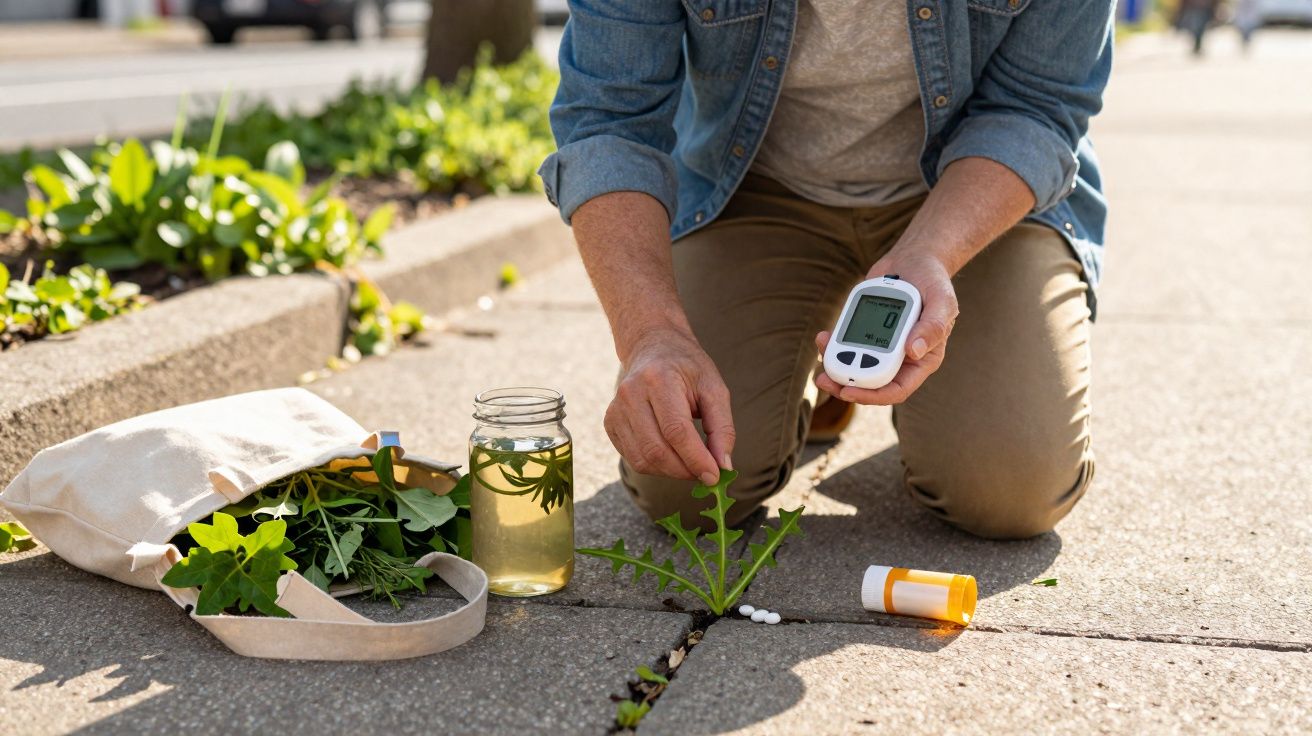
The man crouched between two wheelie bins where the pavement had split. He wasn’t searching for loose change or a dropped key. Instead, he carefully teased out a stubborn little plant forcing its way through the concrete outside a chemist in Brooklyn. People brushed past with carrier bags holding insulin pens and glucose test strips. He slid the scruffy “weed” into a paper bag as though it were a gemstone.
Inside, posters boasted about the newest advanced diabetes medicines. Out on the street, the plant had no box, no leaflet, no glossy campaign and no sales rep-just jagged green leaves and a tiny yellow bloom.
He glanced up and said, almost under his breath, “You realise this could put half those meds out of business.”
I laughed. Then I looked it up.
The “diabetes weed” in the pavement that unsettles an industry
If you’ve walked past a garden in late spring, you’ve probably seen this sort of plant and muttered something unprintable. It appears between tomato plants, along driveways, beside bus stops-thin leaves, serrated edges, and a faint cucumber-like scent when you crush it between your fingers. Most of us pull it up and chuck it in the bin without a second thought.
But in herbal forums, small research groups, and everyday kitchens from India to Mexico, that same kind of unglamorous green is often spoken about with a different label: “diabetes weed.” It isn’t meant to be cute. It’s shorthand for a long-running, low-level rumour-that certain common plants may help bring blood sugar down enough to make the pharmaceutical business model feel… exposed.
Bitter melon, fenugreek and dandelion: “diabetes weed” plants people keep talking about
Start with bitter melon (Momordica charantia), a climbing vine that many gardeners yank out like an unwelcome invader. In New York or London it’s usually treated as an “interesting” vegetable you might spot in an Asian supermarket. In parts of Asia, Africa and the Caribbean, it’s been cooked and steeped for generations by people managing “sugar disease” long before anyone owned a glucose meter.
Research is slowly inching closer to what tradition has claimed. Small clinical trials suggest bitter melon extract can lower fasting blood sugar and improve glucose tolerance in people with type 2 diabetes. One paper even compared its impact with a commonly used diabetes medicine, showing results that were modest but genuine. Not a miracle. Not mystical. Just a plant influencing some of the same metabolic pathways that multi-billion-pound tablets target-without the slick adverts wedged between Premier League highlights.
So why does big pharma look uneasy whenever “diabetes weed” talk catches on? Because plants such as bitter melon and dandelion don’t slot neatly into the usual profit engine. You can’t patent something that grows in a neglected corner of a car park. You can monetise purified extracts, redesigned molecules and proprietary delivery systems-but you can’t own the idea of a leaf.
That’s how you end up with the standard script: “Interesting, but unproven.” “More research is needed.” “Stick to your medication.”
To be fair, they’re not wrong about the risk: nobody should throw insulin away because a social media clip promised a cure. Still, the pressure is obvious-keep plants as background noise and prescriptions as the main storyline. And it leaves a lingering question: what if one of these “weeds” works better than we’re comfortable admitting out loud?
How people are quietly using “diabetes weeds” at home for type 2 diabetes
Speak to people actually living with type 2 diabetes, and you often hear a different story from the one on pharmacy leaflets.
- Maria, 58, in Texas began drinking a small cup of bitter melon tea before lunch. She didn’t stop her tablets-she simply added the tea as a personal trial. Over three months, alongside small diet changes and daily walks, her HbA1c fell by a full percentage point.
- Hassan in London gets dried fenugreek seeds posted over from Morocco by his grandmother. He soaks a teaspoon overnight, drinks the cloudy water in the morning, then eats the softened seeds with yoghurt. It’s not fun and it’s not photogenic-but the after-meal spikes on his glucose monitor eased enough that his diabetes nurse asked what he’d changed.
Clinicians don’t routinely ask about “grandma’s bitter tea”. There’s no tick-box on most forms for fenugreek water. Yet the proposed mechanisms are plausible and, in some cases, supported by early evidence: slowing carbohydrate absorption in the gut, encouraging insulin release, and improving how cells respond to glucose. Alongside bitter melon and fenugreek, you’ll often see gymnema and dandelion mentioned for similar reasons-though the evidence base varies and is generally smaller than for medicines.
None of this replaces lifestyle changes. None of it makes medication unnecessary for everyone. Some people will always need tablets. Some will always need insulin.
But for many people with early or moderate type 2 diabetes, combining these plants with regular movement, better food choices and weight management may help delay stronger drugs for years. That’s not a story that flatters shareholder reports. It’s the kind of story that circulates in kitchens, WhatsApp groups and the quiet corners of waiting rooms.
And let’s not pretend anyone manages it perfectly. Even the most organised person misses the tea, forgets the seeds, or grabs the pastry. That doesn’t erase the potential-it just puts these plants where they belong: as real-world tools, not magic bullets.
This is also where tension with big pharma sharpens. A plant that grows cheaply and nudges blood sugar down by 10–20% won’t wipe every prescription off the shelf. But if millions of people use it, fewer high-dose prescriptions are issued, fewer patented combinations look “essential”, and fewer people become lifelong customers paying hundreds of pounds a month. The plant quietly does its work, and the revenue line dips. In industry terms, even “a little” is worth resisting.
Using “diabetes weed” plants safely-without losing your head
If you’re thinking, “All right, but what do I actually do with a weed?”, the sensible route is small and measurable.
Choose one plant with both tradition and at least some research behind it-bitter melon, fenugreek, or dandelion leaf are common starting points. Then pick a single format you can actually stick with: food, tea or a reputable capsule.
- Bitter melon (food): buy it fresh from an Asian grocer, slice it thinly, remove the seeds, and stir-fry a small portion with egg, onions or other vegetables.
- Bitter melon (tea): steep 1–2 teaspoons of dried bitter melon in hot water once daily.
- Fenugreek: soak 1 teaspoon of seeds overnight, drink the water in the morning, then eat the softened seeds with yoghurt if tolerated.
The aim isn’t to drown your life in herbal preparations. The aim is to trial one change slowly while tracking blood sugar with the same seriousness you’d apply to a new prescription.
The biggest mistake is swinging from “I don’t trust anything” to “I trust this weed with my life” in a single leap. People stop tablets abruptly, drink litres of herbal tea, and expect a dramatic rescue. Then, if readings climb-or they feel unwell-they decide all plants are nonsense. That whiplash helps nobody.
A steadier approach is to treat plants as additions to a toolkit. Keep your GP or diabetes team informed: “I’m trying bitter melon tea once a day; I’m still taking my medication; I’m monitoring my readings.” Some clinicians will be sceptical. Others will be practical and say, “Fine-let’s watch what happens.” It isn’t about choosing a side between a blister pack and a vine. It’s about remaining the person in charge of your care.
“I tell patients the same thing,” an endocrinologist told me off the record. “If a plant shaves 10–15 points off fasting glucose and helps someone feel more in control, I’m not going to pick a fight with that. The fight is against uncontrolled diabetes-not against dandelion.”
A few extra realities people forget (but shouldn’t)
Herbs and “natural” products vary hugely in strength and quality. If you’re using capsules or extracts, look for clear labelling, consistent dosing, and suppliers who provide third-party testing where possible. With type 2 diabetes, consistency matters: you can’t interpret glucose trends if the product changes from week to week.
Also, think beyond plants. Sleep, stress and alcohol can shift blood sugar significantly, and they can easily mask (or mimic) the effect of a “diabetes weed”. If you’re trialling bitter melon or fenugreek, try to keep the rest of your routine as steady as possible for a few weeks so you can actually learn something from your data.
Practical rules to follow
- Start with data, not vibes
Check fasting and post-meal glucose before and after introducing any plant for at least two weeks. - Try one plant at a time
Don’t combine five powders and three teas and then guess what made a difference. - Watch for side effects
Bitter melon and fenugreek can cause stomach upset and may contribute to hypoglycaemia when combined with stronger medicines. - Keep your safety net
Don’t stop insulin, metformin or prescriptions without an agreed plan and professional supervision. - Use food first where you can
Prefer cooking and normal portions before jumping to high-dose extracts and “miracle” capsules.
The quiet revolution growing at the kerbside
Someone you know is already trying this. It might be the aunt who sips a murky tea after meals. It might be the neighbour growing “odd cucumbers” on a balcony. It might be you, scrolling at 2 a.m., wondering whether a plant could offer even a sliver of freedom from the constant numbers game.
Reality is less dramatic than the headlines. No single weed will “end diabetes for millions” overnight. What these plants can do is chip away at a more subtle belief-that you’re only a passenger in your own health story while an industry does the driving.
Bitter melon winding up a chain-link fence, dandelions pushing through tarmac: they’re reminders that human biology evolved alongside plants long before it encountered modern medicines. Some plants are useless. Some are dangerous. Some are quietly effective for particular people. Sharing experiments, glucose readings, failures and small wins may be the real threat to the system-not a miracle cure, but millions of small acts of self-education and stubborn curiosity.
Summary table
| Key point | Detail | Value for the reader |
|---|---|---|
| Common “weeds” have real science behind them | Plants such as bitter melon, fenugreek and dandelion show measurable blood-sugar effects in small studies | Offers grounded options beyond hype and conspiracy clips |
| Use plants as complements, not replacements | Introduce one plant at a time, track glucose, and coordinate with your clinician | Reduces risk while adding practical tools for control |
| Big pharma’s discomfort is about profit, not magic | Unpatentable plants can’t be monetised like medicines, even if they help lots of people a little | Helps you see the system clearly without falling for false “cure” promises |
FAQ
Question 1: Can a “diabetes weed” like bitter melon replace my diabetes medication?
Answer 1: For most people, no. These plants tend to work best as a complement rather than a full replacement. Some people may be able to reduce medication over time, but any change should be gradual, recorded, and done with medical supervision.Question 2: Which “diabetes weed” has the strongest research behind it?
Answer 2: Bitter melon and fenugreek have some of the more substantial evidence, including small human trials showing reductions in fasting blood sugar and improved glucose tolerance. Dandelion and gymnema are also discussed, but the evidence is generally more limited.Question 3: Is it safe to pick weeds from my garden and eat them?
Answer 3: Not by default. Gardens and lawns may have pesticide residues, and many plants have lookalikes. If you’re experimenting, start with verified products or fresh produce from trusted shops rather than foraging.Question 4: How long does it take to see any effect on blood sugar?
Answer 4: Some people notice small shifts within 1–2 weeks, while others need a month or longer. If you see no trend after 4–6 weeks of proper tracking, that particular plant may simply not be useful for you.Question 5: Why don’t doctors talk more about these plants if they can help?
Answer 5: Herbal medicine is barely covered in much medical training, and the studies are often small compared with drug trials. Many clinicians stay cautious not because they “hate plants”, but because their clinical and legal frameworks are built around prescribed medicines, not “weeds.”





Comments
No comments yet. Be the first to comment!
Leave a Comment