
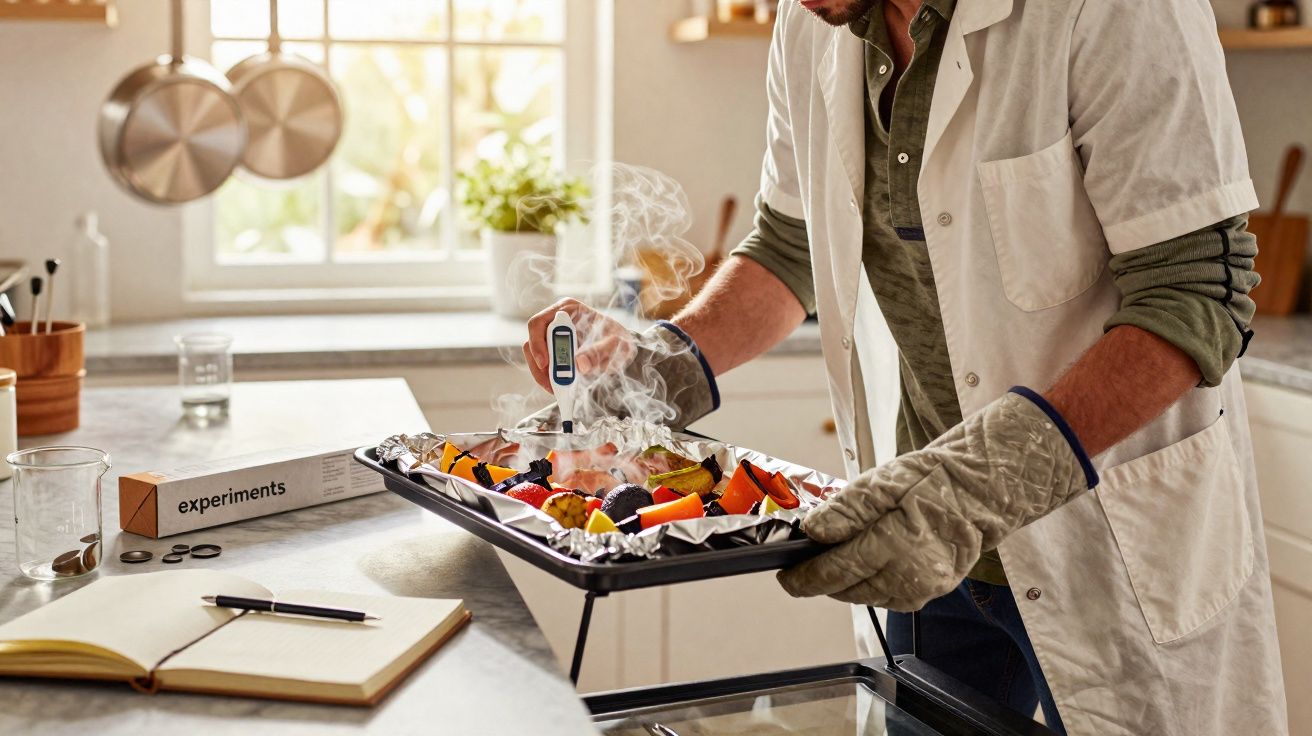
The tray slides out of a blisteringly hot oven with that unmistakable sizzle.
Vegetables have caught and sweetened at the edges, the salmon skin has crisped, and a crumpled sheet of aluminium foil flashes like a strip of silver surf. Someone narrows their eyes at the table and asks, almost under their breath: “Isn’t that stuff… bad for you when it’s really hot?”
For a moment, dinner feels less like dinner. You recall an old headline linking aluminium to Alzheimer’s. A TikTok warning you to stop wrapping potatoes in foil. Your mum’s faith in a dented roasting tin that’s seen decades of Sunday lunches. Three generations of kitchen habits hovering over an ordinary weeknight meal.
It smells fantastic, yet you pause-long enough to irritate yourself. Science seems to say one thing, social media another, and your instincts whisper this feels risky. You’re still hungry, though. So what actually happens when aluminium meets high heat, fat, salt and acid?
What scientists actually observe when aluminium meets a very hot kitchen
Step into a busy restaurant kitchen and you’ll spot aluminium everywhere: stacks of aluminium trays shuttling in and out of ovens, foil tented over joints, foil lining pans, foil catching drips. If aluminium at high heat were an instant health catastrophe, professional chefs would be keeling over en masse.
And yet the worry isn’t invented. For years, aluminium has been tangled up in rumours about brain disease-particularly Alzheimer’s. Add in short-form videos, alarmist posts and badly summarised studies, and suddenly your Sunday roast starts to feel like a chemistry practical.
To cut through the noise, I spoke to someone who deals with this for a living: Dr Hannah Lewis, a UK-based toxicologist who advises food regulators. Her answer was nuanced-far too nuanced for a 15-second clip-which is precisely why confusion persists.
Here’s the unglamorous but essential baseline: aluminium is the third most abundant element in the Earth’s crust. It’s present in soil, water and plants. In other words, we all take in small amounts of aluminium daily from food, drinking water and packaging-even if we never touch foil.
Regulators are not alarmed by presence; they care about dose. The European Food Safety Authority (EFSA) uses a tolerable weekly intake for aluminium of 1 mg per kilogram of body weight. For a 70 kg adult, that works out at roughly 70 mg per week from all sources. It’s not a target to aim for-more a broad upper boundary where they remain comfortable.
Where cooking comes in is migration: aluminium can move from foil or cookware into food. High-heat cooking can increase migration, especially when food is acidic or salty. Longer oven times, plus ingredients such as lemon juice, tomatoes, soy sauce or brine, can all push migration higher. The real question is not “does migration happen?” but “how much migrates, and is that amount meaningful in practice?”
Laboratory studies show that tightly wrapping acidic foods in foil and baking them for a long time can transfer tens of milligrams of aluminium into a meal. In extreme “worst-case” set-ups-everything in aluminium, very acidic, very salty, long cooking times-one meal can come close to, or even exceed, that weekly EFSA guideline.
That sounds alarming until you factor in real life. Most meals aren’t drenched in acid and salt, and-crucially-your body absorbs only a small fraction of the aluminium you ingest. The majority passes through; the portion retained is typically under 1%.
As Dr Lewis framed it, this is less about a single dramatic traybake and more about long-term patterns: “Daily use of aluminium pans, plus foil, plus antacids, plus high-aluminium drinking water, over decades.” One foil-baked salmon isn’t a cliff edge. It’s a long, gentle slope shaped by repeated exposure.
Aluminium foil at high heat: what changes the risk most
If you want a simple mental shortcut, it’s this: direct contact + moisture + acidity/salt + time + heat = more migration. Reduce any of those factors and you reduce aluminium transfer-often without changing the recipe.
How to cook hot, fast and safe with aluminium (without overthinking it)
If foil makes your life easier, you don’t need to swear it off. The easiest, highest-impact tweak is to avoid placing moist, acidic food directly against aluminium whenever you can. Use foil as a lid or a tent, rather than as the surface your food sits on.
Practical examples:
- Bake lasagne in glass, ceramic or stainless steel, then cover with foil for the first half so the top doesn’t over-brown.
- Roast potatoes in a tray, and use foil only loosely over the top to prevent scorching.
- For marinated chicken, place baking paper on the tray, put the chicken on the paper, then add foil over the top if you want a steamy finish.
When high heat and long cook times are non-negotiable-slow-roasted shoulders, baked fish, whole cauliflowers-use a barrier layer. Sliding a sheet of baking parchment/baking paper between the food and the foil does a great deal of work: same oven, same timings, noticeably less aluminium migration.
A quieter everyday trap is storage. Salty or acidic leftovers wrapped in foil (even cold, in the fridge) can still pick up aluminium once the foil is damp and pressed against the food. That gorgeous tray of lemon chicken covered tightly in foil overnight? Not your best routine.
Treat foil as an oven tool, not a storage solution. Once food has cooled a little, move leftovers into a glass or plastic container. If you insist on keeping it on the tray, put parchment directly on the food and foil over the top.
The strongest “migrators” are usually tomato-based sauces, citrus-heavy dishes and soy-rich marinades. If you’re planning a long bake with those flavours, it’s worth asking: could this one go in enamel, ceramic, glass or stainless steel instead? In most homes, a single good alternative roasting dish covers nearly all the high-use scenarios.
“My advice isn’t ‘ban aluminium from your kitchen’,” Dr Lewis said. “It’s to use it intelligently, and not let one material dominate your exposure for decades. Variety is safety.”
And here’s the human reality: on a rushed weekday, nobody wants to stand there calculating migration rates and tolerable weekly intake figures. You want dinner on the table before the children unravel. Let’s be honest: almost nobody does those risk calculations day to day.
- Use foil mainly as a cover, not as a direct contact surface for food.
- Avoid tightly wrapping acidic or salty foods in foil for long, high-heat cooking.
- Choose glass, ceramic or stainless steel for your longest, hottest and most acidic roasts.
- Store leftovers in proper containers, not directly under foil.
- Watch for scratched or pitted aluminium pans, and rotate with other materials.
Two often-missed points: aluminium cookware finishes and the environment
Not all aluminium cookware behaves identically. Anodised aluminium has a hardened surface layer that can reduce reactivity compared with bare aluminium, while deep scratches and pitting can increase contact between food and the metal. If a pan is badly worn and you often cook tomato sauces, citrus dishes or salty reductions in it, that’s a sensible moment to switch materials-or keep that pan for less acidic cooking.
It’s also worth separating health risk from waste. Disposable aluminium trays and heavy foil use can be convenient, but they add to household waste unless they’re cleaned and recycled properly. If you can shift just your “big acidic bake” meals into a reusable glass or stainless-steel dish, you often reduce both aluminium exposure and single-use consumption, with almost no change to how you cook.
So, is the aluminium risk confirmed-or still uncertain?
For many people, the fear isn’t really about cookware. It’s about dementia. Aluminium has become a shorthand villain for what we dread about ageing, which is why any hint of a “confirmed link” lands so hard even when the evidence is complicated.
The honest state of play in 2025 looks like this: researchers have detected aluminium in the brains of some people with Alzheimer’s, including within plaques and tangles. However, when scientists look at long-term population data, the pattern is not clean. Higher aluminium exposure does not reliably translate into higher dementia rates in a simple, predictable way.
That’s why UK, EU and WHO-aligned regulatory positions repeatedly return to the same cautious conclusion: evidence for a clear cause-and-effect link between dietary aluminium and Alzheimer’s remains weak and inconsistent. The practical focus becomes “as low as reasonably achievable” for overall exposure-not telling people to panic and throw out foil.
There is, however, one group where the buffer is smaller: people with kidney disease. When kidney function is reduced, aluminium is cleared less efficiently, so normal exposures can accumulate. Clinicians already flag aluminium-containing antacids and certain water sources for these patients. Heavy, frequent cooking on aluminium could be an additional avoidable load. Anyone with kidney problems should discuss cookware and other aluminium sources with their doctor or renal dietitian.
For everyone else, the framing shifts from “proven danger” to “avoidable burden”. The question becomes less “Will this foil-baked fish give me dementia?” and more “Over 40 years, how many low-effort opportunities did I have to reduce a known body burden?”
Because aluminium exposure doesn’t come from one place. It can come from water treatment, food additives, packaging, cookware and medications. You cannot micromanage all of it. What you can do is choose the levers that cost almost nothing: parchment between food and foil, an alternative roasting dish for the most acidic meals, and a better habit for storing leftovers.
There’s also a trust problem. People are tired of yesterday’s “safe” becoming today’s “risk”. They’ve watched non-stick pans, BPA, ultra-processed foods-and now aluminium-move through their feeds as a procession of cupboard-based threats.
So an expert answer like “you probably don’t need to panic-just adjust your routine” can feel unsatisfying. It’s too measured to go viral. Yet it’s where most serious researchers land on aluminium at high heat: not a harmless halo, not a confirmed horror story-just another dial you can turn down gradually, without giving up the pleasure of a properly roasted potato.
| Key point | Detail | Why it matters to you |
|---|---|---|
| Aluminium migrates most with acidity + heat | Lemon, tomatoes, salt and long cooking times noticeably increase migration | Helps you decide when to limit aluminium foil use |
| Link with Alzheimer’s is not clearly established | Aluminium has been observed in affected brains, but human data are inconsistent | Puts scary headlines in perspective and reduces unnecessary anxiety |
| Simple habits can reduce exposure | Use a barrier (baking paper), use more glass/steel, avoid storing food under foil | Gives practical, quick actions you can apply every day |
FAQ
Does cooking in aluminium foil at high heat cause Alzheimer’s?
Current evidence does not show that normal cooking with foil causes Alzheimer’s. Aluminium has been found in some diseased brains, but large human studies have not demonstrated a clear, direct link from dietary aluminium to dementia.Is it safe to roast vegetables on aluminium foil every week?
Roasting plain or lightly seasoned vegetables on foil once or twice a week is unlikely to be a major risk, particularly if they are not heavily coated in acidic sauces. If you’d rather reduce contact, use a tray lined with baking paper and keep foil as a loose cover.Which foods draw the most aluminium from foil or pans?
Acidic and salty foods-citrus marinades, tomato sauces, pickled or brined dishes, soy-heavy glazes-tend to pull out more aluminium, especially with high heat and longer cooking times.Should people with kidney problems avoid aluminium cookware?
People with reduced kidney function may need to be more cautious because aluminium clears more slowly. They should discuss cookware and other exposure sources (including antacids) with their doctor or renal dietitian.What’s the easiest swap if I want to cut down on aluminium?
Buy one solid glass, ceramic or stainless-steel roasting dish and use it for your longest, hottest and most acidic bakes. Line it with baking paper for easy washing up, and keep foil mainly as a loose cover rather than the surface your food sits on.
Comments
No comments yet. Be the first to comment!
Leave a Comment