
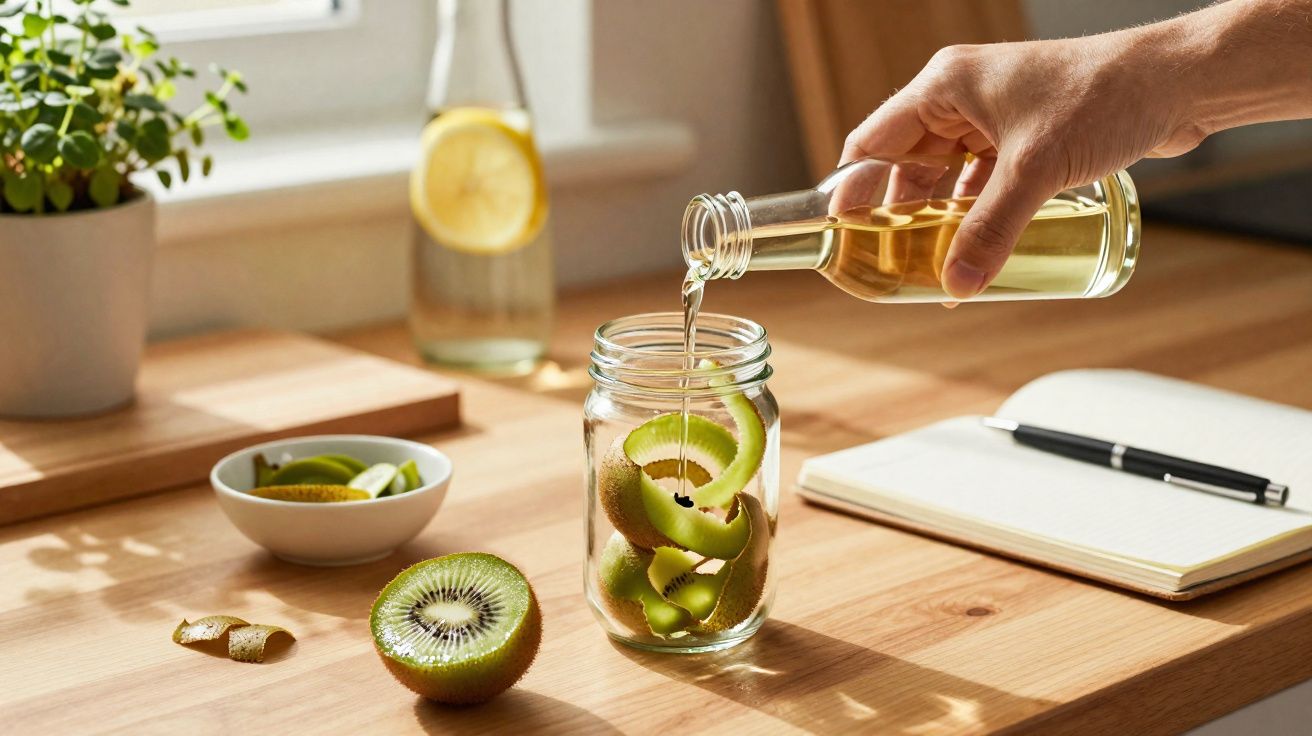
Sharp vinegar hangs in the air of a quiet kitchen. On the worktop sits a small glass bowl holding something most of us scrape straight into the bin without a second thought: curled ribbons of kiwi peel, vivid green against a cloudy, acidic bath. A nutritionist friend peers down at it as if it’s a miniature lab set-up. She stirs, pauses, then smiles. “This is the bit nobody mentions,” she says. “A lot of the good stuff is hiding in what we throw away.”
Until that moment, I’d peeled kiwis on autopilot-fuzzy skin off, sticky fingers wiped, on to the next job, the next day. Watching those scraps steep, it felt faintly rebellious: taking what’s usually discarded and turning it into something useful. She put it plainly: mix kiwi peels with vinegar and you don’t just end up with a jar-you create a signal that “waste” isn’t always waste.
Why experts are suddenly whispering about kiwi peels and vinegar
The first surprise when you mix kiwi peels with vinegar is how quickly the liquid changes. In minutes, clear vinegar blushes into a soft green-gold, like a pale herbal tonic. It looks oddly lively for something made from leftovers.
That colour shift is the visible part of what’s happening. Under the surface, the vinegar is drawing out a dense mix of plant compounds from the peel-polyphenols, vitamin C, enzymes and minerals. Some dietitians describe it as a “micro-dose of concentrated plant armour”. Others are more reserved: intrigued by the mechanism, cautious about the claims.
A food scientist summed up kiwi peel with a memorable line: “It’s the noisy neighbour nobody invites-despite being secretly helpful.” In tests, the peel often shows higher antioxidant levels than the bright green flesh most people prefer. Vinegar matters here because it isn’t just a preservative; it acts as an extractor and a carrier, making certain compounds easier to disperse through food than a dry peel ever could.
There’s also early research interest. In a small pilot project in a New Zealand university lab, researchers compared vinegar infusions made from different kinds of fruit waste, measuring antioxidant capacity and antimicrobial effects. Kiwi peel vinegar performed better than expected, particularly when steeped for longer than a week. Against plain vinegar, the infused samples showed a greater ability to neutralise free radicals. Not a miracle and certainly not a cure-just a modest lift in defensive potential.
From a nutrition perspective, experts tend to group the interest into three strands:
- Antioxidants and plant compounds that support routine cellular maintenance.
- Fibre and traces of prebiotic material clinging to the peel, which may gently favour a healthier gut microbiome.
- Behaviour change, because people who adopt small food rituals often waste less, cook more, and pay closer attention to what they consume.
That third strand is easy to overlook, yet it may be the most significant: a tiny habit that nudges bigger patterns over time.
One chef in Lyon told me that during inflation spikes her customers became “much more attentive” to any idea that stretched food value. She began using fruit-peel infusions as a quiet, eco-minded detail in drinks and dressings. The kiwi peels and vinegar version quickly became a staff favourite-splashed into salad dressing, stirred into sparkling water, and brushed over grilled vegetables. Not for show, she insisted, but because it felt like giving the whole fruit the respect it deserves.
The kitchen logic: peel as protection, vinegar as solvent
On paper, the reasoning is disarmingly straightforward. Many plants concentrate defensive compounds in their outer layers: pigments, bitter molecules, and structural fibre that help them survive. We routinely remove that “protective jacket” and discard it within seconds.
Vinegar, on the other hand, is one of the oldest, most widely used kitchen preservatives-an everyday, food-safe acidic solvent with centuries of culinary credibility. Put the two together and you have a low-tech extraction happening on your counter: the peel gives up flavour and plant compounds; the vinegar holds on to them and keeps the mixture stable.
One practical note often missed in online hype: the peel is also where residues can sit. If you’re going to make a habit of kiwi peel vinegar, it’s worth thinking about sourcing (organic if possible) and washing properly-simple steps that make the whole ritual more sensible.
How to try the kiwi peel + vinegar trick at home
The method is refreshingly uncomplicated.
- Peel 2–3 ripe kiwis.
- Instead of binning the skins, rinse the kiwi peels briefly under cool water (or scrub lightly if needed).
- Pat dry, then slice into thinner strips to increase surface area (optional, but helpful).
- Put the peels into a clean glass jar.
- Cover completely with a mild vinegar: apple cider vinegar, rice vinegar, or white wine vinegar all work well.
- Leave about 2 cm of headspace, seal the lid, and give the jar a gentle shake.
Now wait. The steeping window most experts suggest is 5 to 14 days in a cool, dark cupboard. A quick daily swirl encourages more even extraction. Once the smell turns fruity-sharp and the colour deepens, strain out the peels and decant the flavoured vinegar into a clean bottle. For use, a spoonful in water (well diluted) or a splash on salad is plenty to begin with.
Real life, of course, rarely matches the ideal. You might imagine yourself saving every peel, labelling jars neatly, and recording dates like a home fermenter. Let’s be honest: almost nobody keeps that up daily. Many nutrition coaches therefore advise starting small-one jar a week, perhaps after a relaxed weekend breakfast-so the habit feels achievable rather than performative.
Common pitfalls with kiwi peels and vinegar
Most disappointments come from rushing:
- Stuffing the jar to the brim with peels, leaving little room for circulation.
- Choosing the harshest, most industrial vinegar available, then wondering why it tastes like a cleaning cupboard.
- Leaving the jar in direct sunlight, which can dull delicate compounds and push flavours towards a “cooked” note.
Gentler choices usually produce a softer, more drinkable result.
The other trap is wishful thinking. A kiwi peel + vinegar infusion won’t undo heavy smoking, chronic sleep deprivation, or a diet dominated by ultra-processed foods. It’s a nudge, not a rescue mission. A gastroenterologist I spoke to put it this way:
“I’m fond of these small kitchen rituals-not because they cure anything, but because they reconnect people with cause and effect. When you do one modest, caring thing for your body each day, the benefit is cumulative. Vinegar is simply the vehicle for that mindset.”
If you want sensible guardrails, keep these cues in mind:
- Choose organic kiwis when you can, or scrub the peel to reduce potential pesticide residue.
- Use a vinegar you would happily eat in a salad, not the cheapest bottle on the shelf.
- Begin with short infusions (5–7 days) to find your taste tolerance.
- Keep the finished kiwi peel vinegar in the fridge if you prefer a fresher, brighter flavour.
- If you take medication or have reflux, kidney problems, or ongoing gut issues, speak to a health professional before using acidic tonics daily.
A quiet revolution-or just another wellness fad?
There’s a reason some specialists get unexpectedly animated about a humble jar of kiwi peels and vinegar. The appeal isn’t social media aesthetics; it’s the shift away from “buy more supplements” towards “get more value from what you already have”. The practice asks for almost no extra spending-just a different way of looking at the same fruit bowl. In an era exhausted by grand wellness promises, that restraint can feel genuinely radical.
Environmentally, the act is tiny but meaningful: you catch something on its way to the bin and give it a second life. Stretch that idea across citrus peels, herb stems, and apple cores and food waste doesn’t disappear-but it does start to change shape. Waste becomes ingredient, and that mindset often spills into other choices around clothing, energy use, and household routines.
Sceptics have fair points. Some clinicians worry that a simple kitchen trick will be inflated into a “detox” storyline. Overly acidic drinks can aggravate sensitive stomachs and contribute to enamel wear, especially if sipped throughout the day. People with reflux, kidney conditions, or specific medication interactions may be poor candidates for frequent vinegar habits. The grounded advice remains consistent: enjoy the ritual, but don’t mythologise it.
A practical add-on, if you do enjoy it: treat kiwi peel vinegar as a flavour tool first. Use it to make vegetables more appealing, to brighten a lentil salad, or to add lift to a marinade-because the easiest health habit to keep is the one that makes everyday food taste better.
In the end, mixed kiwi peels and vinegar won’t change the world on their own. Yet they quietly introduce a different question amid all the noise: what else are we throwing away-nutritionally, practically, even emotionally-that might be valuable if we paused before opening the bin?
Summary table
| Key point | Detail | Why it matters to you |
|---|---|---|
| Kiwi peel power | Kiwi peels contain antioxidants, fibre and plant compounds that can be richer than the fruit flesh | Helps you reframe everyday scraps as potential allies |
| Vinegar as carrier | Vinegar extracts and preserves compounds in a simple, home-friendly way | Offers a low-cost ritual that adds flavour and possible benefits |
| Mindset shift | Using peels turns “waste” into a resource and encourages more mindful eating | Supports long-term habits that affect health, budget and the environment |
FAQ
Is it safe to eat kiwi peel infused in vinegar?
For most healthy adults, clean kiwi peels steeped in food-grade vinegar are generally safe in small amounts. If you have allergies, kidney issues, reflux, or other medical concerns, consult a health professional first.How long can I keep the kiwi peel vinegar?
Once strained, the flavoured vinegar will usually keep for several weeks to a few months in a sealed bottle. Store it in a cool, dark place, or in the fridge for a fresher taste.Can I use any type of vinegar?
Milder options such as apple cider, rice, or white wine vinegar are typically best. Very strong distilled vinegar often produces a harsh flavour that few people want to use regularly.How do I use the infused vinegar in daily life?
Stir it into salad dressings, add to marinades, splash into sparkling water, or dilute a teaspoon in a large glass of water.Will this replace vitamins or medical treatment?
No. Kiwi peel vinegar is a small supportive habit, not a substitute for a balanced diet, medical advice, or prescribed medication.


Comments
No comments yet. Be the first to comment!
Leave a Comment