
The onions had started to feel like an accusation from the back of the kitchen drawer: a couple of soft patches, a faintly sour whiff, and that fine white fuzz that only appears when you’ve left it too long. I’d bought a big net bag while it was on offer, pleased with myself for being so organised and grown-up. A fortnight later, I was leaning over the bin, peeling away sticky skins and chucking nearly half of them, irritated at the waste.
After that, I asked anyone who might know: neighbours, a greengrocer at the market, and that friend who cooks like they trained in a restaurant. The advice was all over the place. Keep them in a dark cupboard. Use mesh. Never refrigerate. Always refrigerate. It sounded as though everyone had been handed a secret set of rules-except me.
Then, on a quiet Sunday, I finally came across the one approach that actually made a difference.
And it starts in the pantry.
The quiet enemy of your onions isn’t what you think
Open most kitchen drawers and you’ll find the usual mix: onions nudging potatoes, a half-used head of garlic, maybe a slightly miserable shallot pushed to the back. We store them together because they’re “the sort of veg that keeps”.
But they don’t keep well when they’re crowded. Onions begin to soften, their papery skins pick up damp, and little green shoots pop out of the top like guilty antennae. Before long, the firm, weighty bulbs you bought feel oddly light and rubbery.
The worst moment is slicing one open and finding the centre already going brown.
A greengrocer in a tiny street market put it perfectly in one line: “Your onions are suffocating.” He showed me the crate under his stall-onions laid out in loose layers rather than heaped up-so air could move around each bulb.
At home, we tend to do the reverse. We cram onions into bowls, bags, or deep drawers, stack them several layers high, and press them up against potatoes that give off moisture and natural gases. In as little as ten days-especially in a warm kitchen-spoilage can start quietly.
A French consumer group that looked at typical home storage found that most people end up losing at least a third of their onions before using them. That’s flavour and money straight into the bin.
The reason is simple: onions are still “alive” after harvest. They slowly breathe through their skins, releasing a small amount of moisture and gas. When bulbs are packed tightly with other produce, the trapped air becomes warm and humid-exactly what encourages soft spots (often at the base or between outer layers). As the onion tries to grow again, it sends up a sprout that burns through the sugars and juices inside. The onion effectively ages in fast-forward.
We tend to blame the supermarket, the season, or the weather, but in most cases the real issue is the way we store them at home.
The pantry trick for onions that stay firm for nearly a month
The solution is almost laughably low-tech: create a breathable pantry zone and follow a “one onion, one pocket” rule.
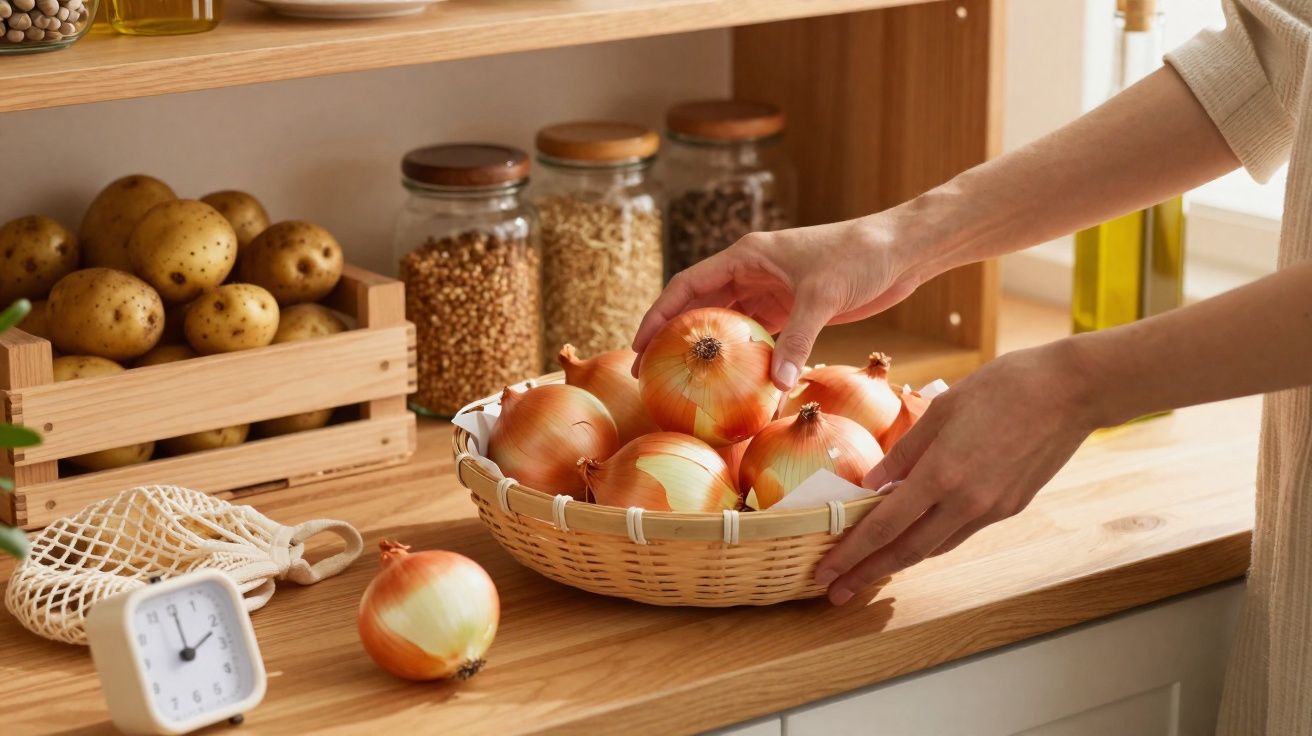
Use something that lets air move: a paper bag, a clean cardboard wine box, or an old wooden crate. If the container is a bit too closed, make a few holes. Then give your onions room-ideally in a single layer, or in small separated sections so they aren’t pressing into one another. The aim is air on all sides of each bulb.
There’s one more rule that matters just as much: onions should be stored on their own. No potatoes, no apples, no fresh herbs tucked in beside them. Keep onions in the dark, in a cool corner, with space to breathe.
Picture opening the pantry and seeing onions lined up like books on a shelf. Not exactly decorative-but oddly satisfying. I tested the “one onion, one pocket” system with a hanging fabric shoe organiser. Each bulb sat in its own little compartment.
Three weeks later, I pulled one out for dinner: still heavy, skin dry and crisp, no soft patches, no smell. By the month mark, only one had started to sprout slightly, and the rest were completely usable. Before that, I was losing half a large bag in under two weeks.
The change wasn’t subtle. They simply lasted.
The most common mistake is tucking onions into deep drawers with little airflow, or mixing them with potatoes “to save space”. That slowly ruins them. Warm kitchens and sealed plastic bags make it worse, turning each bulb into a tiny greenhouse.
And let’s be realistic: hardly anyone reorganises their pantry every day. So the method has to survive normal life. That’s why a fixed onion spot works so well-you set it up once, then just use it.
“Treat onions like they’re wearing a light coat: they hate sunshine on their backs and they sweat when they’re crowded,” a chef once joked to me. “Give them a quiet corner and they’ll wait for you all month.”
- Store onions in a cool, dry pantry or cupboard, away from the oven and direct sunlight.
- Choose breathable storage: paper bags, mesh, wood, or fabric pockets-never sealed plastic.
- Keep onions separate from potatoes, apples, and very moist produce.
- Lay them in a single layer or very small groups so air can circulate.
- Check weekly and remove any onion that’s soft or sprouting to protect the rest.
A couple of extra pantry habits that make onions last longer
When you bring onions home, take two minutes to sort them. Use any with bruises, cuts, damp patches, or loose necks first-those are the ones most likely to turn quickly. If one onion is already going off, it can raise humidity and encourage mould around the others in the same container.
It also helps to keep your onion spot genuinely dry. If your pantry tends to be humid (common in smaller flats or kitchens with limited ventilation), avoid storing onions against an outside wall that gets cold and damp. A small open crate on a shelf with a bit of clearance is often better than a closed cupboard floor where air barely moves.
When this small onion habit quietly changes the way you cook
Something genuinely shifts when onions simply… stay good. You stop doing the last-minute sniff test and rotating a bulb in your hand, wondering if you’ll need a trip to the shops.
You also start cooking more freely. Making a quick onion jam for toast on a Tuesday doesn’t feel wasteful. A big pot of soup or a slow-cooked sauce becomes a simple choice, not a “use them before they die” panic. There’s a calm in knowing your basic ingredients are waiting for you, not steadily deteriorating.
We’ve all had that moment where a recipe begins with “chop an onion” and you already feel drained because you suspect half the bag has gone bad.
| Key point | Detail | Value for the reader |
|---|---|---|
| Separate storage | Onions kept away from potatoes and apples | Slows sprouting and rot, wastes fewer onions |
| Air circulation | Single layer in breathable bags, boxes, or pockets | Keeps bulbs firm and dry for up to a month |
| Cool, dark spot | Pantry or cupboard, far from oven heat and light | Preserves flavour and texture, better tasting dishes |
FAQ:
- Should I put onions in the fridge? Whole dry onions keep best in a cool, dark pantry. The fridge is mainly helpful for cut onions-store those in a sealed container for 2–3 days.
- Can I store onions and potatoes together? No. Potatoes release moisture and gases that speed up onion sprouting and spoilage. Give each its own separate spot.
- What kind of bag is best? Paper or mesh bags work brilliantly, as do fabric shoe organisers and wooden crates. Anything that allows air to circulate freely is suitable.
- How do I know an onion has gone bad? Soft spots, a sour or mouldy smell, visible mould, or bulbs that feel very light and hollow are all signs it should be thrown away.
- Do red, white, and yellow onions store the same way? The method is the same, but yellow and brown onions usually keep the longest. Red and sweet onions are more delicate and are best used sooner.

Comments
No comments yet. Be the first to comment!
Leave a Comment