
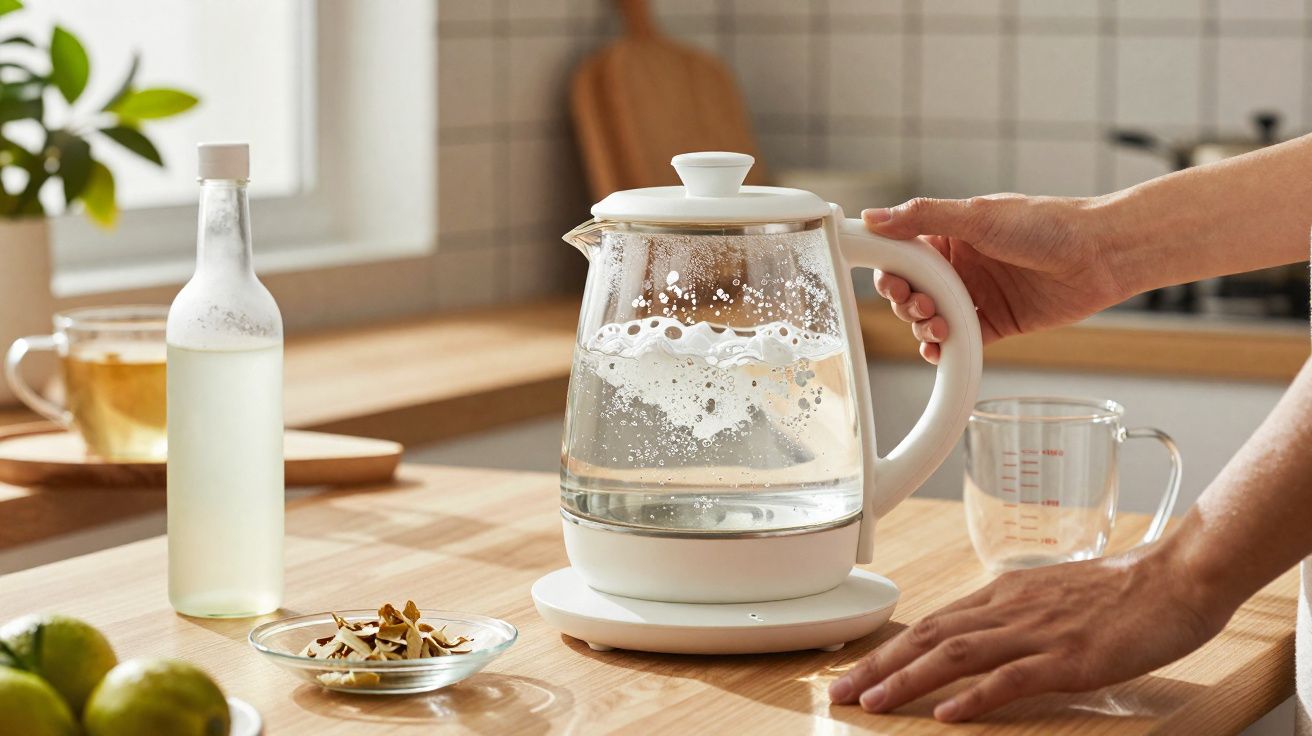
White, crusty flecks gripping the heating element. A milky ring staining the base. And that slight chalky note in what should have been your first properly calming brew of the day.
You tip the water away, catch a couple of floating specks of limescale, and suddenly the whole kettle feels… a bit grim. You consider attacking it with a sponge, buying yet another “miracle” product, and resent the time you don’t have for any of it.
What many people miss is that the thick scale inside a kettle can all but disappear in moments - simply by boiling one everyday ingredient.
Why your kettle turns white – and why scrubbing is a losing game
The first time you live in a hard-water area in the UK, your kettle becomes an unwelcome timeline. The start: bright stainless steel. Not long after: a dusty white film. Then, before you know it, flakes and crust appear, with a little chalky “island” forming around the heating element.
It’s not exactly shocking - just unpleasantly normal - until the day you pour water into your mug and spot a tiny white shard drifting on top like it’s got every right to be there. That’s usually the moment you realise the build-up is far thicker than you imagined. And scraping at it with the back of a sponge feels wildly optimistic.
One water company survey reported that, in some of the hardest-hit regions of England, limescale can start forming in kettles within days of regular use - not months, but days. Add in every morning brew and late-night cuppa, and you end up growing a quiet little mineral reef on your kitchen counter.
Most households fall into one of two camps. Either they ignore it until the kettle looks like a science project, or they go in hard with knives, scourers and harsh chemicals. The first approach leaves you drinking slightly chalky tea. The second scratches the metal, reduces the kettle’s lifespan and can fill the kitchen with unpleasant fumes. Neither is a great outcome.
In truth, limescale is simply the mineral residue left behind when hard water is heated - largely calcium carbonate. There’s nothing mysterious about it. The more often (and the hotter) you boil, the quicker it builds up in layers. Trying to scrub it away is a bit like attempting to wear down stone with a dishcloth.
Once you think of limescale as “rock dust” welded to your kettle, the right approach becomes obvious: you don’t need more effort - you need chemistry. So the better question isn’t “How hard should I scrub?” but “What will dissolve rock?”
White vinegar kettle descaling: the one ingredient that melts limescale while your tea cools
The surprisingly effective answer is sitting in many people’s fridge door: plain white vinegar. Nothing fancy, no special “descaler” branding - just the clear, sharp stuff you might splash on chips and then forget about.
When you boil a diluted mix of white vinegar in your kettle, the acetic acid reacts with the calcium carbonate. Instead of scratching or scuffing, it breaks the limescale down into soluble compounds that rinse away. In real life, it looks like this: thick, chalky ridges turning into a smooth, clean base in the time it takes to scroll your phone.
The simple method
- Fill the kettle halfway with 50% cold water and 50% white vinegar.
- Bring it to the boil once, then switch it off.
- Leave it to sit warm for 20–30 minutes.
- Pour it away and rinse the kettle twice with fresh water.
- Boil a full kettle of clean water once or twice, then discard it, to remove any lingering smell.
No scraping. No specialist products. Just a cheap bottle of vinegar doing the work quietly and efficiently.
To be honest, almost nobody does this daily. Most of us only clock the limescale once it’s become embarrassing - a guest lifts the lid and you suddenly remember those white rings, or a housemate mentions the tea tastes “a bit… chalky?”, and you can’t stop thinking about it.
Common mistakes people make
People tend to stumble in the same ways when they finally tackle it:
- Using neat vinegar and leaving it overnight, assuming stronger means better.
- Going at the inside with metal scourers, which can damage surfaces.
- Not rinsing properly, then deciding they “hate vinegar” because the next brew tastes vaguely like a chip shop.
A gentler approach works better: light, regular descaling rather than dramatic rescue missions. If you’re in a hard-water area, doing it every few weeks is usually enough. If you’re not, once a month often does the job. And if the smell bothers you, a slice of lemon in the first post-vinegar boil can help - but only after you’ve done the plain-water rinse.
There’s also something oddly satisfying about seeing stubborn limescale lift away with almost no effort. It’s a small, manageable win in a home full of jobs you keep meaning to do. As one reader summed it up:
“I’d been scraping at that kettle for ages. Then I boiled vinegar once and the scale just… floated off. It felt like cheating.”
The process at a glance
- Use white vinegar only (not balsamic, malt or wine vinegar).
- Mix 50% cold water, 50% vinegar inside the kettle.
- Boil once, then let it sit for 20–30 minutes.
- Empty it, and if needed wipe gently with a soft cloth.
- Rinse, then boil clean water once or twice before making tea.
Beyond a cleaner kettle: what this tiny ritual changes
There’s a subtle shift when your kettle goes from crusty to clear in a single morning. Your first cup of tea tastes fresher. The base actually reflects the light again. And you realise how long you’d been treating cloudy, off-looking water as “just how it is round here”.
Practically speaking, a descaled kettle heats water more efficiently. The heating element doesn’t have to work through a blanket of mineral build-up, so the kettle boils faster and uses less electricity. Over time, that can mean lower bills, fewer faults, and fewer kettles binned because they’ve effectively been cooked from the inside by a thick white shell.
It’s also one of those small household tasks that feels huge until you start - and then it shrinks immediately. No special tools, no complicated routine, no tutorial required. Just a normal ingredient already in your kitchen doing something remarkably effective while you get on with your morning.
Two extra habits that slow limescale build-up
If you want to stretch the time between descales, a couple of small tweaks can make a noticeable difference:
- Don’t leave water sitting in the kettle all day. Empty it after use and refill with fresh water when you need it; repeatedly boiling the same water concentrates minerals.
- Consider a filtered water jug if your area is particularly hard. It won’t eliminate limescale entirely, but it can reduce how quickly calcium carbonate builds up.
A quick safety and upkeep note
After descaling with white vinegar, it’s worth doing the final clean-water boils with the lid open in a well-ventilated kitchen if you’re sensitive to smells. Also, always let the kettle cool slightly before rinsing - sudden temperature changes can stress some materials.
| Key point | Detail | Why it matters to you |
|---|---|---|
| Vinegar vs limescale | Boiling a 50/50 mix of white vinegar and water dissolves thick deposits quickly. | A fast, low-cost way to rescue a kettle without scrubbing or specialist products. |
| Frequency matters | Light descaling every few weeks prevents heavy build-up from taking hold. | Less hassle long term and a better-tasting daily cuppa. |
| Energy and lifespan | A clean heating element transfers heat more efficiently and stays in better condition. | Lower running costs and fewer kettles replaced due to hidden limescale damage. |
FAQ
Can I use any vinegar, or does it have to be white vinegar?
Stick to plain white vinegar. Malt, balsamic or wine vinegars can stain, smell stronger and leave residues you don’t want anywhere near your tea.Will vinegar damage my kettle’s heating element or coating?
When diluted and used for short periods, white vinegar is generally safe for most electric kettles and stainless steel. If your kettle has special coatings or the manufacturer warns against descaling agents, check the manual first.How do I get rid of the vinegar smell afterwards?
Rinse thoroughly, then boil at least one full kettle of clean water and discard it. If needed, boil and discard a second kettle. The smell usually clears completely.What if my limescale is extremely thick and old?
Run the boil-and-soak method twice. Between rounds, wipe gently with a soft cloth rather than using anything abrasive.Is this method safe for plastic kettles?
Most plastic-bodied kettles still have a metal base inside, which is where limescale forms. A brief treatment with diluted white vinegar is usually fine, but check your manual if you’re unsure about the interior materials.


Comments
No comments yet. Be the first to comment!
Leave a Comment