
Leftover pizza, last night’s roast chicken, that pricey ramen you promised yourself you wouldn’t waste. Two minutes after you hit “start”, you open the door and get the same familiar let-down: cheese that’s turned rubbery, meat that’s dried out, broth that somehow tastes… muted. It’s the same dish, yet it no longer feels like the same food.
In professional kitchens, chefs almost bristle when you suggest reheating the “wrong” way. At home, many of us jab the 30‑second button on autopilot. Those tiny decisions - plastic tub or pan, lid or no lid, full power or gentle heat - quietly rewrite texture, aroma and the comfort you expected from that plate.
On an ordinary Tuesday evening, that’s the difference between leftovers feeling like a bonus and leftovers feeling like a sentence. And one reheating method, more than any other, can quietly flip the script on flavour and texture.
Why reheating can ruin a perfectly good meal
The biggest problems usually begin in the same place: the microwave. It isn’t “bad” as such - it’s just fast, uneven, and it heats from the inside out. Proteins tense up, starches firm, fats melt and then set again. One moment lasagne is cosy and soft; the next the edges are volcanic while the centre is a chilly block.
You notice it immediately. Chicken becomes dry and stringy. Rice ends up oddly firm on top and slurry-like underneath. Vegetables lose their bite and slide into that dull, canteen-style softness. The food hasn’t actually “gone off”, but your brain files it under disappointing. That’s when reheating stops being a convenience and starts feeling like self-sabotage.
The mechanics are unforgiving. Blast leftovers on high in a microwave and water molecules vibrate violently, escaping as steam. Surfaces dry out - especially bread, pizza crust and lean meat. Meanwhile starches in rice, pasta and potatoes retrograde as they cool (recrystallising into something hard and dense), then can turn gummy when overheated. Sauces often split: fat floats to the top in greasy patches, while what’s left underneath tastes thin and flat.
Your tongue reads those signals before you can explain them. Dry becomes “stale”. Rubbery becomes “cheap”. Soggy becomes “why bother?”. What seems like a flavour issue is often a texture issue created in a few rushed reheating minutes - and the method you choose can determine whether you still love a dish or never cook it again.
On a rainy Sunday in Lyon, a home cook called Elise laid leftover roast potatoes on a plate and microwaved them on high. They emerged pale, floppy, and strangely damp on the surface. Annoyed, she binned half, then reheated a second batch in a hot pan with a slick of oil. Same potatoes, roughly three extra minutes - and they were golden and crisp again. “I realised,” she said, “I wasn’t reheating food. I was killing it.”
That experience is painfully common. Office workers moan about tragic reheated pasta. Parents brace themselves for rubbery nuggets their kids refuse. In one YouGov UK survey, more than half of respondents said leftovers “rarely taste as good” the following day, and most pointed the finger at how they reheat - not at the original recipe.
There’s also a practical layer people overlook: food safety. In UK guidance, leftovers should be reheated until piping hot throughout (often cited as around 75°C at the core) and then eaten - not warmed, cooled and warmed again. Those repeat heat/cool cycles raise the risk of bacterial growth and they also punish texture every time.
Finally, what you reheat in matters more than most of us admit. Reheating in a plastic takeaway box is convenient, but a microwave-safe glass or ceramic dish tends to heat more evenly and makes it easier to stir, cover and control moisture. That control is where “sad” leftovers start turning back into proper food.
The small reheating shifts that change everything for leftovers (microwave, pan, oven)
The single most reliable upgrade usually starts the day you stop microwaving leftovers on full power. Set the microwave to 50–60% power and simply extend the time. Soups warm more evenly, cheese melts instead of turning plastic, and sauces stay glossy rather than separating.
Covering food loosely with a microwave-safe lid or a small plate helps, too: it holds in enough steam to prevent drying, without drowning everything. For rice and pasta, mixing a spoonful of water into the top layer helps the starch loosen rather than stiffen. For pizza, placing a glass of water in the microwave slows crust dehydration. It sounds like a TikTok gimmick, but it’s straightforward kitchen physics.
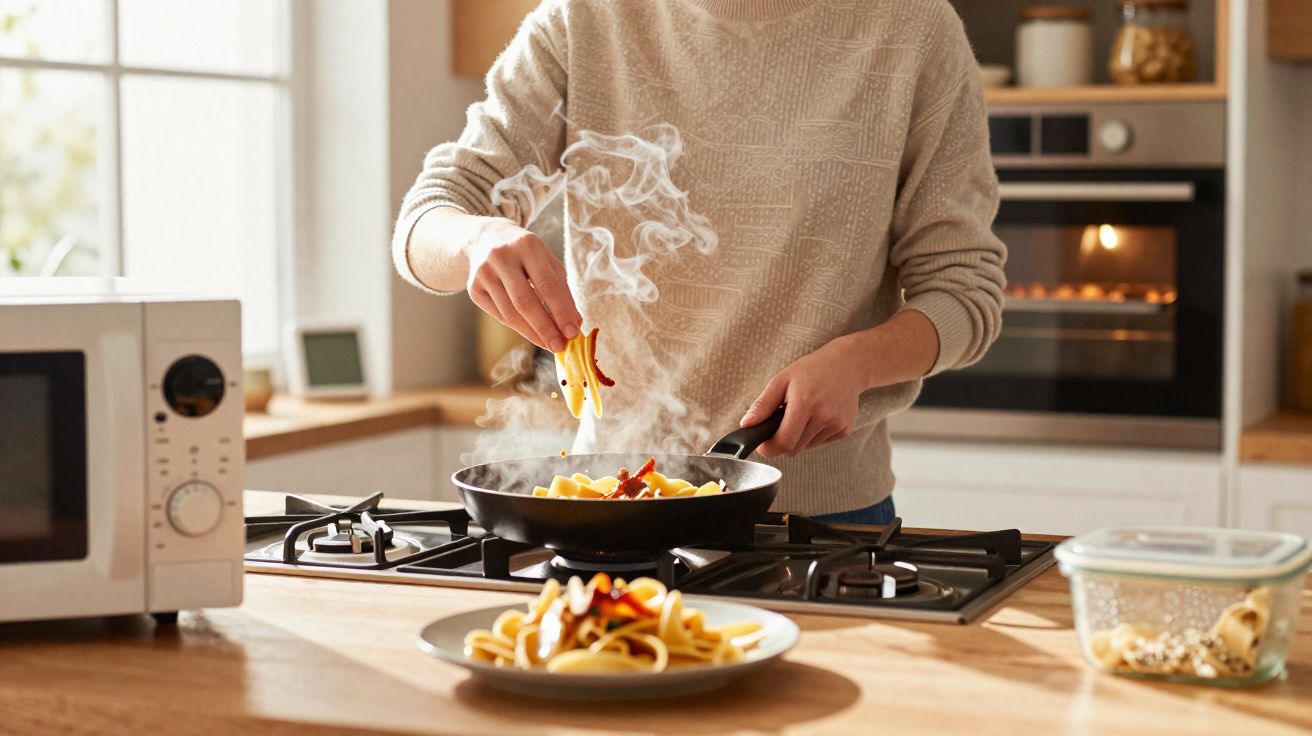
Let’s be honest: almost nobody does this perfectly every day. You get home exhausted and you want heat, not a science lesson. Still, switching reheating methods for just a handful of dishes can feel like a small life upgrade. Cold roast chicken? Avoid the microwave; warm it gently in a covered pan over low heat with a splash of stock. Leftover chips or roast potatoes? Put them straight into a hot frying pan or an air fryer - never the microwave. Curry or stew? Reheat slowly on the hob, stirring now and then, and you’ll keep the flavours deep and the texture soft without turning it to mush.
A mindset shift helps as much as any gadget: treat reheating as finishing the cooking, not as an annoying chore. That thought alone nudges you to add a teaspoon of water, a drizzle of oil, or a squeeze of lemon right at the end. Suddenly the leftover isn’t a sad photocopy of yesterday’s meal; it becomes today’s version.
Some foods and the microwave simply don’t get along. Fried chicken’s proud crust goes leathery because steam is trapped with nowhere to escape. Steak can overcook internally while the outside stays drab. Baguette turns hard, then oddly chewy. A pan or oven gives you what flavour loves: contact heat, browning and evaporation.
Texture-sensitive dishes - risotto and ramen are prime examples - live or die by reheating method. A leftover risotto “puck”, sliced and pan-fried into little cakes, tastes miles better than the same rice reheated in a bowl on high power. Ramen broth can cope with the microwave on low, but the noodles are better warmed separately in hot water rather than being zapped into oblivion. Tiny choices, huge differences in what your mouth experiences.
Home cook Laura, who batch-cooks lunches for the week, puts it plainly:
“The day I stopped microwaving everything on high was the day my leftovers stopped tasting like punishment and started tasting like real meals again.”
Her approach is straightforward. She keeps the microwave for soups, stews and saucy dishes - always covered, always at medium power. Anything meant to be crisp goes into the air fryer or a hot pan. Bread gets a quick spell in the oven or toaster. It’s not restaurant-perfect, but it’s a long way from that limp, anonymous “office lunch” feeling.
- Crispy foods (pizza, chips, nuggets): reheat in a pan, oven, or air fryer - not directly in the microwave.
- Moist dishes (curry, chilli, pasta in sauce): use gentle heat, keep it covered, and add a splash of liquid on the hob or in a low-power microwave.
- Rice and grains: break up clumps, add 1 tablespoon of water per portion, and cover tightly so it steams.
The table that quietly changes your reheating habits
| Key point | Details | Why it matters to readers |
|---|---|---|
| Microwave power & timing | Use 50–60% power with longer heating times, stirring or rotating halfway through. Cover loosely to hold gentle steam rather than blasting the surface dry. | Reduces burnt edges and cold centres, so leftovers taste closer to freshly cooked food instead of something you endure. |
| Choosing the right tool | Use the microwave for soups, stews and saucy dishes; a pan or oven for anything meant to be crispy; a kettle or hot water bath for noodles and delicate proteins. | Matching method to food type protects the texture you liked in the first place, instead of flattening everything into the same soggy result. |
| Adding moisture or fat back in | For rice, pasta and meats, add a spoonful of water, stock or oil before heating. For bread and pizza, reheat with a touch of steam or added fat. | Replaces moisture lost in the fridge, bringing back juiciness and mouthfeel so the dish tastes rich again rather than tired and dry. |
Once you start paying attention to what reheating does, you can’t really unsee it. That spoonful of water stirred through rice stops feeling like hassle and starts feeling like basic self-respect. Those pan-crisped leftover potatoes become the reason you deliberately cook extra next time.
There’s a quietly emotional side to this as well. Leftovers carry the imprint of the first meal: a birthday dinner, a lazy Sunday roast, a late-night takeaway. When reheating strips away texture and dulls flavour, it isn’t only the food that feels flattened - it’s the memory attached to it.
Choosing a better reheating method is a small, almost invisible act. You lower the microwave power. You warm soup in a saucepan instead of in its plastic container. You slide yesterday’s pizza into a hot pan for three minutes. Nobody applauds - but the first bite tells you everything.
That’s the difference between “leftovers again” and “hang on, this is actually good”. And perhaps that’s the point: not perfection or kitchen heroics - just the feeling that even on the most ordinary weekday, your food still deserves to taste like something you were looking forward to.
FAQ
- Is microwaving food bad for flavour, or just for texture?
It’s mainly a texture issue. The microwave heats quickly and unevenly, drying surfaces and tightening proteins and starches, which makes food feel rubbery or soggy. When texture drops, your brain often interprets that as “less flavour”, even if the flavour compounds are still present.- What’s the best way to reheat pizza so it isn’t soggy?
Use a hot, dry pan on medium heat or an air fryer. Warm a slice for 3–5 minutes until the base is crisp and the cheese has just melted. If you have to use a microwave, use low power in short bursts, then crisp the bottom in a pan for a minute.- How do I keep leftover rice from going hard in the microwave?
Break up the clumps, sprinkle 1–2 tablespoons of water per portion, then cover tightly with a lid or microwave-safe plate. Heat on medium power and let it stand covered for a minute afterwards so the steam softens the grains again.- Why does reheated chicken get so dry and stringy?
Chicken is often lean, so when it’s reheated quickly the remaining moisture escapes and the muscle fibres contract. Gentle heat plus a little stock, sauce or even a splash of water helps keep it tender rather than chalky.- Can I safely reheat leftovers more than once?
Food safety guidance generally recommends cooling quickly, storing in the fridge, and reheating only once until piping hot. Repeated cooling and reheating increases the risk of bacterial growth and also destroys texture.



Comments
No comments yet. Be the first to comment!
Leave a Comment