
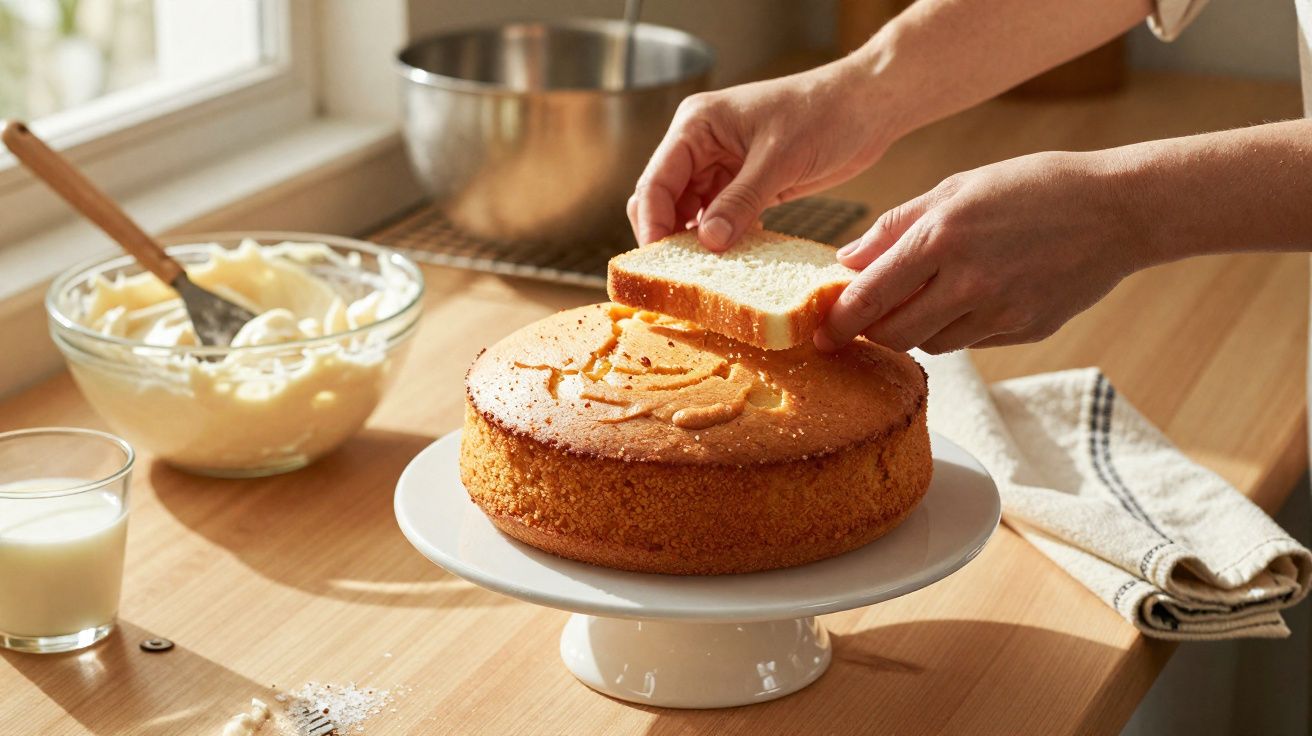
The cake was flawless at 10 a.m.
Golden on top, springy in the middle, and the kitchen scented with butter and vanilla. You ease it onto the worktop, promise yourself, “I’ll frost it later,” and get on with the rest of the day.
By 5 p.m., the rim has gone dry, the surface feels a bit tough, and your once-proud homemade cake suddenly looks like it’s been sitting in a heatwave.
An auntie will insist it’s your recipe. A friend will blame the oven. And you’ll privately wonder whether you’re simply not “good at baking”.
Then some bakers reach for a fix that feels almost laughably low-tech:
they lay a slice of bread on top of the cake.
Somehow, when it’s finally time to frost, the sponge is still soft-nearly as if it’s just come out of the oven.
It’s the sort of trick you doubt… right up until you try it.
Why a slice of bread stops your cake drying out
Keeping a cake moist is, in reality, a race against the clock.
From the second you lift a sponge out of the oven, steam begins to escape. As the surface cools, water molecules steadily migrate from the cake into the surrounding air.
Leave a cake uncovered and the top can turn leathery. Wrap it tightly while it’s still warm and you trap too much steam, which can leave the surface slightly gummy. Home bakers end up stuck in the awkward middle: the cake must cool, but you don’t want it to dry out.
That’s where a plain slice of bread earns its keep-resting on top like a small, edible shield.
Not beautiful, but impressively effective.
Picture this: you bake a chocolate cake the night before a birthday. You hold off on frosting because a freshly frosted cake looks best on the day. The cake cools on the worktop and, like many of us, you throw a loose sheet of foil over it and head to bed.
The next day you lift the foil. The centre is fine, but the edges are dry, crumbly, and a little disappointing. You end up trimming them, losing perfectly good cake and precious time.
Now imagine the same cake on the same worktop-but once it’s cooled, you place a slice of sandwich bread over the top and then tent the foil over it. By morning the bread feels a touch stale at the edges, yet when you press the cake gently it’s still tender. That one small change makes a huge difference.
What’s going on is straightforward kitchen physics.
Bread is essentially a sponge: starch plus tiny air pockets that readily absorb and release moisture. A cake’s exposed surface is also exchanging moisture with the air-but when you cover it with bread, the cake no longer “deals” directly with a dry room. It exchanges moisture with the bread instead.
The cake gives up some moisture, and the bread absorbs it.
Meanwhile, the slightly humid pocket between the bread and the cake stays put, helping to slow further drying.
In other words, the bread becomes the sacrificial layer: it goes stale first, so your cake doesn’t have to.
You spend one slice of bread and end up with a dessert that tastes freshly made.
How this slice of bread keeps sponge cake moist: step by step
Begin only when the cake is completely cool to the touch.
If it’s even a little warm, leave it on the rack longer-warm cake plus trapped moisture can turn sticky very quickly.
Once cool, move the cake to the plate or board you’ll use for frosting later. Take one or two plain slices of soft bread (white bread or a brioche-style loaf works especially well) and lay them flat across the top. Cover as much of the surface as possible without piling slices on top of each other.
Next, loosely cover everything with cling film or foil, tenting it so it doesn’t press down on the bread or cake. Place it somewhere cool and dry on the worktop, away from sunlight or heat. That’s all-you’ve just bought yourself several delicious hours.
It feels almost too simple, which is exactly why many people ignore it.
They wrap the whole cake tightly in cling film or drape a tea towel over it, assume that’s “good enough”, and then wonder why the top is still crusty by evening.
Two common pitfalls are worth avoiding:
- Using the bread too early: if the cake is still warm, you’ll hold steam right against the surface and risk a sticky or slightly soggy top.
- Choosing strongly flavoured bread: rye, garlic, or anything aromatic can pass its flavour along to your dessert in the worst possible way.
Most of us recognise the pre-guest panic-when you’re rushing and you half-guess the storage step. The plain truth is that small details are what separate an “it’s fine” cake from a “wait… you baked this?” cake.
There’s a useful mindset shift hiding inside this little hack.
It’s a reminder that protecting your cake doesn’t require fancy kit-just a bit of intention and something you probably already have in the cupboard.
Pastry chef Elena M. once told me, “I don’t baby my cakes with gadgets. I just control their environment. Bread is cheap insurance for texture.”
One more practical note: if your sponge has a very delicate surface (for example, a thin crust or a light, airy crumb), place the bread gently and avoid dragging it across the top. If a few crumbs cling to the slice when you remove it, that’s normal-lift slowly and discard the bread.
And if you’re baking far ahead, remember this trick is best for short holding at room temperature. For longer storage, freezing layers (well wrapped) is often a better plan than leaving cake out for extended periods.
To make the method easy to remember, use this mini checklist:
- Use soft, neutral-flavoured bread (white, milk, or brioche style).
- Wait until the cake is fully cool before covering it with bread.
- Lay the bread flat on top, then tent with cling film or foil.
- Keep it at room temperature, away from direct sun or heat.
- Remove the bread just before frosting and discard that sacrificial slice.
Once you’ve seen how much softer your cake stays, you’ll never look at a bread heel in quite the same way again.
Beyond the hack: what it says about home baking
Part of the charm of the bread-on-cake trick is how old-fashioned it feels-like something your gran might have done long before kitchen blogs, clever gadgets, and “smart” fridges. It’s observation, a bit of improvisation, and suddenly the problem is solved.
It also gently pushes back against the idea that homemade desserts require perfect timing. With this, you can bake in the morning, frost in the evening, and still serve a cake that tastes like it’s only just been baked.
Realistically, nobody does this every day.
Most of us bake for birthdays, holidays, or the occasional Sunday when we need the smell of butter in the air to reset the week.
On those occasions, small tricks feel surprisingly big.
A slice of bread stops being “just bread” and becomes permission to stretch time a little-to bake when you can and still put something soft, generous, and worth gathering around on the table.
You may even find yourself sharing the hack in group chats and family messages, the way the best kitchen secrets travel: quietly, practically, and longer than any recipe card.
| Key point | Detail | Value for the reader |
|---|---|---|
| Use bread as a moisture shield | Place a soft slice directly on the cooled cake surface | Keeps the cake tender until frosting time |
| Timing matters | Only cover the cake once it’s completely cool | Avoids a sticky or soggy top layer |
| Simple tools, big payoff | Bread plus loose wrap, stored at room temperature | Reduces stress and last‑minute dryness fixes |
FAQ: slice of bread on cake
- Question 1 Can I use any type of bread on my cake?
- Question 2 How long can I leave the bread on top of the cake?
- Question 3 Won’t the bread stick to the cake surface?
- Question 4 Do I still need to wrap the cake if I use bread?
- Question 5 Does this trick work for cupcakes or layered cakes?


Comments
No comments yet. Be the first to comment!
Leave a Comment