
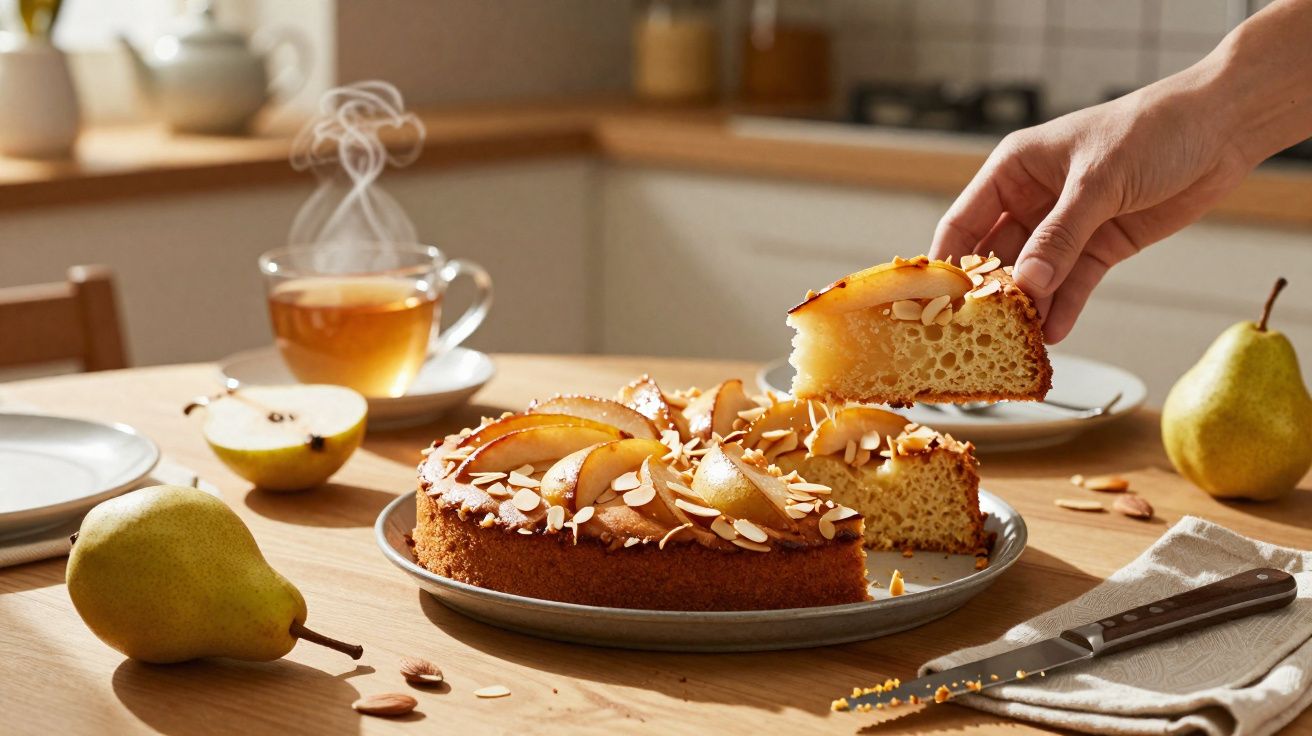
Outside, the sky lay like a smooth sheet of grey - the kind that makes the afternoon feel as though it’s been paused on “nearly evening” for hours. On the kitchen counter, a bowl of pears was slowly going soft and speckled: too bruised for lunch, still far too lovely to bin. The phone kept vibrating with work emails, the kettle clicked itself off, and someone in the room asked, almost absent-mindedly, “Have we got anything sweet?”
That small question landed like a challenge. Not a showpiece pudding, not a three-hour baking marathon - just something comforting: warm, scented, and with a bit of crunch at the centre. Something that turns a weary mug of tea into a proper break. That’s how a pear and almond cake tends to appear: quietly, almost shyly. It looks unassuming, but one bite is usually enough to win everyone over.
The quiet power of a pear and almond cake
There’s a particular hush that settles when a pear and almond cake comes out of the oven. Not the performative silence of people grabbing their phones - a gentler one, where conversations naturally slow and faces drift towards the aroma without anyone really noticing. Toasted almonds, butter, and baked fruit speak a language most people understand immediately.
This is not a cake that needs drama. It doesn’t pile up into extravagant swirls or call for piping bags and glossy decorations. It sits fairly low and modest, with pear slices sinking into a golden crumb. And then there’s the texture: tender at the edges, fruit-soft in the middle, with a delicate bite from ground almonds (and often a scatter of flaked almonds on top). It tastes like it took more effort than it did - and that’s part of its charm.
On weekday afternoons, when energy dips and patience runs thin, that sort of cake can reset a room without making a fuss. One slice slid across the table becomes a peace offering. Two slices shared from the same plate can open up a conversation that wasn’t happening five minutes earlier. Nobody announces, “Let’s have a meaningful moment.” They just say, “There’s cake in the kitchen,” and people wander over as if pulled by a string.
A London office worker once told me her pear and almond cake “saved” the hardest Monday of the month. The team had missed a deadline, the meeting dragged, and nobody felt brave enough to leave on time. She’d baked the cake the night before mainly to use up overripe pears. At 4:15 pm, she cut it into squares, put it on a plate in the meeting room, and didn’t make a speech. Ten minutes later, the mood had shifted.
“People started swapping recipes, then talking about their kids, then even discussing the project without snapping,” she said, half-laughing. “I didn’t fix anything - the cake did.” It sounds trivial until you remember how many days become a blur of rushed coffees and half-eaten snacks. A warm, homemade slice at tea time hits differently. Without saying it outright, it suggests: someone thought this moment was worth making nicer.
A small 2023 survey by a UK home-baking brand found that 62% of respondents said baking for other people makes them feel “more connected” than sending a message or emoji. Statistics can’t capture the scent of fruit caramelising at the edges of a tin - but they do point to something true. Slightly improvised food, like a pear and almond cake made from pears that were nearly past their best, carries a human signal. It says, “I had a spare pocket of time, and I used it on you.”
Why this pear and almond cake works so well (and so quickly)
The mechanics are almost comically straightforward: an almond-rich batter, fresh pear slices pressed in, and the oven doing the heavy lifting. Ground almonds create a tender crumb that stays moist longer than a standard sponge. As the pears bake, they release juice, and that becomes the softly jammy centre. A finishing layer of flaked almonds (or crushed nuts) provides the crisp contrast that wakes up each forkful.
Flavour-wise, it’s a small ensemble that plays beautifully together. Pear brings floral sweetness; almonds add depth and a faint, pleasing bitterness; butter and sugar smooth everything into one cohesive note. Vanilla works quietly in the background, and if you want a bolder edge, a pinch of cardamom does the job. The proportions matter: overload the fruit and the cake can turn heavy and wet; skimp on pears and you’re left with a plain almond sponge. When it’s balanced, every bite delivers the trio - soft, fruity, crunchy.
The reason this cake can “warm up tea time in a flash” is that it fits into real life. You can mix it by hand in a single bowl, arrange the pears, and slide it into the oven. By the time the table’s cleared and the mugs are set out, you’re most of the way there. There’s no syrup to boil, no icing to perfect, no overnight resting. It works on days when you glance at the clock and think: I’ve got 20 minutes before the next call - I can get the batter done.
If you’re baking for guests, this is also the sort of cake that doesn’t mind being served simply. It’s excellent on its own, but it’s just as happy with a spoon of Greek yoghurt, a dollop of crème fraîche, or a little softly whipped cream - especially if you’re serving it warm.
And if you’re trying to be a bit more mindful about waste, it’s a genuinely useful recipe to keep in your back pocket: pears that are too soft to eat out of hand can still bake into something that tastes intentional rather than rescued.
Small adjustments that transform your tea time
If you’re chasing that soft–fruity–crunchy balance, the pears are where it starts. Aim for pears that are ripe but not collapsing - they should yield slightly near the stem. Too firm and they’ll bake up pale and bland; too mushy and they can dissolve into wet pockets. Peel them if the skins are thick, then slice lengthways into thin “fans”. Slim slices sink neatly into the batter and cook through quickly, giving you that gentle, jammy centre without flooding the sponge.
The batter doesn’t require an electric mixer. Whisk together melted butter, sugar, and eggs, then fold in flour and ground almonds with a spatula. Add a pinch of salt (always), and consider a quick squeeze of lemon over the pears to sharpen their sweetness. Tip the mixture into a lined tin, arrange the pear slices over the top, and scatter flaked almonds as though you’re seasoning generously. Into the oven - and the hardest work is already done.
A finishing touch that’s easy to ignore (and worth remembering) is a light glaze. When the cake comes out, still warm and slightly puffed, brush the top with warmed apricot jam or a little honey - not much, just enough to catch the light. It adds a faint stickiness and makes the almond topping taste more vivid. Let’s be honest: almost nobody does this every day. But when you do, it feels oddly luxurious.
People often worry they’ll ruin a cake like this: a dry crumb, a soggy middle, pears disappearing into the depths. In practice, a pear and almond cake is very forgiving. Ground almonds help it stay moist, and even if it goes five minutes longer than planned it usually remains tender. If the pears sink a little, they often create pockets of fruit that become the most fought-over bites. Here, “imperfect” reads as homemade - not as failure.
There’s also the quieter nerves of serving something you’ve baked yourself: what if nobody likes it, or it looks plain next to something shop-bought? In reality, most people are genuinely pleased to be offered anything warm and fragrant that came from an actual oven. They taste the gesture as much as the crumb. If one corner sticks or the edges are a shade too dark, you call it “the cook’s piece” and eat it yourself in the kitchen, standing up.
We’ve all had days that feel a bit too sharp, and a slice of cake with someone else softens the edges. That’s exactly where this pear and almond cake belongs. The mistakes that do matter are straightforward: cutting it while the centre is still molten so it collapses; letting the batter get drowned in pear juice; using rock-hard fruit that never sweetens. The fixes are equally simple: rest it for 10 minutes, blot very wet slices with kitchen paper, and choose pears that smell of something - not nothing.
“The best cakes,” an elderly baker in Lyon once told me, “are the ones that look as if they were made in a hurry, for people you love, on a day that wasn’t going well.” This pear and almond cake feels exactly like that.
- Choose pears that are ripe but still holding their shape: they should give slightly under your thumb.
- Use ground almonds in the batter for moisture and that gentle bite.
- Bake in a shallow tin so the fruit and crumb cook at the same pace.
- Let it cool just enough to slice neatly, but serve it while still warm.
- Keep it rustic; don’t try to “perfect” every piece.
A pear and almond cake that stays with you after the crumbs
A pear and almond cake doesn’t really finish when the plate is empty. The scent lingers in the house, clinging to curtains and jumper sleeves, drifting into the hallway each time someone passes the kitchen. The crumbs on the board become quiet evidence that something happened here: a pause, a small gathering, a refusal to let the afternoon rush swallow the day whole. You might forget what was said over tea, but you’ll remember that first soft bite and the crunch of almonds.
There’s also a particular satisfaction in taking fruit that was one step from the food bin and turning it into the centre of the table - not just thrift, but care. It’s a way of insisting that ordinary days deserve decent food, even when nothing is being celebrated. A grey Tuesday, improved by a cake that tastes like you decided the moment mattered.
You might pass the recipe on - or keep it as your quiet trick. Next time, you could add a splash of rum, a pinch of cinnamon, or tuck a handful of chopped chocolate under the pears. You might bake it round, square, or in a cast-iron skillet because it’s already on the hob. What tends to stay the same is the second when you set it down and someone looks up from their screen (or their thoughts) and says, surprised, “Oh - warm cake?” That’s the small, golden moment this pear and almond cake is made for.
| Key point | Detail | Why it helps |
|---|---|---|
| Choose the right pears | Pears that are ripe but firm, with a gentle fragrance | A melting centre without turning the cake soggy |
| Almond base | A mix of flour and ground almonds in the batter | Lasting moistness, deeper flavour, and a lightly crisp edge |
| Serve at the right temperature | Let it cool for 10–15 minutes before slicing | Clean slices, juicy middle, and the best tea-time experience |
FAQ
- Can I use tinned pears instead of fresh ones?
Yes - but drain them thoroughly and pat them dry, or the cake can become soggy. Consider reducing any added sugar slightly, as tinned pears are often sweeter.- Do I need a mixer to make this pear and almond cake?
No. A whisk and a spatula are plenty. The batter is straightforward and forgiving, which makes it ideal for quick, last-minute baking.- Can I make the cake ahead for the next day?
Yes. Thanks to the almonds and fruit it stays moist. Keep it covered at room temperature, and if you like it warm, reheat slices gently in a low oven.- What kind of almonds work best for the crunchy topping?
Flaked almonds are the classic choice, but slivered almonds or roughly chopped whole almonds also work, giving a chunkier bite.- Is this cake suitable for people who are gluten-free?
You can replace the plain flour with a gluten-free flour blend and keep the ground almonds. The crumb remains soft and slightly dense, which suits this style of cake well.



Comments
No comments yet. Be the first to comment!
Leave a Comment