
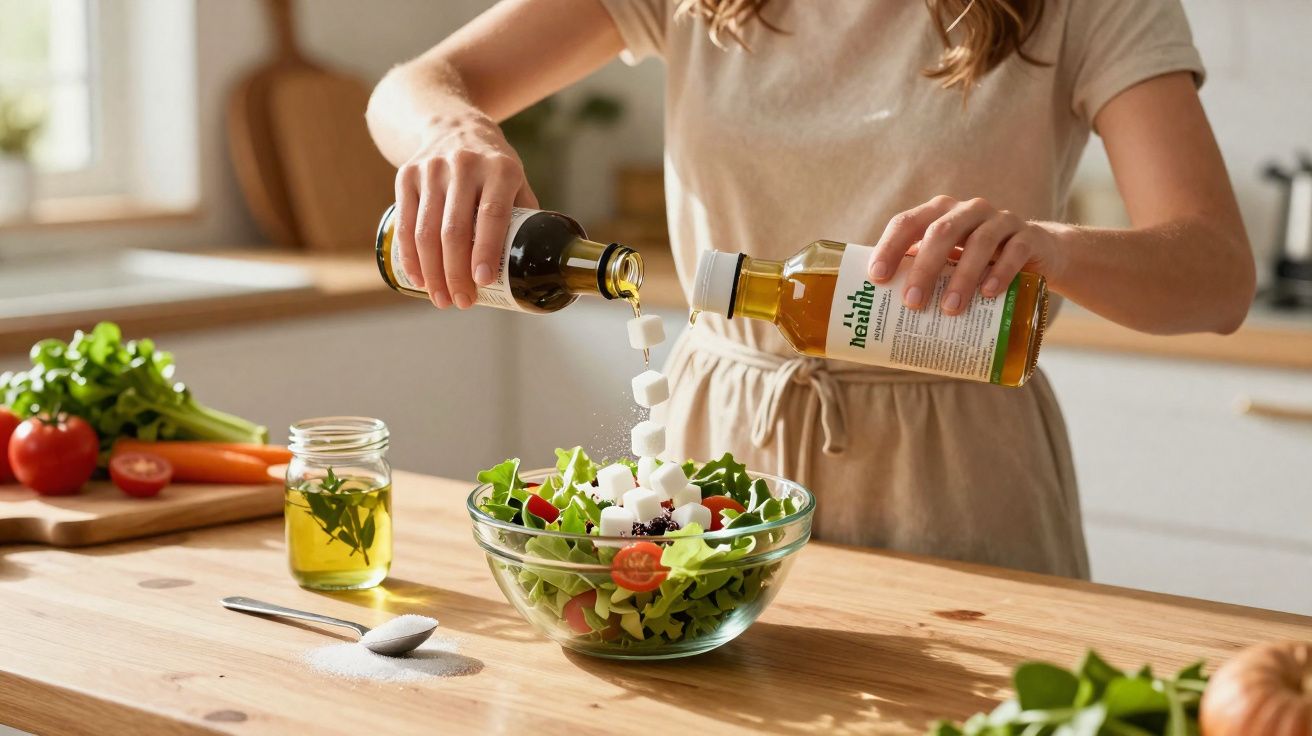
A woman pauses for a heartbeat at the salad bar, then turns the bottle upside down. A thick stream of “light” dressing lands generously over her neatly assembled lettuce, cucumber and grilled chicken. She looks quietly pleased with herself - as though she has chosen the moral option in a cafeteria full of chips and burgers. Nearby, the office lunch queue has the same muted determination: people trying to be “good” for an hour.
Salad means healthy. Case closed. Yes?
What she can’t see is that the dressing she has just soaked her bowl in contains more sugar than a couple of biscuits. She also can’t see how the “fit” branding is, in effect, selling her a dessert wearing a wholesome costume. And she certainly won’t be told why her weight keeps creeping up despite all those heroic salads.
The bottle looks innocent. That’s exactly the problem.
The salad that isn’t as clean as it looks
Take a stroll down any supermarket salad aisle and the contrast is almost theatrical. The vegetables sit quietly, unbranded and modest, while the dressings shout in fluorescent, confident letters: “LIGHT!”, “LOW FAT!”, “FIT!”, “NO GUILT!”. The promise is tempting and simple: squeeze this on your greens and your lunch becomes both tasty and virtuous. It feels like a clever shortcut - flavour and health in one go.
Then you look under the lid and the tone shifts. A surprising number of “healthy” dressings rely on added sugars, syrups and sweeteners - not always obviously sweet on the tongue, but treated by your body much like pudding. You may not notice it; you may barely taste it. Yet it accumulates steadily, mouthful after mouthful.
A French dietitian once told me about a patient who arrived genuinely angry. She had replaced takeaway meals with salads, tracked everything, and weighed herself every week. Nothing improved. Some weeks, the scales even nudged upwards. “I’m eating like a rabbit,” she complained, “so why have I still got this belly?”
The dietitian asked her to bring in every product she was using at home. Out came the star of the routine: “Yogurt Herb Dressing – Low Fat – 40% fewer calories”. The back label revealed the real story - three different types of sugar adding up to roughly 6–8 g per serving. Not per bottle. Per serving. And she was easily pouring three servings at a time. Her “healthy” lunch had been delivering the sugar equivalent of a small fizzy drink, day after day.
Here’s why it happens: “low fat” sells. But once manufacturers remove fat from a sauce, the result can taste thin and dull. To rebuild body and flavour, they often add sugar, starches and a long list of extras to mimic richness. In the aisle, you don’t experience it as a trick - you taste creamy, tangy, maybe a faint sweetness that doesn’t register as a treat. Physiologically, though, your blood sugar can still jump. Insulin follows. Hunger returns sooner. And those 4 pm cravings start to feel inevitable.
That’s how a bowl of raw vegetables turns into a stealthy calorie bomb. Not because lettuce is the enemy - but because the bottle can be.
A quick note about portions and labels (salad dressing reality check)
One more snag: serving sizes on ready-made salad dressing labels can be unrealistically small. In the UK you’ll often see both “per serving” and “per 100 g” (or per 100 ml). If you only glance at the serving figure, you can underestimate what you’re actually pouring - especially when you dress directly from the bottle. A “serving” might be 15 g, while your salad easily gets double or triple that without you noticing.
It’s also worth remembering that restaurant salads can be even harder to judge. A salad that looks lean on the menu may come drenched in dressing, or built with sweet glazes and thickened sauces. If your salad is a daily habit, these hidden additions matter just as much as what you put on at home.
How to stop getting fooled by “healthy” dressings
The fix isn’t to abandon salad. It’s to reduce the influence of the bottle. Next time you pick up a dressing, skip the slogans and go straight to the nutrition panel. Focus on one line: “of which sugars”. Ignore the green leaves on the front, the “NO GUILT” promise, the sporty model. Look at the number in grams.
A useful rule of thumb: for an everyday dressing, aim for under 2–3 g of sugar per serving. Once you’re seeing 5, 6, 8 g or more, you’re drifting from seasoning into dessert territory. And if sugar, glucose–fructose syrup, honey or agave appears in the first three ingredients, treat that bottle as an occasional option rather than your default.
Most people recognise the frustration of “doing everything right” while the scales refuse to budge. You start blaming your discipline, your age, your hormones, your genetics. Almost nobody thinks to suspect their salad dressing - which is exactly why this topic provokes such strong reactions. Pointing out the sugar in someone’s “healthy” bottle can feel oddly personal, as though you’re accusing them of being naïve. In reality, it’s the branding that’s doing the misleading.
And let’s be realistic: hardly anyone reads every label, every day. You check a few, you get bored, you start trusting buzzwords. That small gap - between good intentions and what’s actually in the bottle - is where sneaky sugars slip in.
A nutrition researcher I interviewed put it plainly:
“If you need a marketing slogan to believe a dressing is healthy, it probably isn’t.”
His advice was to return to basics: dressings made from ingredients you can recognise without a chemistry lesson - olive oil, vinegar or lemon, mustard, salt, pepper, herbs. When you control the recipe, you control the sugar. It doesn’t have to be a social-media performance every evening, either. A jam jar, a fork or a quick shake, a handful of ingredients - and you’ve got enough for two or three days.
To keep things practical, here’s a small toolbox:
- Pick dressings with fewer than 6 ingredients and no sugar in the top three.
- Portion with a teaspoon, not the bottle neck, so you know what you’re using.
- Start with 1 part acid (vinegar/lemon) to 3 parts oil, then tweak to taste.
Reclaiming your salad dressing, without becoming paranoid
Once you clock the hidden sugars in dressing, you can’t really unlearn it. Some people then swing from blind trust to full detective mode - scanning every label, feeling guilty about every spoonful. That isn’t the aim. The aim is clarity: knowing when you’re eating sugar rather than being quietly nudged into it by packaging and clever wording. You choose your treats deliberately, instead of having them chosen for you.
You might keep your favourite sweet honey–mustard dressing for weekends, and use a straightforward olive oil and vinegar mix Monday to Friday. You might learn one reliable homemade recipe and make it your standard. Or you might simply realise your “healthy” lunch wasn’t as light as you assumed - and adjust gently. The point isn’t to cancel dressing; it’s to move the power back onto your plate, not into the hands of a bottle designer.
| Key point | Detail | Value for the reader |
|---|---|---|
| Check sugars per serving | Stay under 2–3 g per serving for daily dressings | Cuts hidden sugar load and reduces unexpected weight gain |
| Read ingredient order | Avoid dressings where sugar or syrup is in the top three ingredients | Fast aisle filter even when you’re in a rush |
| Favour simple homemade mixes | Olive oil, vinegar or lemon, mustard, herbs, salt, pepper | Full sugar control, better flavour, often cheaper |
FAQ
Are all ready-made salad dressings bad?
No. Some brands keep ingredients simple and sugar low. The goal isn’t to condemn the entire category; it’s to compare labels and choose dressings with low sugar and short, recognisable ingredient lists.Is honey or agave in dressing “healthier” than white sugar?
They are still sugars and your body processes them in broadly similar ways. They may sound more natural, but in a dressing they still add calories and can fuel cravings, even if the label looks “cleaner”.Can I lose weight just by changing my salad dressing?
In some cases, yes - especially if you eat salads often and your current dressing is very sugary. It won’t replace overall habits, but removing hidden sugars can restart stalled progress and reduce the urge to snack.What’s a quick homemade dressing I can actually stick to?
Try: 45 ml olive oil, 15 ml lemon juice or vinegar, 5 ml mustard, plus a pinch of salt and pepper. Shake in a jar. It will keep in the fridge for a few days and suits most salads.Are “sugar-free” or “zero” dressings a good solution?
They remove sugar, but often replace it with sweeteners and a long list of additives. Some people tolerate them; others notice digestive upset or stronger cravings. Your most reliable option is usually a simple, minimally processed dressing you genuinely enjoy and can use regularly without stress.

Comments
No comments yet. Be the first to comment!
Leave a Comment