
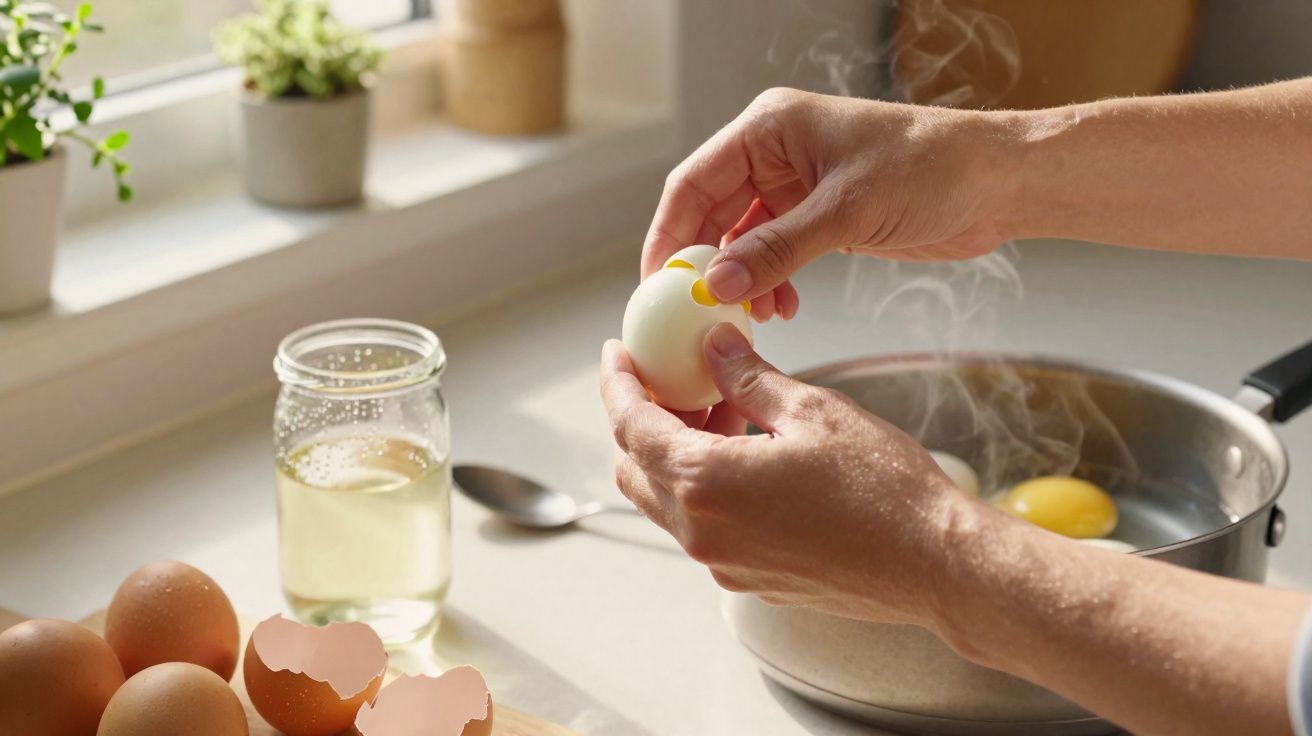
The first snap of shell rang out in my cramped kitchen like an alarm bell. Another hard-boiled egg, another peel that refused to cooperate-shell gripping tight, taking half the white with it in torn, uneven patches. The sink filled with soggy shards, my thumbs stinging from the heat, and my patience was gone before breakfast had properly begun.
Online, people shared flawless, gleaming boiled eggs that seemed to peel in a single, perfect ribbon, as though the world was a calmer place than mine. Mine looked as if they’d barely survived a small blast.
Then, one Sunday, a neighbour wandered in, watched my mess unfold, and said-like it was the most ordinary thing in the world-“You’re not adding vinegar to the water?”
I just stared. Vinegar? In the saucepan?
She shrugged, tipped in a teaspoon, and permanently changed how I cook eggs.
It honestly felt like a cheap little magic trick.
Why a teaspoon of vinegar transforms boiled eggs
The first time you do it, it’s hard to trust what’s happening. You lower eggs into gently boiling water, with a teaspoon of everyday white vinegar swirling around. Ten minutes later, you tap an egg on the worktop, start peeling-and the shell comes away in wide, clean sections. No gouged whites. No pitted craters. Just a smooth, glossy boiled egg.
It’s unexpectedly satisfying. Something that used to feel irritatingly random becomes consistent-almost calming.
If you ask around, you’ll hear the same pattern: everyone has tried a “perfect boiled egg” fix that didn’t deliver. Someone’s nan insisted you must start with cold water. A food blogger swore an ice bath was the only secret. A mate recommended pricking the shell with a pin. And still, people ended up hunched over the sink, hunting down tiny shell fragments and swearing off devilled eggs for good.
One home cook told me she stopped making egg mayo for parties because “the eggs looked like they’d been chewed by a dog.”
Then she tried the teaspoon of vinegar. “I assumed it was another fake hack,” she said. “But the shells just slid off. I ended up laughing at my own saucepan.”
There’s no mystery to it-just simple kitchen chemistry in a supermarket bottle. Eggshells are mostly calcium carbonate. Vinegar is a mild acid. In hot water, that acidity gently weakens the shell and the thin membrane underneath.
That small shift is enough to help the shell separate more readily from the cooked white. You won’t see dramatic fizzing, but you’ll feel it: less grip, bigger flakes, fewer stubborn bits that tear the egg.
The science is subtle. The payoff is obvious.
A quick note on eggs, freshness, and cracking (boiled eggs)
Even with white vinegar, very fresh eggs can still be fiddly. When an egg is new, the white tends to cling more tightly to the membrane, which makes peeling harder. If you can plan ahead, eggs that are a few days old usually peel more easily.
It also helps to lower eggs into the water gently (rather than dropping them in), especially straight from the fridge. Reducing impact means fewer cracks-and fewer whites leaking into the pan.
The exact method that reliably works
Here’s the straightforward approach. Fill a saucepan with enough water to cover the eggs by roughly 2 cm. Bring the water to a gentle boil-think steady bubbles, not a rolling, aggressive boil. Stir in 1 teaspoon of white vinegar, then use a spoon to lower the eggs in carefully so they don’t crack on contact.
Cook for 9–11 minutes, depending on how set you like the yolk. Move the eggs immediately into a bowl of cold water. Leave them for a few minutes, crack the shell, and peel.
You’ll notice the difference as soon as you handle the first egg.
Where people go wrong is usually by “helping” too much without realising it. They tip in half a cup of vinegar “just to be safe”, and the kitchen ends up smelling like a pickling plant. Or they use a fancy infused vinegar that can mark the shells and faintly tint the whites. Or they skip the cold-water finish and then wonder why the shell still fights back.
Realistically, most of us don’t measure a teaspoon every single time we make boiled eggs. But staying close to that amount keeps the balance right: enough acidity to weaken the shell and membrane, not enough to creep into flavour. The cold water bath still plays its part too, helping the egg contract slightly inside the shell-working neatly alongside the vinegar.
“I used to think peeling eggs was basically a lottery,” says Claire, a busy mum of three who puts boiled eggs into lunchboxes. “Now I do the vinegar thing and they peel so easily my kids can do it themselves. Dinner prep suddenly feels like less of a battle.”
- Use plain white vinegar: It’s inexpensive, neutral, and won’t stain your eggs.
- Add just 1 teaspoon per saucepan: Enough to do the job without affecting taste.
- Start with boiling water, not cold: It supports separation between membrane and white.
- Cool the eggs quickly: Cold (or iced) water for a few minutes is plenty.
- Peel under a thin stream of water: Water slips between shell and egg, shifting away tiny fragments.
Making a batch without waste
If you regularly prep salads, sandwiches, or lunchboxes, doing a larger batch of vinegar-boiled eggs can save time-and prevent the frustration (and food waste) of mangled whites. Once you’ve got the method down, it turns an annoying task into something you can do on autopilot on a weeknight.
When small kitchen tricks feel bigger than they are
A teaspoon of vinegar is a tiny detail in an everyday recipe, yet it subtly changes the mood in your kitchen. Suddenly, devilled eggs for a picnic don’t sound like hard work. Cooking a decent batch for salads, lunchboxes, or a brunch spread feels doable after a long day.
You start believing that what you intended to cook will actually come out the way you imagined.
And that quiet confidence makes it easier to choose cooking over grabbing something out of a packet.
| Key point | Detail | Value for the reader |
|---|---|---|
| Vinegar softens the shell | Mild acidity weakens the shell and membrane | Boiled eggs peel more quickly, with fewer torn whites |
| A small dose is enough | Around one teaspoon per pan of water | No strong flavour-just an easier peel |
| Method matters too | Boiling water start, cold water finish | More dependable results, less annoyance |
FAQ
Question 1: Does vinegar change the taste of the eggs?
Answer 1: With only a teaspoon in a pan of water, most people can’t taste any difference. The shell acts as a barrier and the contact time is brief. If you can smell vinegar while peeling, you’ve probably used too much.Question 2: Can I use apple cider or wine vinegar instead?
Answer 2: Yes, they’ll still do the job, but they may lightly perfume the eggs and can tint the shells (and occasionally the whites). For the cleanest, most neutral result, white vinegar is usually best.Question 3: Will this work with very fresh eggs?
Answer 3: Fresh eggs are naturally harder to peel because the white holds tighter to the membrane. The vinegar helps, but for truly effortless peeling, eggs that are a few days old tend to be easier.Question 4: Do I still need the ice bath if I use vinegar?
Answer 4: Yes. The cold water helps the egg contract slightly inside the shell. Together with vinegar, it gives you the best chance of smooth, clean peels.Question 5: Can I prep a big batch of vinegar-boiled eggs for the week?
Answer 5: Yes. Let them cool, peel them, then keep them in an airtight container in the fridge for up to a week. A pinch of salt or a damp piece of kitchen roll in the container can help stop them drying out.

Comments
No comments yet. Be the first to comment!
Leave a Comment