
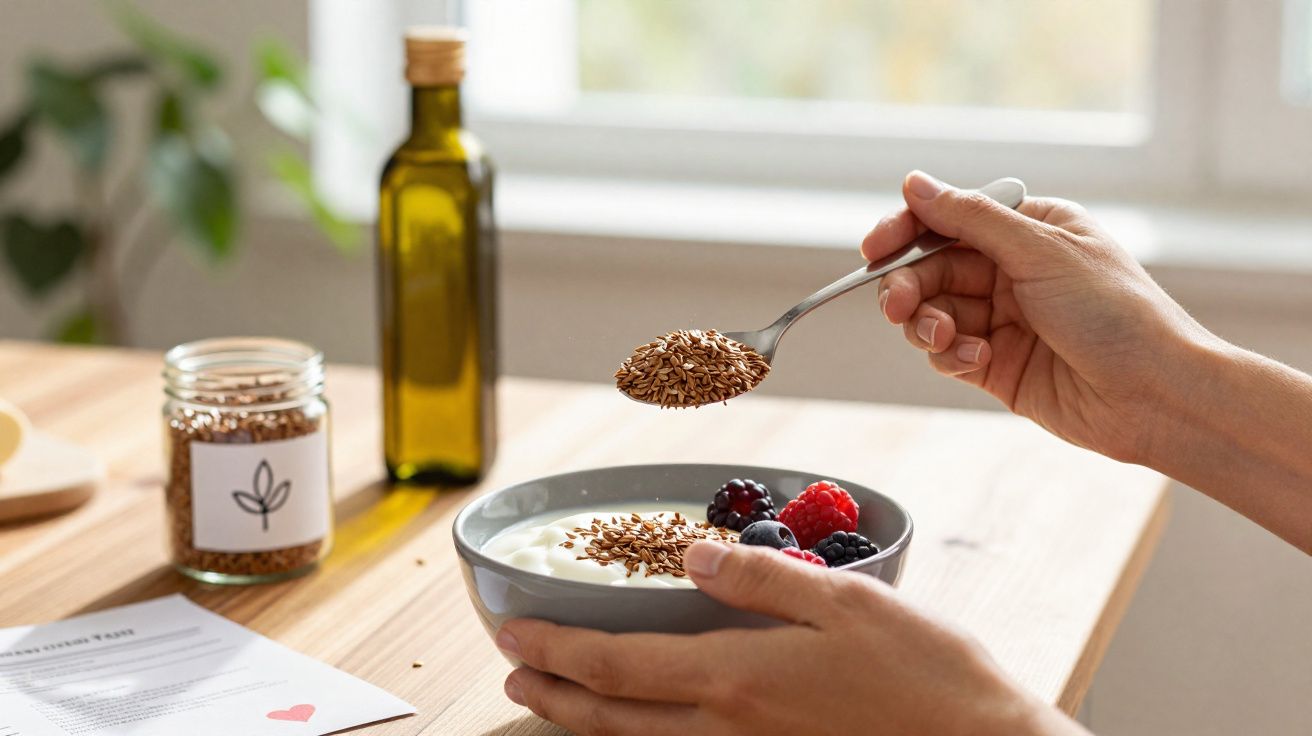
The woman ahead of me in the café pauses, then gives a small shrug and stirs something into her breakfast as if it were a personal rite. There’s no glossy branding and no “superfood” banner-just an unremarkable little jar of seeds she produces from her bag as casually as someone else might reach for their phone.
She tells me that a year ago her cholesterol was, in her words, “a disaster”. Now her doctor is equal parts impressed and confused. Same job, same pressure, same fondness for cheese. The only meaningful change? One spoonful of seeds, every single morning.
After that, I began spotting them everywhere: sprinkled over porridge in co-working spaces, whirred into smoothies on Instagram, scattered over salads in office lunchboxes. A quiet, crunchy shift-everyone seemingly gravitating towards the same contender for the “ultimate anti-cholesterol seed”.
The tiny seed doctors keep seeing in blood test results: flaxseed and cholesterol
Let’s name it plainly: flaxseed. The small brown or golden seeds you can easily overlook on the supermarket shelf. They’re not neon-bright, they’re not exotic, and they don’t make much of a spectacle. Yet many cardiologists and GPs have noticed a familiar trend in patient blood results: people who use flaxseed regularly often see their cholesterol readings look better than they did a few months earlier.
A tablespoon of crushed seeds can seem laughably small next to decades of routine-butter on toast, charcuterie boards, family meals heavy with cream. And still, taken most days, that modest spoonful of ground flaxseed can steadily chip away at LDL, the so-called “bad” cholesterol.
Not as a miracle cure-more like a slow, stubborn friend who keeps turning up.
In Canada, researchers tracked adults with high cholesterol who added ground flaxseed to their usual diet. After several weeks, many participants saw LDL fall by around 10–15%. Their lives didn’t suddenly become calmer, their jobs didn’t change, and the days didn’t get less hectic. The constant, again and again, was that spoonful at breakfast or lunch. Nobody rewrote the medical textbooks overnight-but the lab reports were hard to dismiss.
You hear similar stories in everyday life. One middle-aged engineer told his GP he’d done only one realistic thing: he hadn’t attempted a grand overhaul, he simply mixed ground flax into his morning oats and occasionally into soup. His next blood test wasn’t perfect, but it was undeniably less alarming. For him, it felt like finally finding a lever he could pull without flipping his life inside out.
Those small wins spread quickly-through waiting rooms, WhatsApp chats, and Sunday lunches. “Do you know what helped me?” someone says while passing the salt. And flaxseed quietly moves from kitchen to kitchen.
Why flaxseed can lower LDL cholesterol (and what’s doing the heavy lifting)
A lot of flaxseed’s effect comes down to soluble fibre-the same type of fibre that gives oats their heart-friendly reputation. In the gut, soluble fibre behaves a bit like a soft sponge: it binds to some of the bile acids your body uses to digest fats. To make more bile acids, the liver pulls additional cholesterol from the bloodstream. Over time, LDL can gradually drift downwards.
Flaxseed also contains lignans (plant compounds with antioxidant properties) and alpha-linolenic acid (ALA), a plant-based omega-3. Together, these are thought to help nudge inflammation lower and support healthier blood vessels. No single nutrient is a magic bullet, but this combination can tilt the odds in your favour. One spoonful won’t erase years of excess-yet repeated daily, it sends the same calm message to your metabolism: ease the pressure a little.
That’s why many nutrition-focused clinicians talk less about punishment diets and more about small, repeatable behaviours: a spoon here, a habit there.
A useful extra: flaxseed and triglycerides, blood pressure, and gut health
Although the headline is often cholesterol, people frequently choose flaxseed because it can support several related markers at once. Some individuals also see improvements in digestive comfort thanks to the fibre content, and others report steadier energy because fibre slows the speed at which sugars enter the blood.
It won’t replace broader lifestyle changes-sleep, movement, and overall diet still matter-but flaxseed can be one of the simplest additions that supports the whole system rather than just one number.
How to use one spoonful of flaxseed so it actually works
The detail many people miss is crucial: flaxseed needs to be ground. Whole seeds often pass through the digestive system largely intact. They may contribute some fibre, but much of their cholesterol-friendly potential stays locked inside the seed.
A practical starting point is 1 tablespoon of ground flaxseed per day. Stir it into foods you already eat-yoghurt, porridge, cottage cheese, or a smoothie.
If you’re prone to digestive sensitivity, start with 1 teaspoon for a few days and build up. Your body often needs time to adjust to extra fibre. You can grind seeds fresh using a coffee grinder or blender, or buy milled flaxseed and store it in an airtight container in the fridge. The healthy fats are delicate; colder storage helps protect them.
It helps to think of flaxseed less as a “treatment” and more as a kitchen habit that slips into your day and stays there.
Many people try flaxseed once, feel nothing, and drop it by the next week. Cholesterol doesn’t fall like a phone battery percentage-it shifts slowly. The progress shows up on blood tests, not on the scales the next morning. Let’s be honest: almost nobody sticks with something daily unless it has at least a little meaning, enjoyment, or routine attached to it.
So create a tiny ritual you almost like. Perhaps it’s the moment you top fruit and yoghurt before opening your emails, or the final flourish on a bowl of homemade soup. When you’re rushed, you can simply stir your spoonful into a glass of water or juice, drink it, and move on. The common mistake is waiting for “the perfect meal” to add flaxseed-because that meal rarely arrives.
Some people rush the process, doubling or tripling the dose from day one. Then they get bloated, feel uncomfortable, and blame the seed rather than the speed. Increase gradually, drink enough water, and speak with your doctor if you take blood thinners or have a gut condition.
“What changes cholesterol over time isn’t the food you eat once a month-it’s the small things you repeat without thinking,” a cardiologist told me. “Flaxseed is one of those rare tools that’s inexpensive, easy to find, and genuinely practical-if you give it a proper chance.”
To make it effortless, here’s a quick cheat-sheet:
- 1 level tablespoon of ground flaxseed per day is a sensible starting dose that, for many people, can begin lowering LDL over time.
- Always choose ground flaxseed, not whole, so your body can access the nutrients.
- Mix it into foods you already eat: yoghurt, porridge, smoothies, salads, soups.
- Keep ground flaxseed sealed in the fridge to reduce the risk of the fats turning rancid.
- Tell your doctor if you have high cholesterol or take medication; flaxseed is a useful tool, not a replacement for medical care.
Buying and storing flaxseed: small choices that make it easier to stick with
If you’re choosing between brown and golden flaxseed, the difference is mostly taste and appearance; both can be good options. What matters more is freshness and storage. Ground flaxseed is convenient, but it can oxidise more quickly once milled-so buy a size you’ll use up, keep it sealed, and store it cold.
If you grind your own, only grind what you’ll use in the next day or two. The goal isn’t perfection; it’s making the habit so simple you can repeat it.
Beyond cholesterol: what this tiny ritual really changes
The lab numbers are one thing. The feeling of taking back a bit of control is another. Cholesterol often enters our lives like a verdict: a number on a screen, a concerned look from a clinician, another tablet added to the morning routine. A spoonful of flaxseed doesn’t erase that reality, but it offers a different narrative: I’m doing something concrete each day that moves me in the right direction.
In a difficult week, that can matter more than we like to admit.
And over time, the same daily spoonful can do quiet background work. The soluble fibre can support digestion; some people feel less constipated or less weighed down after heavy meals. Others notice steadier energy because fibre slows how quickly sugars hit the blood. It’s not dramatic and it doesn’t make a flashy transformation photo-it’s simply a body that runs a little more smoothly. A friend once joked that flaxseed turned his chaotic breakfast into something that actually “holds” until lunch.
Many of us recognise the pattern: a health scare triggers extreme promises-no more cheese, no more wine, the gym five times a week. Then real life reasserts itself. The strength of a spoonful of seeds is its modesty. It fits alongside your existing habits rather than trying to crush them. It won’t solve everything, but it can open a door: if one small change can shift cholesterol a little, what might a second small change do? A 15-minute walk after dinner. An extra portion of vegetables. A slightly smaller pastry.
That’s how health improves in the real world: gradually, and with a bit of kindness for the person who has to live the plan. Flaxseed just happens to be one of the simplest levers to reach for.
| Key point | Detail | Why it matters to you |
|---|---|---|
| Flaxseed targets LDL cholesterol | Soluble fibre and lignans can help reduce “bad” cholesterol over time | A realistic, low-effort way to support heart health |
| One spoonful can be enough | Around 1 tbsp of ground flaxseed per day showed benefits in studies | Easy to build into a busy daily routine |
| It must be ground and stored cold | Grinding unlocks nutrients; refrigeration protects fragile fats | Helps ensure you get the benefits you’re expecting |
FAQ
Can flaxseed really lower cholesterol with just one spoonful a day?
Research suggests that roughly 1–2 tablespoons of ground flaxseed daily may help reduce LDL cholesterol over several weeks, particularly as part of an overall balanced diet.Is it better to eat flaxseed whole or ground?
Ground is far more effective. Whole seeds often pass through the digestive system without being fully broken down, so you miss much of the benefit.When is the best time of day to take flaxseed?
Whenever you’ll remember it. Many people prefer breakfast in yoghurt or porridge, but consistency matters more than timing.Can flaxseed replace my cholesterol medication?
No. Flaxseed can complement medical treatment, not replace it. Speak with your doctor before changing or stopping any prescribed medication.Are there side effects or people who should be careful?
Some people feel bloated if they increase fibre too quickly. Anyone with gut conditions, hormone-sensitive cancers, or those taking blood thinners should check with a healthcare professional before using flaxseed regularly.






Comments
No comments yet. Be the first to comment!
Leave a Comment