
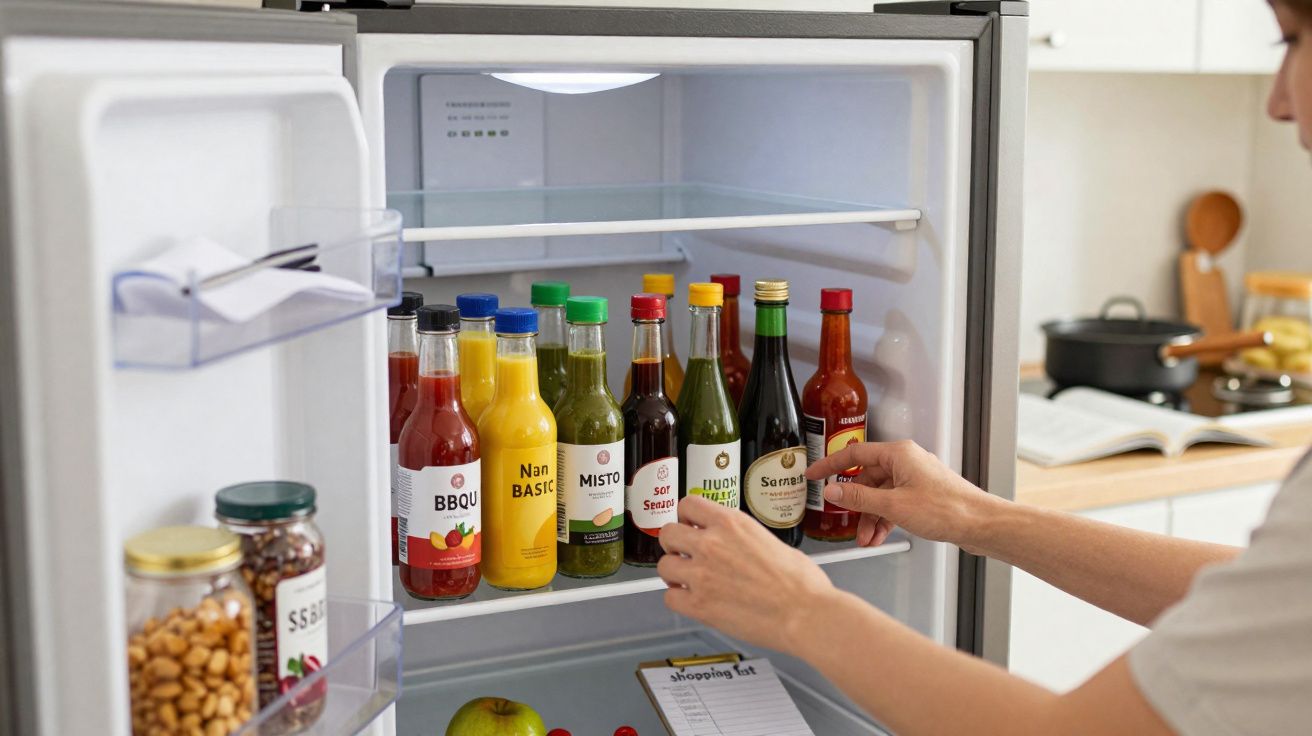
You pull open the fridge and the light lands on the door shelf chaos: mustard balanced on its head, three half-used salad dressings, and a jar with a label that’s given up trying. Your mind does a small, silent groan. You’re only attempting to sort out dinner, yet you feel worn out before the frying pan has even had a chance to heat.
You take the ketchup, shut the door, then open it again because you’ve remembered the soy sauce. Without realising, your shoulders tighten. Those tiny pauses stack up, one after another.
Then you go round to a friend’s place and see their door shelf arranged like a miniature reference library: aioli, barbecue sauce, chilli paste… all in alphabetical order. You chuckle-until you reach for the harissa and find it in two seconds.
Something in your brain quietly lets go.
Why alphabetised condiments feel oddly calming
Most evenings include a very specific moment: you stand in front of the open fridge and your thoughts simply… buffer. Pesto or peanut sauce? Salad or stir-fry? Eggs or “let’s order a takeaway”? That mental slowdown has a name: decision fatigue.
The fridge door-packed with condiments-is one of the stealthiest places decision fatigue shows up. A crowd of bottles and jars, competing colours, and too many labels all ask for your attention at once. It rarely registers as “stress”, yet your brain experiences it as noise.
Putting your condiments into an alphabetical row turns that volume down.
Think back to the last time you couldn’t locate the sriracha. You nudged past pickles, mayonnaise, and jam, prodded every bottle as if it might confess, while the pan on the hob crept closer to burning. That’s micro-stress-small, frequent, and surprisingly draining.
Now picture a different routine: your hand reaches the door, your eyes sweep left to right, and you already know-without effort-that “S” sits between “P” and “T”. The sriracha is there. No rummaging, no mental clutter, no extra heat building on the hob.
When one point of friction disappears, the whole evening can feel noticeably lighter.
Our brains do best with patterns that don’t need re-learning every day. Alphabetical order is a system most of us met early on-reciting A to Z at school-so it’s familiar in a way that feels effortless.
Once ketchup and kimchi, mustard and miso follow that same quiet rule, your mind stops searching randomly and starts retrieving deliberately. That shift uses less energy. The fridge door stops feeling like a tiny battleground and becomes more like a well-ordered bookshelf: predictable, calm, and strangely reassuring.
A bonus you don’t expect: fewer wasted jars
When everything is visible in a consistent line, duplicates are harder to miss. You’re less likely to buy a second jar of capers or open a new bottle of hot sauce while another one is already lurking at the back. Over time, that can reduce food waste and the “how many half-finished sauces do we own?” guilt.
A quick safety win while you’re there
This is also an easy moment to do a fast, practical check: wipe any sticky bottle necks, scan for anything past its use-by date, and move rarely used items (like speciality pastes) to a lower shelf where they’re less likely to topple. The goal isn’t perfection-it’s removing avoidable friction.
How to alphabetise your condiments (without making yourself miserable)
Begin with a five-minute reset, not a full-blown kitchen overhaul. Take everything off the door shelves and make quick piles by category: sauces, dressings, jams, and “no idea what this is but it’s sticky”. No judgement-just speed.
Next, choose your alphabet “rules”. Will you sort by brand (Heinz, Kikkoman) or by type (ketchup, soy sauce)? For day-to-day cooking, sorting by type usually works better-most of us think “mayonnaise”, not “the jar with the blue lid”.
Then arrange them from left to right in straightforward A–Z order: aioli, barbecue sauce, Caesar dressing, chutney, hot sauce, jam, ketchup… No label maker required. Your eyes will pick up the rhythm within a couple of days.
The common mistake is going full perfectionist on day one. You don’t need to decant everything into matching jars or buy elaborate organisers. That’s how helpful systems become exhausting projects.
And let’s be realistic: hardly anyone maintains this flawlessly every day. What you need is a small weekly “reset” where you nudge the alphabetical order back into place. Two minutes on a Sunday evening while the pasta water comes up to the boil is plenty.
Be flexible with the rule, too. If tall bottles won’t fit on the same level, run the alphabet per shelf rather than across the entire door. The aim is ease-not a showroom fridge.
Somewhere between “I live in chaos” and “my fridge looks like a design catalogue” is a sweet spot where your brain finally gets a breather.
- Start tiny
Alphabetise just one door shelf first, not the entire fridge. - Use real-life names
Sort by what you genuinely call things: “hot sauce”, not the official product description. - Reset weekly
Attach a quick tidy to something you already do, like putting the food shop away. - Allow rebels
Large jars or rarely used sauces can live in a “misc” corner without guilt. - Watch what changes
Pay attention to whether choosing sauces feels faster or calmer after a week or two.
What alphabetised condiments quietly change about your evenings
Once your sauces consistently sit in order, something subtle shifts. Your brain stops spending energy on “Where’s the tahini?” and has more left for “What can I actually make tonight?” You move from searching to imagining.
Dinner starts feeling less like a quiz with missing answers and more like a game. You notice “G” for gochujang and remember that spicy roasted cauliflower recipe you meant to try. The fridge becomes a menu rather than a maze.
You’ll still be tired after work-none of this fixes that-but the route to feeding yourself can feel less jagged.
| Key point | Detail | Value for the reader |
|---|---|---|
| Alphabetical order reduces tiny decisions | Removes the repeated “where is it?” search each time you cook | More mental energy left for actual meal choices |
| Small, weekly reset beats big overhauls | A two-minute tidy done alongside other tasks keeps the system going | Less stress without adding another chore |
| Visual flow sparks new ideas | Seeing sauces in a clear, predictable line prompts recipe inspiration | More varied, satisfying dinners with less effort |
FAQ
- Do I really need to alphabetise every single condiment?
Not at all. Begin with what you reach for most-oils, sauces, dressings. The rarely used jars can stay in a loose “misc” zone.- What about family members who ignore the system?
Make it obvious and uncomplicated. After a few days of finding the ketchup instantly, most people naturally stick to it because it helps them as well.- Should I use labels or special organisers?
Only if you enjoy it. The alphabet is the system. Clean shelves and a little space between bottles are usually enough.- What if I have too many condiments to fit neatly?
Create a “seasonal” or “back-up” box on a lower shelf for spares, and keep the active line-up alphabetised on the door.- Can this really change my stress level?
On its own, it won’t rescue a difficult day. But removing dozens of tiny, invisible decisions each evening can make the routine feel smoother-and kinder to your brain.


Comments
No comments yet. Be the first to comment!
Leave a Comment