
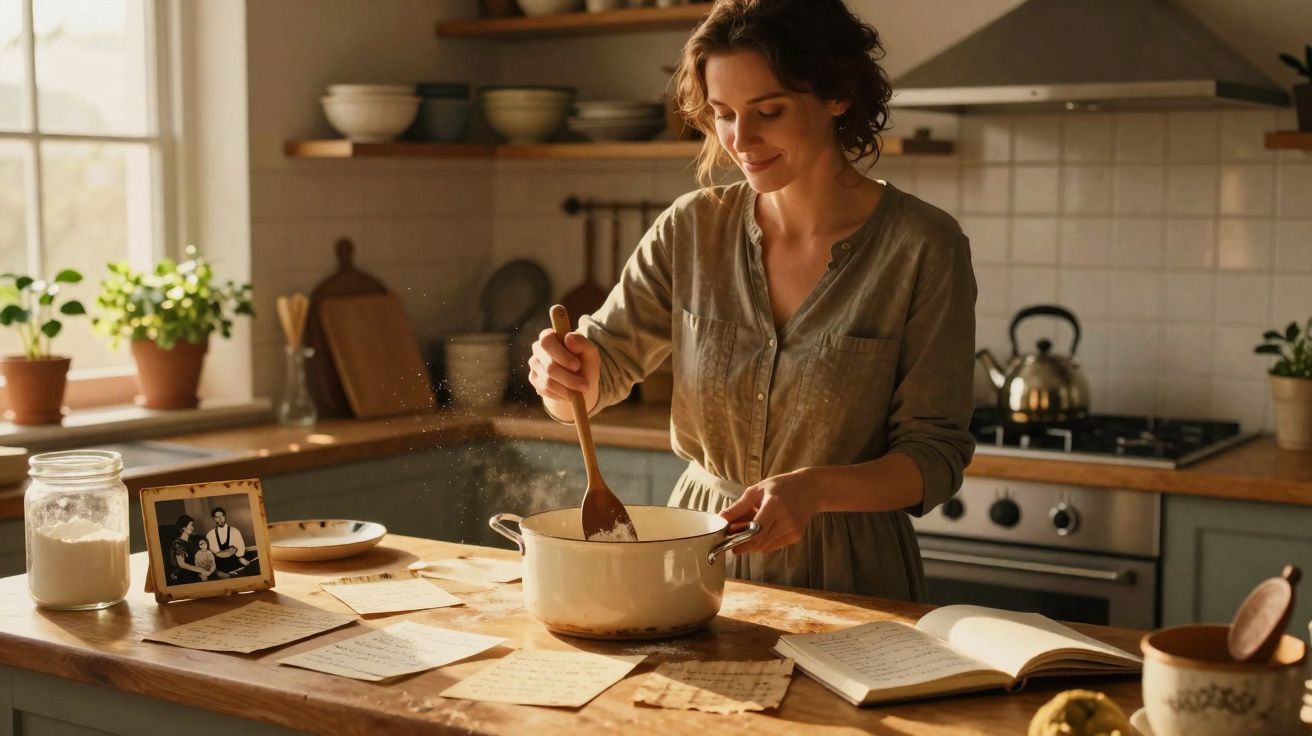
The first thing that hits you is the noise.
Not the television, not a buzzing phone, but a wooden spoon rapping the rim of a weighty pot, followed by the gentle sizzle of onions meeting hot oil. In a compact kitchen painted a sharp lemon yellow, a woman in her forties bends towards the hob, her hair pulled back under the same washed-out scarf her grandmother once tied on. Three handwritten notebooks lie open on the worktop, pages darkened by old splashes of oil and years of use.
She barely glances at them now. A pinch of cumin, a loose handful of rice, a quick pour of vinegar she doesn’t bother to measure. Her teenage daughter records from the doorway, telling herself it’s for TikTok, when really it’s so she won’t forget. The woman stirs, breathes in, and you can see it happen: her shoulders ease, as if she’s briefly stepping into another version of her life. A small smile appears, like it surprises her.
This is the place where she began to rewrite who she was.
The kitchen where a woman starts over
On paper, Anna became “the woman who’d lost everything”. A divorce. Her job disappearing. Grown-up children already halfway out the door. Savings chewed up by a move she never asked for. She told her friends she was “fine”, then spent late evenings scrolling through other people’s lives until her eyes hurt. The only room that still felt usable was the kitchen; the rest of the flat seemed provisional, with half-open boxes and walls that looked temporarily borrowed. The kitchen, by contrast, filled itself quickly.
One afternoon, hunting for packing tape, she pulled open a box and uncovered her grandmother’s recipe notebooks. The handwriting ran at a slant. Ingredients were written in two languages. In the margins, tiny asides sat like coded messages: “More lemon next time,” and “For your wedding day, maybe?” Anna sat down on the cold floor and read them the way you’d read a diary. That same day, she cooked until the smoke alarm protested.
Her first “reinvention” didn’t involve a vision board or a coaching programme. It arrived as a pot of lentil stew that smelled exactly like childhood Sundays. She scorched the bottom, muttered a swear word, then laughed at herself. Afterwards she posted a photo of the ugly, reassuring stew on Instagram with a rambling caption about starting over at 43 with a saucepan and a broken heart. People responded. Not in the thousands-just a few dozen: old classmates, a neighbour, a cousin she hadn’t spoken to for years.
Nobody talked about plating or photography. They wrote about their grandmothers. About meals they missed. About recipes they wished they’d kept. Anna clocked something she hadn’t been able to name before: the food on her table wasn’t merely dinner. It was a shared memory bank-an easy bridge between who she had been, who she wanted to become, and the people walking alongside her in quiet online fragments.
If you watch her two years later, you could mistake her steadiness for confidence she’s always had. She hasn’t. In her life, reinvention looked less like a dramatic pivot and more like a slow, stubborn simmer. Each recipe she cooked from those notebooks became a conversation with a different Anna: the shy granddaughter learning to peel potatoes; the young mother feeding a family on very little, but with pride; the divorced woman tasting the silence of a table laid for one.
How recipes become a map of generations
As her posts continued, her followers began asking for the stories that sat behind the ingredients. Not only “how long in the oven?”, but “where did this come from?” So Anna started to write: one story per recipe. Her grandfather’s soup that travelled to Europe with a single suitcase. The cake her mother baked after every exam result. The roast chicken she made on the day she signed the divorce papers, eaten straight from the tray with greasy fingers and mascara running. Her cooking turned into a timeline-an unfolding family archive-and a way of saying: I was here, and my people were here before me.
Anna’s method isn’t glossy. There are no linen aprons and no talk of “elevated plating”. She begins with memory, every time. Before she chops an onion, she asks herself a simple question: whose memory is this-my grandmother’s, my mother’s, mine, or perhaps my daughter’s future one? Then she chooses one detail to keep sacred: the brand of tomato purée, the way the bread is torn rather than sliced, the battered cheap metal pot that’s nearly black underneath.
Everything else can shift. She substitutes ingredients, reduces the sugar, adds fresh herbs her grandmother never had access to. She calls it generation-proofing the recipe: keeping the spine while changing the limbs. The point isn’t to recreate the past perfectly; it’s to let it live in the present. When a dish finally feels right, she writes the story beside the ingredients on the same page, as though they’re meant to be read together.
She also learned-by trial, error, and a few miserable dinners-what breaks the spell. Making things complicated just to impress people online. Cooking meals that photograph beautifully but mean nothing to her. Following trends instead of following memory. On weeks when she tries to be “content creator Anna” rather than “woman-rebuilding-her-life Anna”, the food tastes oddly flat. She notices immediately, and the comments change too: more polite likes, fewer messages beginning with “this reminds me of my grandfather”.
So she built herself a set of quiet rules: one emotional anchor per recipe; one person she’s cooking “with”, even if they’re no longer here; one story she’s actually ready to tell. And on days when she has nothing in the tank, she doesn’t cook for the camera at all. She boils pasta, opens a jar of sauce, and eats without ceremony. Let’s be honest: nobody truly does this perfectly every day. The internet doesn’t need a report on those nights. Her soul does.
Anna’s kitchen archive: keeping the recipes usable, not museum-perfect
Over time, Anna found that memory only becomes practical if you can repeat it. So she began testing her favourites the way you would for someone else: writing timings clearly, converting “a handful” into rough metric amounts, and noting what changes when you cook for one person instead of four. She’ll add small, useful lines like “add 200 ml water if it thickens too much” or “rest for 10 minutes before serving”, not to sanitise the recipe but to make sure the comfort is reproducible on a Tuesday evening.
She also started protecting the notebooks themselves. Between floury fingers and splashes of oil, old paper doesn’t last forever. Anna now photographs each page and keeps a backed-up folder on her phone, alongside the voice notes and the photos she posts. It isn’t about perfection; it’s about making sure the family archive survives a spilled pan of sauce and the ordinary chaos of a small kitchen.
Somewhere along the way, Anna realised she wasn’t only documenting recipes-she was rewriting her place inside her family’s story. Not as a footnote, not as “the one who got divorced”, but as the author of a new chapter. She printed the first forty recipe-stories into a home-made cookbook and posted copies to her cousins. The responses weren’t what she expected: a cousin crying over a potato salad; an uncle sending a photo of the same pot on another continent; a niece writing, “I didn’t know we had all this history.”
That’s when Anna understood her kitchen had become more than a hiding place. It had turned into an engine. Every dish said, this line doesn’t end with me. Every story said, we’ve survived worse than this moment. Somewhere between flour-dusted hands and phone notifications, she had quietly-stubbornly-reinvented herself as the keeper, and the transformer, of several generations’ worth of life.
Passing the spoon: what this changes for us
Anna’s most useful trick is almost laughably simple: she records voice notes while she cooks. Not polished podcasts-just quick fragments. “Gran used to sing here.” “Dad always wanted extra salt.” “I made this when Lucas was born.” Later, she replays them and chooses one thread to pull into writing. That’s how the recipes stay tied to real life, instead of turning into generic “family favourites” with no actual family attached.
She keeps a “memory shelf” too: a single object for each person or generation. A chipped mug that was her grandfather’s. A wooden board her father carved. A plastic bowl from the early years of motherhood. When she can’t decide what to cook, she picks one object up, holds it for a moment, and lets the memory choose the dish. It sounds sentimental; on the hardest days it’s the only thing that gets her to switch the hob on.
If you’re trying to rebuild yourself through cooking, the real trap is perfection: expensive ingredients, flawless photos, the pressure to turn pain into a “brand”. Anna has walked into that wall more than once. She talks about nights when she deleted photos because the light wasn’t “right”, even though the story was raw and honest. She remembers the time she attempted a 27-ingredient recipe she found online and ended up crying over dry chicken and a sink full of washing-up.
Her best advice is almost embarrassingly gentle: begin with the dish that makes you feel safe, not the one designed to impress. Write down your version, even if the wording is clumsy. Let the recipe carry a question you’re living with: “Who am I without him?” “What do I want my children to remember?” The kitchen is kinder when it isn’t a stage. It becomes a small, tiled therapist’s office-only it smells better.
One evening, while showing her daughter how to fold dumplings, Anna said something she hadn’t planned to say out loud:
“Every time we cook this, we prove we didn’t vanish with the people we lost. We’re still here, and so are they-in a way that fits in your hand.”
Her daughter didn’t reply. She simply shaped another dumpling and set it on the tray beside the others, in a neat, imperfect line.
That night Anna wrote three lines in her notebook and circled them:
- Recipes are proof of continuity when everything else feels as though it’s coming apart.
- Stories give those recipes weight, so they aren’t just calories-they’re context.
- And somewhere between oil and salt, you can start to recognise yourself again.
A recipe book that’s really a life story
When you leaf through Anna’s growing collection, you don’t find a sleek cookbook. You find crossings-out, smudged ink, and dates tucked into corners: “First night alone.” “Job interview tomorrow.” “She left for university this morning.” The recipes read less like instructions and more like documentary scenes: boil this, stir that, breathe, cry, taste, keep going.
What she’s building isn’t unique, yet it feels quietly radical. A family that crossed borders. A marriage that ended. Children who speak a language their great-grandparents never heard. Instead of trying to “protect” old recipes from change, she lets each life stage leave a fingerprint: less sugar in the cake, more spices in the stew, plant-based versions that would have shocked her elders. The through-line isn’t purity. It’s presence.
Online, as her audience has grown slowly, the comments beneath her posts reveal as much about the readers as about her cooking: “My dad used to make this when money was tight.” “I’m cooking my way back to myself after burnout.” “I never met my grandmother, but I feel like I know her through this.” Anna’s kitchen is still small. Her life is still untidy. She still has evenings when cereal is dinner and the notebooks stay shut. Yet each new recipe-story stitches another patch onto the blanket she’s wrapping around herself-and, unexpectedly, around strangers as well.
Perhaps that’s the real power here. Not that cooking “fixed” her, like the tidy moral at the end of a self-help book, but that it gave her a language strong enough to hold grief, joy, fear of the future, and pride in the past in the same ladle. A language her grandmother would recognise, even if she’d have no idea what hashtags are. A language her daughter will one day speak differently, but still hold in her hands over a steaming pot, telling her own version of the story to whoever is listening.
| Key point | Detail | Benefit for the reader |
|---|---|---|
| The kitchen as a refuge | Turning a crisis into a repeated cooking ritual | Finding a practical place to steady yourself when everything is shifting |
| Recipes as an archive | Linking each dish to a person, place, or life stage | Creating a living family memory that’s personal, shareable, and able to be passed on |
| Reinvention in small doses | Adjusting recipes without rejecting the past, one change at a time | Accepting that change can be gentle, gradual, and tangible |
FAQ
- How do I start if I don’t have old family recipes? Choose one simple dish that feels like “home” to you-even if it’s shop-bought or something you invented at 20. Cook it, write down what it brings up, and let that become page one of your story.
- What if my family history is painful or complicated? You don’t owe anyone a glossy version. Pick the memories you can carry right now and leave the rest for later. Sometimes the most truthful recipes are the ones that admit, “this dish holds mixed feelings.”
- Can I still reinvent myself through cooking if I’m not good at it? Skill matters less than meaning. Start with very basic recipes, make them often, and allow your improvement to become part of the story you’re telling.
- How do I involve my kids or friends in this process? Give them small jobs: stirring, tasting, choosing music. Ask what the dish makes them think of. You’re not only feeding them-you’re co-writing the next chapter together.
- Is it okay to change traditional recipes to fit my lifestyle? Traditions last because they adapt. Keep one or two signature elements as a thread to the past, then adjust the rest to suit your life now. That’s how a recipe becomes properly yours.

Comments
No comments yet. Be the first to comment!
Leave a Comment